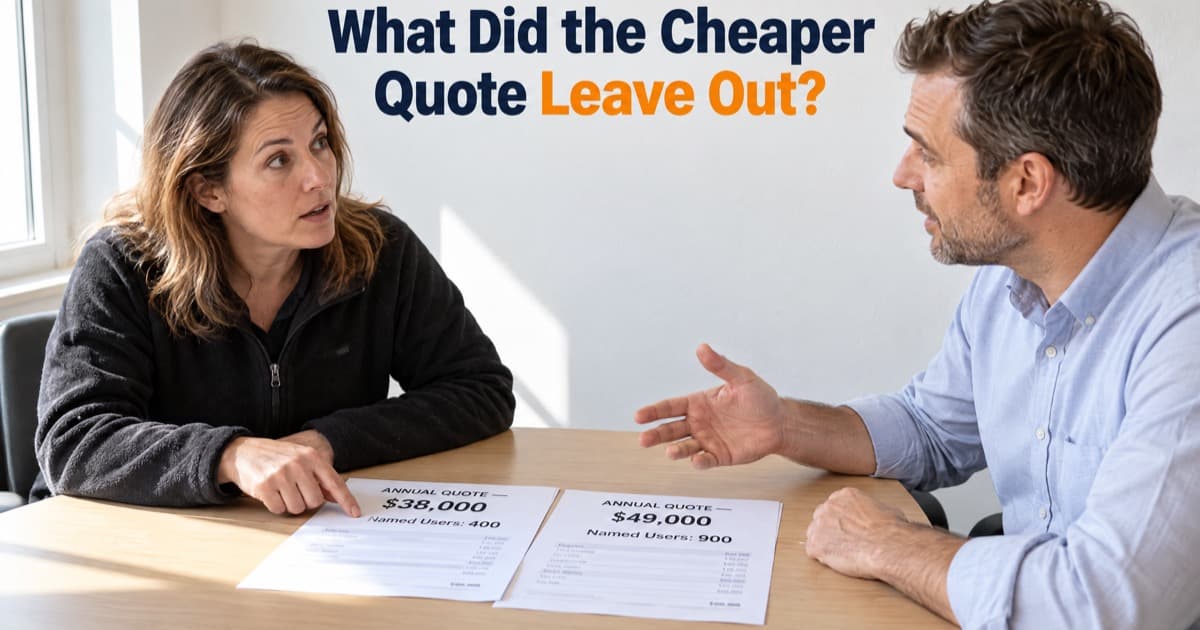
The Buyer Is Evaluating Other Vendors. Is That an Objection or an Opening?
Here is a two-second test for the "we are evaluating other vendors" objection: ask the buyer what will decide it. If they can name the criteria, you are on a real shortlist and the line is an opening. If they cannot, nobody has written the rules yet, and you can help write them. Either way, the worst move is the one most reps make, which is to pitch harder or cut the price before they know how the winner gets picked. So when you hear it, say: "That makes sense. How will you choose between us? Is there a scorecard, and who fills it in?" Then ask for the date the decision is made. Criteria, who weighs them, and the deadline: those three answers tell you what to do next.
Shortlists, bake-offs and the line that ends the pitch
The line usually arrives in the second half of a good call, after the buyer has agreed the problem is real:
- "Just so you know, we're evaluating other vendors."
- "You're one of three we're looking at."
- "We're talking to a couple of other companies too."
- "We'll be doing a full comparison before we decide."
It is rarely hostile. Most buyers say it because their process requires it, or because they want you to sharpen your offer. But it changes the job. Before the line, you were selling against the buyer's status quo. After it, you are being scored against named alternatives on a sheet you have not seen. Every claim you make from here is a number in somebody else's spreadsheet, and the buyer will compare it with whatever the other two said. If you are working through objections in general, the objection handling guide covers the wider map. This page is about this one line.
Discount, disparage, or disappear: how reps lose the bake-off
Three habits lose this moment, and all three feel like good selling while you are doing them.
Discounting before anyone asked. "If price is a factor, I'm sure we can be competitive." The buyer has not mentioned price. You have just told them your first number was soft, and you have put price at the top of a scorecard that may have had it in third place.
Disparaging the competition. "A lot of those tools look good in a demo and fall over at scale." You do not know which tools are on the list, and the buyer may like one of them. Even if you are right, it sounds like fear, and it hands the buyer a reason to ask the other vendors about you.
Disappearing into a feature tour. "Let me show you a few more things we do that others don't." More features do not help when you do not know which rows the buyer is scoring. You are filling time with answers to questions nobody on the committee will ask.
All three skip the same step. The rep starts competing before learning what the competition is about.
What does a buyer weigh when evaluating other vendors?
The line sounds the same every time, but it covers at least four different situations. The question "how will you choose?" sorts them in one answer.
| What is really going on | What you hear when you ask how they will choose | What it means for you | Your next move |
|---|---|---|---|
| A formal scorecard already exists | "We have five criteria, weighted. Procurement built it." | The rules are set, but a missing row can still be raised | Ask to see the criteria and whether anything the team cares about is missing |
| An informal comparison with no rules yet | "Honestly, we'll just see who feels right." | Whoever defines "right" first has the advantage | Offer three questions every vendor should be able to answer |
| A favorite is chosen and you are the comparison | "We need three quotes for the file." | You are column padding unless something changes | Ask directly what would have to be true for you to win |
| A price lever with no real alternative | "Mostly price, to be honest." | The others may be a negotiating tactic | Ask what price is being compared against, line by line |
The first two rows are the common ones, and they are good news. A scorecard you can see is a scorecard you can sell to. A comparison with no rules yet is an invitation to bring the rules.
Emeric, Rosamund and the scorecard at Miradore
Miradore Hotels runs nine boutique hotels. Guests text the front desk about late check-ins, towels, parking and restaurant bookings: about 1,100 texts a week across the group. Roughly 38 percent arrive after 10 p.m., when most properties run a single night auditor, so around 418 texts a week sit unanswered until morning. Rosamund is the director of guest experience. Emeric is an account executive at Velmora, which sells guest messaging software that answers routine texts at any hour and routes the rest to whoever is on shift. Velmora costs $1,850 a month for the group. The call is going well until Rosamund mentions the shortlist.
Defending the shortlist spot:
Rosamund: I should say, we're evaluating other vendors. You're one of three.
Emeric: Totally understand. I'll be upfront, a lot of the tools in this space were built for big chains and they struggle with boutique properties. And if price comes into it, I'm confident we can sharpen our number.
Rosamund: Good to know. One of the others is about $400 a month less, so that would help.
Emeric: Let me see what I can do. Can I show you our reporting dashboard while we're here?
Emeric made three moves and learned nothing. He insulted a vendor Rosamund may like, offered a discount nobody had asked for, and then went back to features. Rosamund now knows his price has room in it, and she still has not told him how the decision gets made. He will hear the result by email in December.
Asking for the scorecard:
Rosamund: I should say, we're evaluating other vendors. You're one of three.
Emeric: That makes sense for a decision this size. How will you choose between the three? Is there a scorecard?
Rosamund: There is. Price is 30 percent, integration with our property management system is 25, setup time is 20, languages 15 and support 10.
Emeric: That's clear, thank you. Who built it?
Rosamund: Our finance lead and I, with input from IT.
Emeric: Earlier you said the night shift is where the pain is: 418 texts a week waiting until morning. Where does that show up on the scorecard?
Rosamund: It... doesn't, really. We assumed every tool answers at night.
Emeric: Most will send an auto-reply. The difference is whether the guest gets an answer or a "we'll get back to you." Would your GMs want that measured?
Rosamund: Our GMs would want it at the top. Half the bad reviews we get mention something that happened after midnight.
Emeric: Then here's a suggestion. Add a row for after-hours resolution, and run each shortlisted tool at one property for two weeks with the same measure. When does the committee decide?
Rosamund: December 4.
Emeric: Then the test needs to start by November 17. Can we put thirty minutes on Monday to pick the property and agree how the row gets scored?
Rosamund: Monday at ten. I'll bring the finance lead.
The second pass never mentions the other vendors. Emeric asked how the decision would be made, who made the rules, and when. Then he connected the scorecard to a cost Rosamund had already named herself, which is why she, not Emeric, proposed putting the new row at the top. He did not touch the price. It stays at 30 percent of the score, but it is now one row among six instead of the whole conversation, and the row Velmora wins is the one the GMs care about most. A fair test also protects him if he is wrong: if another tool answers the night shift better, Miradore should buy it, and Emeric learns that in two weeks instead of two months.
Shortlisted? Ask how the winner gets picked.
ConvoSparr lets you practice this moment out loud with an AI buyer who tells you they are evaluating other vendors, shares the scorecard only if you ask the right question, and then scores how you handled it.
Scorecard drills for the next shortlist call
The question has to come out calm, and before you defend anything. Practice it until it is your first reflex:
- Say the question in one breath: "How will you choose between us? Is there a scorecard?" No preamble and no reassurance first.
- Ask who built it. Criteria written by finance read differently from criteria written by the people who will use the tool every day.
- Map the buyer's own pain to a row. Use the number they gave you earlier in the call. If it has no row, ask whether it should.
- Get the date. A decision date tells you whether there is time for a test, a reference call or a second meeting.
- Never name a competitor first. If the buyer names one, ask what they liked about it before you say anything about it.
- Keep the price where the scorecard put it. Do not offer a discount until the buyer asks for one, and then ask what it is being compared against.
Go back to the test at the top of this page. A buyer who says "we're evaluating other vendors" has told you there is a decision coming and a set of rules for it. Ask what decides it, and you stop guessing which rules you are being scored on.
Updated Nov 13, 2026
Run this scenario for real
ConvoSparr drops you into a live voice call with an AI buyer who runs this exact play. Handle it out loud, then get a transcript, scores, and coaching notes on how you did.
Free to start. No credit card required.