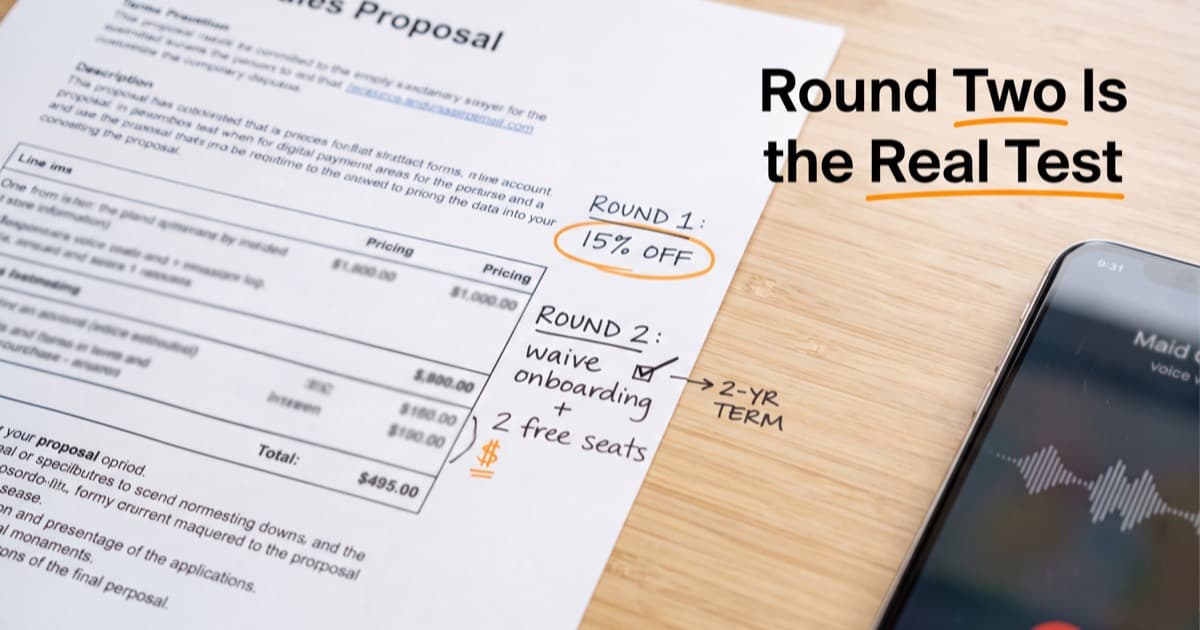
How to Negotiate With Procurement After the Buyer Already Said Yes
Procurement is not the part of the deal where someone decides whether to buy. That was settled before you were introduced. Procurement decides what the thing you already sold is going to cost, and the person on the other end of the call is paid on the difference between your first number and your last. Negotiating with procurement goes well when you treat it as a second sale with a different scorecard, and badly when you treat it as a formality standing between you and a signature you think you have already earned.
Why Procurement Only Appears Once the Deal Looks Done
Nobody schedules procurement into a deal. A threshold trips and they arrive. Annual spend over an internal line, a term longer than a year, a supplier not already approved, and there is a new name on the thread who has read none of your discovery notes and does not need to.
By then you have spent six weeks answering questions that mattered to the person who will use the product. Does it handle split shifts. How long is setup. Will my team hate it. None of those answers is currency here.
Procurement also lands once you have started counting the deal and naming the month it closes, which is the least useful state to bring to a price conversation and the one the calendar hands you every time.
Where Sellers Give Back the Margin They Earned
Answering the first ask as though it were the last. The opening request is a probe, not a position. Meeting it in full teaches the other side that your numbers move when pushed, which guarantees a second push.
Selling value to a person who is not buying value. The return on investment case landed weeks ago, with someone else. Repeating it here reads as a refusal to engage, and it costs you the one thing you still control: what you get back for moving.
Letting the champion go silent. Most reps stop talking to the person who wanted this the moment procurement joins. That person owns the timeline and is the only one with a reason to push the paperwork along.
Treating the deadline as yours alone. Your quarter end is visible to them. Theirs is invisible unless you ask, and the unasked question is a free concession later.
What Is a Procurement Lead Measured On?
Most procurement roles are scored on savings against a baseline, cycle time, and risk terms, in roughly that order. The baseline is almost always the number you submitted first, so your opening quote is not only a price. It is the ruler you will be measured against for the rest of the deal, and a percentage is what gets reported upward, so a small cut on a visible line can matter more than a large one buried in a schedule.
That has two consequences you can use. A discount handed over unprompted still gets counted, so you paid and got no credit for paying. And savings is not the only column: a shorter cycle, a capped increase, a payment term. Each is a reportable win, and several cost you far less than money does.
A Sourcing Call at Auverne Air, Line by Line
The rep sells Veldane, a scheduling platform for ground crews and gate staff. Isolde, Director of Ground Operations at Auverne Air, a regional carrier with six crew bases, ran the evaluation and wants it live before the winter schedule locks in November. The quote is $96,000 a year for three bases. Cormac, category manager for corporate services, joins with that quote in front of him and a number in his head.
The call that ends eight thousand dollars lower:
Cormac: I have your quote at 96 for the three bases. I will be straight with you, that sits outside where we land with software vendors your size. I need to see something in front of it.
Rep: Understood. What sort of number were you thinking?
Cormac: Something that starts with an eight.
Rep: Let me see what I can do. I think I can get you to 88 if we keep the scope where it is.
Cormac: Appreciated. Send the revised paper across and I will queue it.
Rep: Great. Are we still good for a November start?
Cormac: That depends where legal lands. I will come back to you.
Three things went wrong in under a minute. "What sort of number were you thinking" handed over the anchor and invited a figure chosen to be beaten. "Let me see what I can do" moved the price with nothing asked in return, which tells Cormac the next push will work too. And the close arrived as a question about the rep's timeline rather than a condition on the money. Eight thousand dollars bought no term, no start date, and no commitment on legal.
The call that pays in terms instead:
Cormac: I have your quote at 96 for the three bases. That sits outside where we land with software vendors your size. I need to see something in front of it.
Rep: That is fair, and I would rather not spend your cycle on paper going back and forth four times. Can I ask what this one is measured on at your end? Savings against the submitted number, the three year total, or closing before the schedule locks?
Cormac: Savings against the submitted quote, mostly. And I have nine of these to clear this quarter.
Rep: Here is what I can do and what I would need back for it. I can take the annual to 88, eight off the number you are measured against, if we move to a three year term with the uplift capped at three percent. That is a saving you report in year one and a larger one across the term, and it is the version I can sign this week rather than take to an exception review.
Cormac: And if I want 88 on a single year?
Rep: Then a single year is 94. The eight is what the term is worth to us, not something I was holding back. I would rather tell you what each number buys than move the same number twice.
Cormac: What else is movable?
Rep: Payment terms. Net 45 instead of net 30 costs us very little and I know it sits on your list. And I will put the fourth base in writing at today's rate, so when Isolde adds it in spring you are not running this exercise again.
Cormac: Send it as two lines, the single year and the three year, and I will take the three.
The second call moved the same eight thousand dollars and came back with a three year term, a capped increase, a payment term Cormac can report, and a fourth base priced before anyone has to defend it. Asking what the deal is measured on produced the word "submitted", which named the number the savings would be calculated against. Quoting 94 for the single year is the load bearing line, because it turns a discount into the price of something. And two lines rather than one let Cormac choose, which is easier to approve than a figure he must argue for.
The hardest calls are the ones you only get once.
A procurement call arrives late, moves fast, and does not come back for a second take. ConvoSparr lets you run the conversation out loud against an AI counterpart who pushes on price the way a real category manager does, then scores how much you gave away and what you got for it.
The Trades That Cost You Less Than a Discount
Write the trades down before the call, while nobody is waiting on the line. Not your floor, but what you take in exchange for each move.
| What you can trade | What it costs you | What it is worth on their scorecard |
|---|---|---|
| Longer term with a capped uplift | Flexibility you rarely use | Reportable savings, and a closed file for two more years |
| Payment terms, net 30 to net 45 | Little, if you are not cash constrained | A working capital win they are frequently targeted on |
| Locked pricing on a future site or seat block | Upside on an expansion nobody had signed | Removes a second sourcing exercise from their year |
| Signing standard paper without redlines | Nothing, if your paper is already reasonable | Cycle time, the metric nobody mentions and everyone is judged on |
Take This Into Your Next Renewal
Run the call before you have to. Set up a negotiation session against a counterpart who opens with a target and pushes twice, then work this checklist:
- Ask what the deal is measured on before you say any number. Savings, total, cycle time, or terms.
- Say your first number once and let it sit. It is their baseline whether you defend it or not.
- Attach a condition to every move, in the same sentence. "I can do 88 if" is a trade. "I can do 88" is a gift.
- Price the alternatives instead of moving one figure twice. Two priced options beat one negotiable figure.
- Keep your champion in the thread. They own the start date, which is the deadline that actually binds.
- Say out loud what you will not trade, before someone is there to test it.
Six items is more than anyone holds under pressure, which is why this is worth rehearsing rather than reading. The gap between knowing the first one and doing it, with a real target sitting in someone else's notes, is the difference between a renewal you priced and one priced for you.
Updated Sep 19, 2026
Run this scenario for real
ConvoSparr drops you into a live voice call with an AI buyer who runs this exact play. Handle it out loud, then get a transcript, scores, and coaching notes on how you did.
Free to start. No credit card required.