'Live Before the 14th, or After?' The Assumptive Close, Timed Right
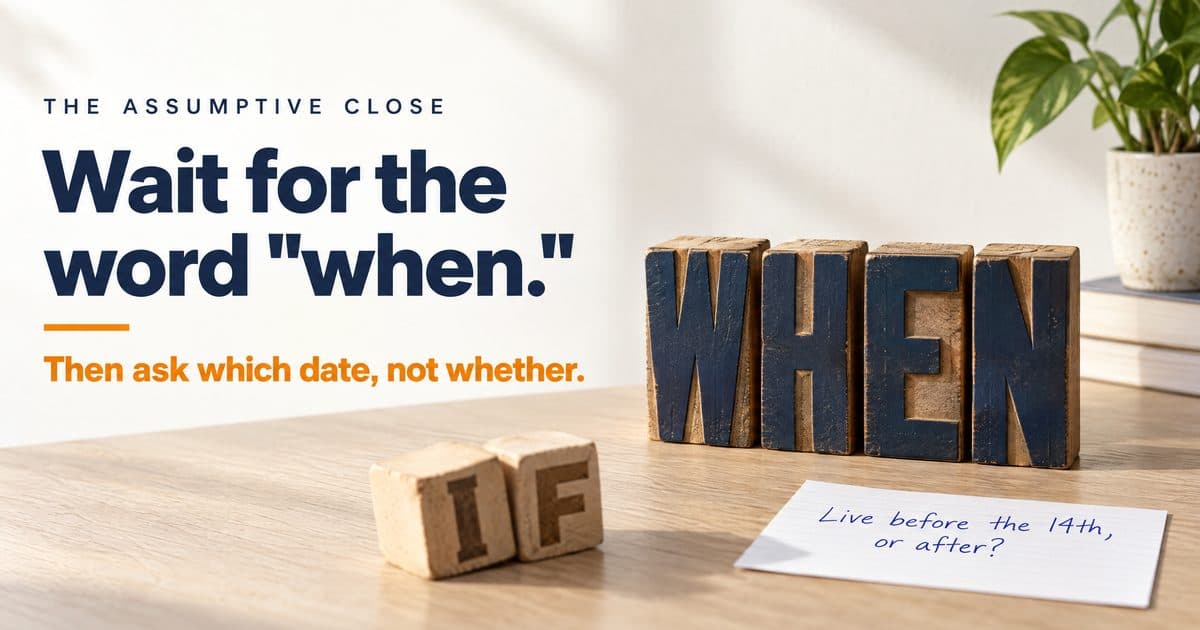
The assumptive close works only once the buyer says 'when' instead of 'if'. Assume the next step any earlier and you hand them a reason to back away.
Clementine: So when we move the cafés over first, who trains the baristas on the new order screen?
Cosimo: We do, on a thirty-minute video call per café. Do you want them live before the holiday blend ships on the 14th, or after?
Clementine: Before. Definitely before.
Cosimo never asked Clementine whether she wanted to buy. He asked her a scheduling question, and her answer committed her to a start date, a rollout order and, by implication, the purchase. That is an assumptive close. Ten minutes earlier on the same call, the same move would have blown up in his face, and the difference between the two moments is one word Clementine used without noticing.
Here is the answer up front. An assumptive close is a closing technique where you speak as if the buyer has already decided, and ask about a detail of the next step (a start date, who signs, which option) instead of asking whether they want to go ahead. It works when the buyer has already made the decision in their own head and just has not said it, which you can usually hear: they start saying "when we" instead of "if we." Used before that point, it skips a decision the buyer has not made, and buyers notice being skipped. So the skill is not the line. It is the timing.
What is an assumptive close?
The assumptive close replaces a yes-or-no question with a choice that only makes sense if the answer is yes. "Do you want to move forward?" invites a no, or a "let me think about it." "Should the order go live on the 1st or the 15th?" invites a date. If the buyer gives you the date, the decision rides along with it.
It is one of the oldest closing techniques in sales, and it has a reputation problem because it is so often used as a trick: a rep who has heard no buying signals at all slides a contract across the table and asks which pen the buyer prefers. That version deserves the reputation. The useful version is narrower. It is a way to make a decision the buyer has already reached easy to say out loud, by giving them a small, concrete question to answer instead of a big, abstract one.
That distinction is the whole article. An assumptive close does not create agreement. It collects agreement that already exists. If you want the wider picture of how a call should end, the guide on how to close a sales call covers the full range of endings; this piece is about one specific line and exactly when to use it.
Listen for "when," not "if"
The most reliable signal that a buyer has decided is a change in their grammar. Early in a call, buyers talk about your product hypothetically: "If we did this, how long would setup take?" "Would it work with our accounting system?" Later, once they have pictured themselves using it, the conditional disappears: "When we roll this out, can the cafés order separately?" "Who on your side do we call when an order fails?"
That switch from "if" to "when" is not a guarantee, but it is the clearest permission you will get. Two other signals usually travel with it:
- They have reacted to the price and moved on. Not loved it, just stopped arguing with it. A buyer who heard $640 a month and went straight to a setup question has accepted it for now.
- They are asking about life after the purchase. Training, support hours, who owns the account, how billing works. Nobody asks how the invoice is addressed for a product they are not buying.
Here is a simple rule. If you have heard "when" plus one of those two, assume. If you have heard none of the three, ask a plain question instead ("How does this compare to what you were expecting?") and keep listening. If you have heard only one, test with the softest line on the ladder below and see what comes back.
Reading about it only gets you halfway.
Run this exact conversation out loud against a realistic AI buyer on ConvoSparr and get a scored review of how you handled it.
Five assumptive lines, from safe to reckless
Not all assumptive closes presume the same amount. The safest ones assume only a small next step. The riskiest assume the signature itself. Match the line to the signals you have actually heard.
| The line | What it presumes | Safe when | Risk if you are wrong |
|---|---|---|---|
| "Who else should see this before you decide?" | That a decision is coming | Almost always; it is a soft test | Very low. They just name someone, or no one |
| "Would a two-week trial with one café or all three be more useful?" | That they want to try it | They asked how it works in practice | Low. "Neither yet" is easy to say |
| "Do you want them live before the 14th, or after?" | That they are buying, and a date is the open question | They said "when," and the price did not get pushback | Medium. A wrong guess sounds presumptuous |
| "Should the agreement go to you or to finance?" | That the deal is agreed and only paperwork is left | They have said yes in substance, just not formally | High. If they had not decided, you just told them you stopped listening |
| "I'll send the contract over tonight." | Everything | Only when they have literally said yes | Very high. It reads as a pressure move |
Most reps who say the assumptive close does not work are starting at row four with signals that only justify row one. Move down the ladder one rung at a time. Each answer either earns the next rung or tells you to stop climbing.
Cosimo's last six minutes with Pembury Roasting
Cosimo sells Corbel, a wholesale ordering portal for coffee roasters. Clementine runs wholesale at Pembury Roasting, a roastery that supplies its own three cafés plus about forty restaurant accounts. Right now every order comes in by text or email, and Clementine re-types them into a spreadsheet at 6 a.m. so the roast schedule is right. She has seen the demo. The price is $640 a month.
Assuming at minute nine, on a hunch:
Clementine: If we did this, would the restaurants have to download something?
Cosimo: No, it's a web link. Honestly, it's really simple. So should I get you set up for the 1st?
Clementine: Whoa. I haven't seen how it handles standing orders yet. Half our accounts order the same thing every Tuesday.
Cosimo: Oh, sure, it does standing orders. So, the 1st?
Clementine: Let me talk to my business partner and get back to you.
Clementine's question still started with "if." She was still evaluating, and Cosimo answered her evaluation question with a commitment question. That is the moment the call turned: she heard him stop listening. Her standing-orders point was a real gap in what she had seen, and he waved it away and repeated the date. "Let me talk to my business partner" is what buyers say when they want out of a conversation that is moving faster than they are.
Assuming after she said "when":
Clementine: If we did this, would the restaurants have to download something?
Cosimo: No, it's a web link they bookmark. What do your Tuesday regulars do now?
Clementine: Text me the same order every Monday night. Half of them, anyway. I keep a list.
Cosimo: Corbel can hold those as standing orders. They'd only touch it to change something. Does that cover the Monday texts?
Clementine: That would cover most of them. So when we move the cafés over first, who trains the baristas on the new order screen?
Cosimo: We do, on a thirty-minute video call per café. Do you want them live before the holiday blend ships on the 14th, or after?
Clementine: Before. Definitely before. The holiday orders are the worst week of the year for me.
Cosimo: Then let's work back from the 14th. Cafés first in week one, restaurants in week two. Should the agreement go to you, or to whoever handles your accounts?
Clementine: Send it to Rhiannon, she does our books. Copy me.
Notice what Cosimo did before he assumed anything. He answered her "if" question with a question of his own about her Tuesday regulars, which let her raise the standing-orders gap herself and hear it closed. Only then did her grammar change: "when we move the cafés over." That was his signal, and he used the third rung of the ladder, a date choice tied to something she cares about, the holiday blend. Her answer was enthusiastic, so he climbed one more rung to the paperwork question, and she gave him a name. He never asked "do you want to buy Corbel?" and he never needed to.
What if the buyer says you're getting ahead of yourself?
Sometimes you misread the signals, and the buyer tells you so. "Hang on, we haven't decided anything" is not a disaster if you treat it as information instead of an obstacle. Three rules:
- Agree immediately and plainly. "Fair, I jumped ahead. What would you need to see to decide?" Do not defend the assumption or re-ask it with different words. That is what Cosimo did wrong in the first pass when he said "So, the 1st?" a second time.
- Ask for the gap, not the yes. The pushback almost always hides one specific thing they have not seen or settled: standing orders, a partner's sign-off, a budget date. Find it and deal with it.
- Drop back to the softest rung. Once the gap is closed, start again at "Who else should see this before you decide?" rather than jumping straight back to dates.
A clean recovery often builds more trust than a clean close, because the buyer just watched you hear "not yet" without pushing.
Is the assumptive close manipulative?
It can be. The test is whether you are assuming a decision the buyer has made or one you wish they had made. Asking "before the 14th or after?" of someone who just asked how their baristas get trained is reading the room. Asking it of someone who is still asking "if" questions is trying to rush them past a decision, and most buyers can feel that even when they cannot name it.
A good check: if the buyer said "neither, I'm not ready," would you be surprised? If yes, you have earned the assumption. If no, ask an honest question instead. The assumptive close is a courtesy to a buyer who has decided, because it lets them say yes with a date instead of a ceremony. Used on a buyer who has not decided, it is a shortcut, and shortcuts in a sales conversation tend to cost you the deal they were meant to save. For how the close fits into the shape of the whole pitch, the sales pitch guide walks through every stage before it.
On your last three calls that ended without a next step, did the buyer ever say "when"? And if they did, what did you ask them next?
Practice this out loud
Run this conversation against a live AI buyer and get a scored review.
Start free, no cardPractice this callPractice this before it counts
ConvoSparr puts you in a live voice call with an AI buyer who pushes back like a real one. Every session ends with a transcript, scores, and coaching notes.
Free to start. No credit card required.