How to Ask for Referrals: Name One Person, Not 'Anyone'
How to ask for referrals right after a customer's win, without the vague 'know anyone?' Try: 'Who is the one ops lead you trade notes with?'
When did a happy customer last answer "do you know anyone else who could use this?" with an actual name, a phone number and a promise to make the introduction this week?
For most reps the honest answer is never. The customer says "absolutely, I'll keep you in mind," means it kindly, and forgets it before the call ends. Nobody refused you. You simply asked a question that has no answer, and a polite person filled the silence with a polite noise.
Here is how to ask for referrals so the answer is a name. Ask right after the customer has said, in their own words, what your product changed for them, while that number is still in the air. Ask about one specific kind of person they already know, not "anyone": "Who is the one operations lead you trade notes with?" Then remove the work. Offer to write the introduction yourself, let them edit it, and agree on when they will send it. A referral ask that names a person, rides on a fresh result and costs the customer two minutes gets a name. One that asks them to search their whole network for you gets a nice sentence and nothing else.
Why does "know anyone who could use this?" get no names?
Because it hands the customer a research project. To answer it honestly, they would have to scroll through every contact they have, guess which of those people has your buyer's problem, and judge whether recommending you could embarrass them. Nobody does that work on a call. They say "I'll think about it," which is the same stall a prospect uses, just friendlier.
Three things make the vague ask fail:
- "Anyone" matches no one. Memory works on cues. "A friend who runs a cleaning company" brings a face to mind; "anyone who could use this" brings nothing.
- It arrives without a reason. If the ask comes at the end of a billing call or a support ticket, the customer has no fresh proof in mind that you are worth recommending.
- It leaves all the risk with them. Recommending a vendor puts the customer's reputation on the line. If they do not know what you will say to their friend, the safe move is to say nothing.
The fix for each one is the core of the play below. The sales follow-up guide treats referrals as one of the follow-ups most reps never make; this page is how to make it well.
Ask for one named person, right after a number they are proud of
The strongest referral ask has three parts, and the order matters.
1. Get the result said out loud, by them. Before you ask for anything, ask the customer what changed. "Compared with before you started, what is different on a Monday morning?" When they say "callouts dropped from twenty-three a month to six," that is the moment. The customer has just reminded themselves why you are worth recommending.
2. Narrow the ask to one kind of person. Describe the person by role and situation, so the customer's memory has a cue to grab. "Who is the one other ops lead you trade notes with, the person you would call if your scheduling fell apart?" One person, one role, one situation. If they name someone, you are already past the hardest part.
3. Take the work off their plate. Offer to draft the introduction. "Would it help if I wrote a three-line intro you can edit and forward? You change anything you like." Then agree on when it goes. A referral without a send date is a favor floating in the air, and favors in the air land nowhere.
Reading about it only gets you halfway.
Run this exact conversation out loud against a realistic AI buyer on ConvoSparr and get a scored review of how you handled it.
When should you ask for a referral? Four moments, ranked
Timing does most of the work. The same sentence gets a name at one moment and a stall at another, because the customer's proof is either fresh or forgotten.
| Moment | Why it works or fails | What to say first |
|---|---|---|
| Right after a review where they state a result | Best. The proof is in their own words and still on their mind. | "You said Sunday scheduling went from five hours to forty minutes. Who else is still losing their Sundays?" |
| The day they thank you for solving a problem | Strong. Gratitude is high, but the win is small, so keep the ask small too. | "Glad that is fixed. Is there one person you know fighting the same thing?" |
| Renewal or contract signing | Mixed. They just spent money, so a referral can read as one more ask on top of the invoice. | Ask after the paperwork is done, never in the same breath as the price. |
| Onboarding, before any result | Weak. They have nothing to vouch for yet. | Do not ask. Book the review where you will. |
If you have no review on the calendar where a result gets said out loud, that is the first thing to fix. A customer who never states the win will never pass it on.
The 90-day review at Glimmerhaus Commercial Cleaning
Benedikt is an account manager at Mopwise, which sells crew scheduling software to commercial cleaning companies. Wendeline is director of operations at Glimmerhaus Commercial Cleaning: 140 cleaners across 38 office buildings. Ninety days in, the numbers are good. Here is the ask Benedikt used to make, at the end of a call about something else.
The ask he used to make:
Benedikt: Okay, so that invoice issue is sorted. Before I let you go, quick one: do you know anyone else who could use Mopwise?
Wendeline: Oh, sure, I'll think about it. There are definitely people who would like it.
Benedikt: Great, if anyone comes to mind, just send them my way.
Wendeline: Will do.
Nothing went wrong in the tone, and nothing came of it. The ask arrived on a billing call, so no result was on her mind. "Anyone" gave her memory nothing to search. And "send them my way" left every step to her: deciding who, deciding what to say, and risking her reputation on it.
The ask he made at the 90-day review:
Benedikt: Before we look ahead, I want your words on one thing. Compared with January, what is different for you?
Wendeline: Honestly, Sundays. I used to spend five hours every Sunday night building the week's schedule. Now it's about forty minutes. And callouts are down from twenty-three a month to six, because people swap shifts in the app instead of just not showing up.
He stops here on purpose. The result is now hers, said in her own numbers, which is worth more than any case study he could send.
Benedikt: That is a big change. Can I ask something on the back of it? Who is the one other ops person you trade notes with, someone who is probably still losing their Sundays?
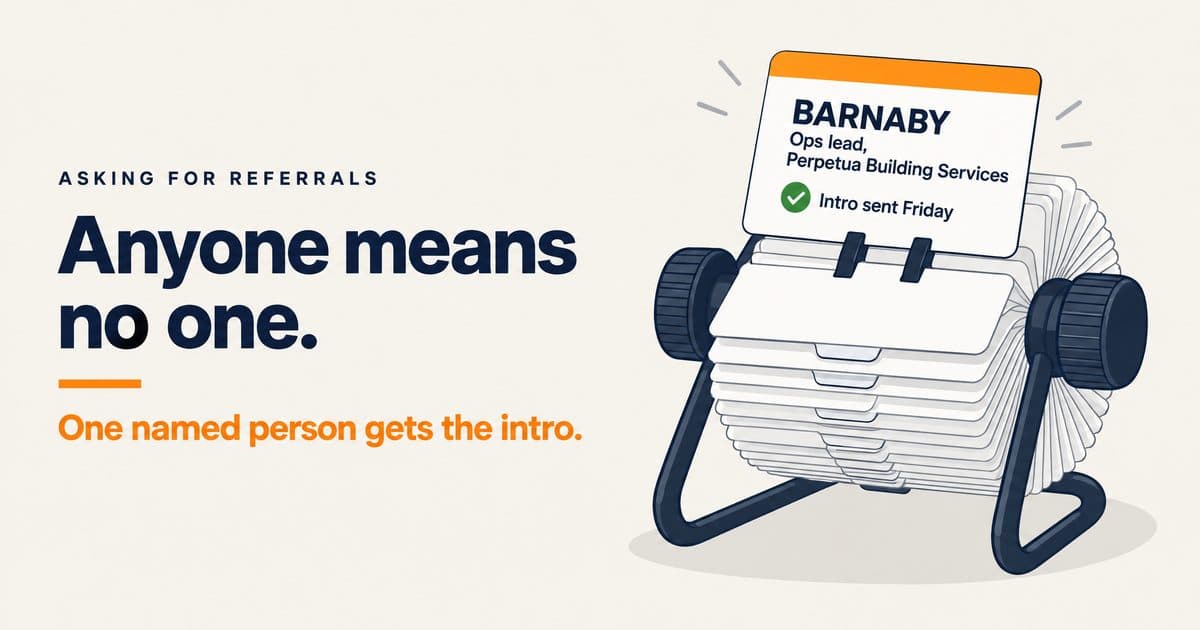
Wendeline: Hm. Barnaby, actually. He runs operations at Perpetua Building Services. We complain about the same things at the association dinners.
The question named a role and a situation, so her memory had a cue. Notice he asked for one person, not a list.
Benedikt: Would you be comfortable introducing us? I can write a three-line note you edit however you like, so it costs you two minutes.
Wendeline: I don't want it to feel like I'm selling to him.
Benedikt: Fair. Then the note just says what changed for you, and that he can ask me if he is curious. No pitch from me unless he replies. I'll send the draft this afternoon. Could it go out by Friday?
Wendeline: Friday works. Send it over.
Her hesitation was the reputation risk, so he answered that directly: her words, his offer to stay quiet until Barnaby replies, and a date. Three parts, one named person, two minutes of her time.
If they hesitate, offer a smaller ask
Some customers will not name anyone on the spot, and that is fine. Do not repeat the question louder. Shrink it.
- Offer to come back with a cue. "No problem. If I sent you two or three roles where this tends to help, would that make it easier to think of someone?" Then follow up in a week with the roles, not with "any names yet?"
- Ask for a reference instead of a referral. "Would you be willing to take one call from a prospect who wants to hear how it went?" That is a smaller favor and builds the habit.
- Ask for permission to use the result. "Could I quote the forty minutes when I talk to other ops leads?" A customer who says yes here often offers a name later on their own.
What you must not do is push past a clear no. A customer who feels cornered over a referral starts to wonder what else you will push for, and that question can surface at renewal.
Write the introduction for them
The draft you send is the difference between a promised intro and a sent one. Keep it short enough to forward without editing, written in the customer's voice, with the result in their numbers:
"Barnaby, you know how much I used to complain about Sunday scheduling. We started using Mopwise in January and it now takes me about forty minutes, and callouts are down to six a month. Benedikt there was useful and not pushy. Worth a twenty-minute look if Sundays are still eating you. Happy to tell you more."
Then send it with a note that hands control back: "Change anything, or skip it if the timing is wrong." Put the agreed send date on your own calendar. If Friday passes, one short check-in is fair: "Did the note to Barnaby go out, or would a different week be better?" If the customer has gone quiet altogether, the guide on how to re-engage a gone-dark prospect covers the same silence from the other side.
Practice the line before the review
The referral ask is about fifteen seconds long, and most reps mumble it because it feels like asking for a favor. Say it out loud before your next review: the question that gets the result in their words, the one-person ask, and the offer to draft the intro. Then say it again to a customer who hesitates, so the smaller ask comes out calm instead of apologetic. A short roleplay with a voice partner who pushes back the way Wendeline did is the quickest way to make all three parts sound like a conversation instead of a script.
Practice this out loud
Run this conversation against a live AI buyer and get a scored review.
Start free, no cardPractice this callPractice this before it counts
ConvoSparr puts you in a live voice call with an AI buyer who pushes back like a real one. Every session ends with a transcript, scores, and coaching notes.
Free to start. No credit card required.