Passed Over for Promotion, Then Asked to Train the Person Who Got It
Passed over for promotion? Within a week, ask for the gap, a review date and the number. One 30-minute talk and a 90-day test tell you whether to stay.
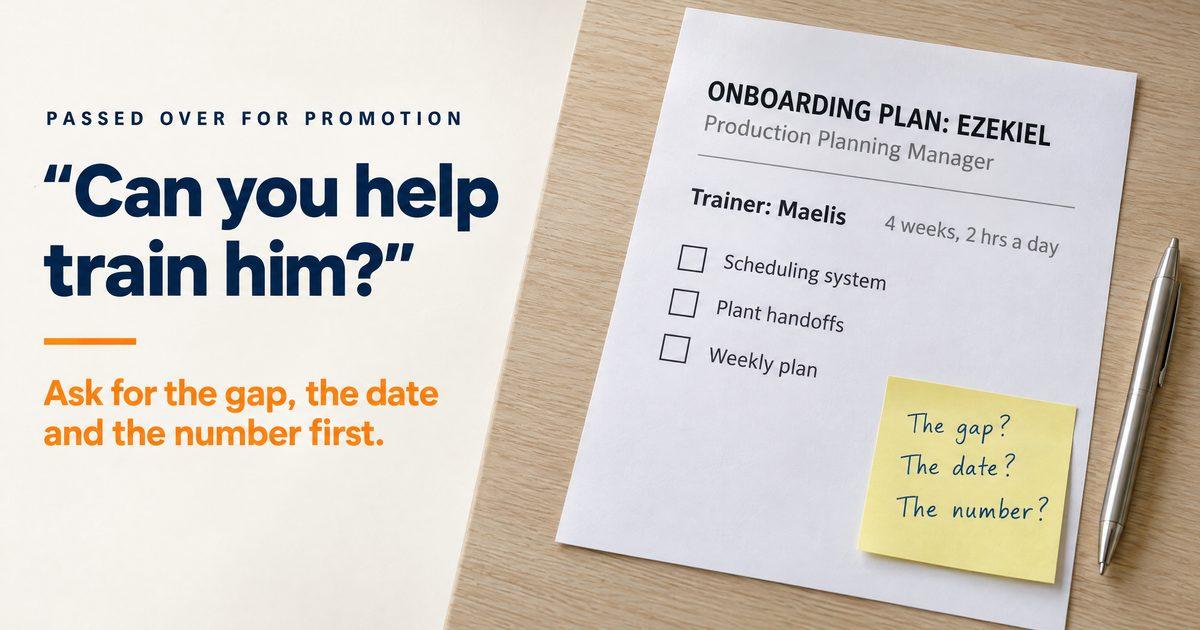
Maelis found out on a Thursday, in the same meeting as everyone else. Bartholomew, the operations director at Teakbridge, a furniture manufacturer with three plants, stood at the front of the planning room and announced that Ezekiel would be joining from outside as Production Planning Manager. Maelis had been the senior production scheduler for four years. She had covered most of that manager's job for the seven months it sat empty. She clapped with everyone else. Then, on the way out, Bartholomew stopped her by the door: "Can you help get Ezekiel up to speed on the scheduling system? You know it better than anyone."
Most people in that spot either say yes on the spot or go quiet and update a resume at night. Both skip the one conversation that decides what happens next.
The answer, before the detail. When you are passed over for promotion, do not react in the moment and do not ask for "feedback." Within a week, book thirty minutes with the person who made the decision and leave with three things: the specific gap that cost you the role, a named date when you will be reconsidered, and the pay that would come with it. Confirm all three in a short email the same day. If you are asked to train the person who got the job, agree in a way that is tied to that plan, not as a favor. Then give the company ninety days to show the plan is real, and decide whether to stay on evidence instead of on the sting.
What should you do after being passed over for promotion?
Wait a day, then ask for a meeting. The first conversation after bad news is usually the worst one, and anything you say in it gets remembered as how you took it. A calm request sent the next morning ("Could we find thirty minutes this week to talk about the planning manager decision and what I should be working toward?") tells them you want a plan, not an argument.
Go into that meeting with one goal: turn a vague no into something you can be measured against. Managers default to soft language here ("it was a really close call," "your time will come") because it is safer for them. None of that is a plan. Three questions make them commit to specifics:
- The gap. "What specifically would the person in this role need to have done that I haven't?" Ask for one or two things, not a list of ten.
- The date. "When would I be considered again, and who decides?" A month and a name, not "next cycle."
- The number. "If I close that gap, what would the role pay?" Promotion pay is set against a band, and knowing the band now saves you a weak offer later. The promotion pay article covers how that number gets set.
Write the answers down, then send them back in a short email within a few hours. The email turns a pleasant conversation into a commitment.
Four reasons the job went to someone else
The reason you are given usually points at one of four real ones, and each calls for a different ask.
| The real reason | What you usually hear | What to ask for |
|---|---|---|
| A skill gap they can name | "We needed someone who has run a budget before." | A real piece of that work in the next quarter, with a named owner checking it |
| A visibility gap | "Leadership didn't know your work as well." | A standing slot presenting to the people who decided, starting this month |
| You are hard to replace where you are | "We can't lose you on the schedule right now." | A named backfill plan and a date, or you have learned something important |
| The decision was made before you applied | "It was a really close call." | An honest answer to "was this role ever open to me?" and a decision about your next ninety days |
The third row is the one people miss: if you are too valuable where you are, getting better at that job will never promote you out of it. The fix is a successor, and a successor needs a date.
Reading about it only gets you halfway.
Run this exact conversation out loud against a realistic AI buyer on ConvoSparr and get a scored review of how you handled it.
Maelis's one-on-one at Teakbridge
Maelis booked thirty minutes with Bartholomew for the following Tuesday. She earns $68,500 as senior scheduler. She knows from the job posting that the manager band runs $82,000 to $101,000.
How the first attempt went, in her head on the drive in:
Maelis: I just want to understand what happened. I've basically been doing the job since March.
Bartholomew: I know, and honestly, it was a really close call. You're a huge part of this team.
Maelis: So what did Ezekiel have that I didn't?
Bartholomew: He's run a planning function before, at a bigger operation. But your time will come. I'd love you to help him settle in, and we'll see where things are by the end of the year.
Maelis: Okay. Sure.
Every line Maelis says is about the past, so every answer is too, and "what did he have" invites a comparison Bartholomew will politely dodge. She gets "your time will come" and "end of the year," which commit him to nothing, and she agrees to the training with no terms at all. She would leave with a new job (trainer) and no new prospects.
What she said in the room instead:
Maelis: Thanks for making time. I'm disappointed, and I'd rather use that to get specific than to look back. What would the person in the planning manager role need to have done that I haven't done yet?
Bartholomew: Honestly? Two things. Ezekiel has owned a capacity budget, and he's used to presenting the weekly plan to the plant managers. You do the work behind both, but they don't see you do it.
Maelis: That's useful. If I owned the capacity budget for the Linfield plant next quarter and presented the weekly plan to the three plant managers, would that close the gap?
Bartholomew: It would go a long way, yes.
Maelis: Then when would I be considered again, and would it be your call?
Bartholomew: We're opening a second planning manager role for the new plant next year. That decision would be mine, probably in the spring.
Maelis: Could we put a date on it? A review on March 3, with you, against those two things?
Bartholomew: March 3 works.
Maelis: And the pay for that role would sit in the same $82,000 to $101,000 band?
Bartholomew: Same band, yes.
Maelis: Good. On helping Ezekiel: I'm glad to. I'd suggest four weeks, about two hours a day, and I'd like to present the weekly plan alongside him while I do it, so the plant managers see me running it. Does that work?
Bartholomew: That actually solves a problem for me. Yes.
Her first question looks forward, so Bartholomew answers with something she can act on, not a defense. She restates the gap as two concrete assignments (the Linfield budget, the weekly plan) and asks him to confirm, which turns his opinion into a deal. "Spring" becomes March 3 because she proposes the date herself, and naming the band now means the eventual offer has a floor before anyone types it. Last, the training request stops being a favor: she gives it a scope (four weeks, two hours a day) and attaches the exact visibility the gap requires. She emails him all four points that afternoon.
When they ask you to train the person who got it
Refusing reads as resentment, and the person you refuse will be making decisions about you within a month. But a yes with no terms is how good people end up running a department for someone else's title. Agree, and set three edges in the same sentence:
- A scope. A number of weeks and a rough amount of time. Without it, "help him settle in" quietly becomes "be his second brain."
- The credit. Something that makes your knowledge visible to the people who decide promotions: co-presenting, owning a handover document, or being named as the system lead.
- The link. Tie it to the plan from your one-on-one. "Happy to, and it fits with presenting the weekly plan" connects the favor to the gap you are closing.
If you are asked to keep doing the manager's work with no change in title or pay, that is no longer a training request. It is a raise conversation, and the praise instead of a raise scenario is built for exactly that turn.
Stay or start looking: the ninety-day test
You do not have to decide on the day you hear the news, and you should not. Give the plan ninety days, then check four things against what was promised:
- Did the assignments you agreed on actually reach you, with real authority, or are you still doing the work behind someone else's name?
- Is the review date still on the calendar, with the same person, or has it drifted to "after the reorg"?
- Has the person who decided seen you do the thing they said you lacked, at least twice?
- When you mentioned the band, did anyone flinch?
Three or four yeses means the plan is real. Two or fewer means it was a way to end an awkward meeting, and you now have ninety days of documented work to show the next employer. If a competing offer arrives along the way, the counteroffer checks help you tell a fix from a patch.
Lines that quietly cost you the next promotion
These make sense in the moment and get remembered at the next decision.
- "I guess I'm just not management material." Said as a joke, remembered as a self-assessment.
- "So what did he have that I didn't?" It makes the conversation about another person, which no manager will answer honestly.
- Asking only for feedback. "Any feedback?" gets you adjectives. "What would the person in this role need to have done?" gets you assignments.
- Going quiet. A month of withdrawal reads as sulking or job hunting.
Maelis's conversation took twenty-six minutes. If you have been passed over for promotion this month, go back to the moment the request came, the one by the door: "Can you help get him up to speed?" Your answer to that is not yes or no. It is the gap, the date, the number, and the terms, and the salary negotiation guide has the rest of the toolkit for when the number finally arrives.
Practice this out loud
Run this conversation against a live AI buyer and get a scored review.
Start free, no cardPractice this callPractice this before it counts
ConvoSparr puts you in a live voice call with an AI buyer who pushes back like a real one. Every session ends with a transcript, scores, and coaching notes.
Free to start. No credit card required.
Keep reading
All articles