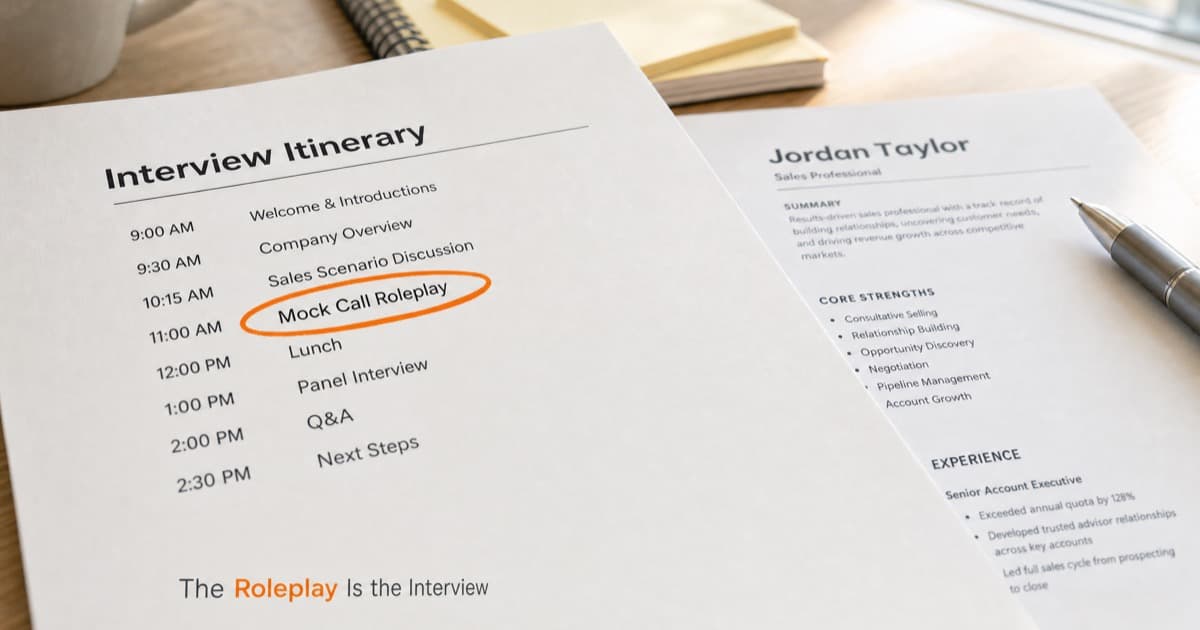
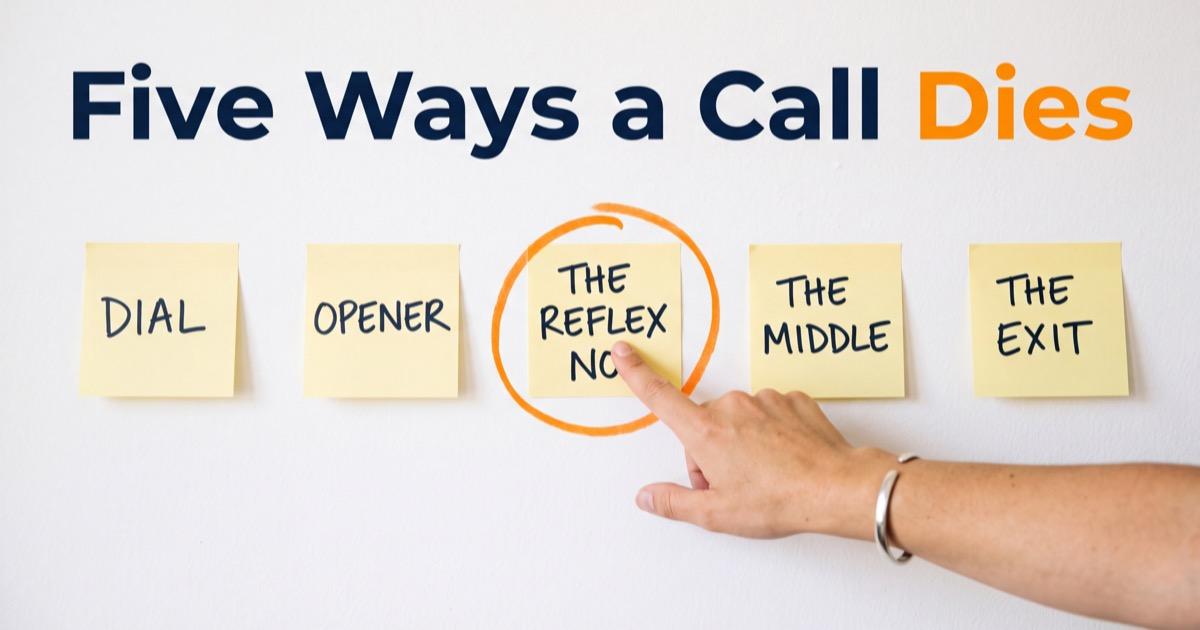
What Is a Mock Call? The Customer Has a Brief You Can't See
What is a mock call? A practice call where someone plays a customer from a brief you can't see, and your score depends on whether your questions find it.
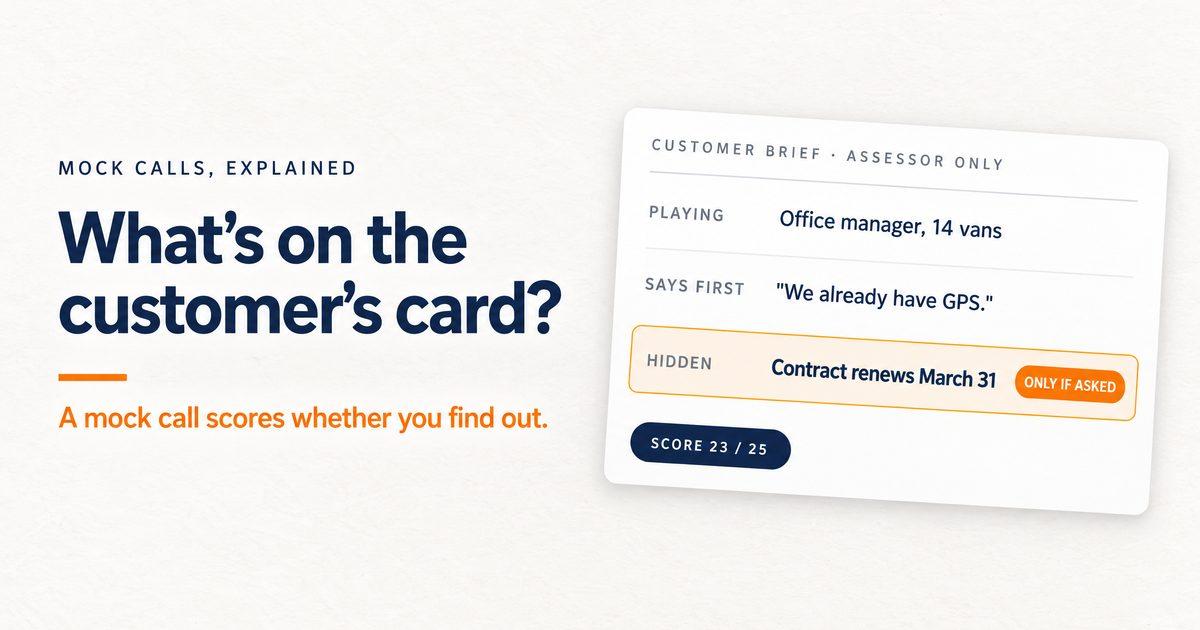
The definition you will find almost everywhere is that a mock call is a practice phone call where someone pretends to be the customer. That is true, and it leaves out the one thing that decides how you do. The person playing the customer is almost never improvising. They are holding a brief: who they are, what they will say first, what objection to raise, and usually one fact they have been told to reveal only if you ask the right question. You never see that brief. The call is a test of whether your questions find it.
So here is the answer in one paragraph. A mock call is a simulated phone call, used in sales training, job interviews and call-center hiring, in which an assessor plays a customer from a written brief while you play yourself, and a scorecard grades how you handled it. It is not a test of your pitch. Most mock call scorecards give the heaviest weight to your questions, how you handle the planned objection, and whether you end with a clear next step. The candidates and new reps who score well treat the call as a hunt for what is on the customer's card, not as a stage for what is on theirs.
What is a mock call, and how is it different from roleplay?
The two words get used interchangeably, but there is a useful line between them. A roleplay is any rehearsal where people take parts: two reps trading lines across a desk, a manager playing a tough buyer on the fly. A mock call adds three things a casual roleplay usually lacks. There is a written brief for the customer, so every person who takes the call faces the same situation. There is a scorecard, agreed before the call, so the result is a number and not a vibe. And it is run like a real call: no pausing, no "can I start again," often with the assessor on a phone or headset rather than across the table.
Those three things are why companies use mock calls to hire and to certify. Two candidates who took the same mock call can be compared fairly. Two reps who took a casual roleplay cannot.
Three places you will be handed one
The phrase means slightly different things depending on who is running it. Knowing which kind you are walking into tells you what the hidden line on the brief is likely to be.
| Setting | Who plays the customer | What is mostly scored | Typical length | What the brief usually hides |
|---|---|---|---|---|
| Sales job interview (SDR, inside sales, account executive) | The hiring manager or a senior rep | Discovery questions, objection handling, asking for a meeting | 10 to 20 minutes | A timing fact (a contract renewal, a budget date) or the real decision maker |
| Call-center or customer service interview | A trainer or a team lead playing an upset caller | Empathy, accuracy, following the process, staying calm | 5 to 10 minutes | The caller's actual problem, which differs from the complaint they open with |
| Onboarding or certification on a sales team | A manager, an enablement lead, or an AI persona | The team's own talk track and qualification method | 15 to 30 minutes | A disqualifying fact, to see whether you qualify out instead of pitching on |
In every row, the hidden line exists for the same reason. It separates people who listen from people who recite. If you pitch for ten minutes, the assessor never gets the cue to reveal it, and the scorecard shows a blank where the most valuable answer should be.
Reading about it only gets you halfway.
Run this exact conversation out loud against a realistic AI buyer on ConvoSparr and get a scored review of how you handled it.
What the customer's brief usually says
Briefs vary, but most contain the same five parts. Here is the one Sunniva, a sales manager at Vanmark, a fleet tracking company, uses for new reps in their first week. She plays the customer herself.
- Role: Augustina, office manager at Kilnworth Heating and Air, 14 service vans, 22 staff.
- Open with: "We already have GPS on the vans."
- Pain, give it if asked about scheduling: two technicians were sent to the same address last Tuesday, and a customer waited four hours.
- Hidden, reveal only if asked how they track the vans today: the current tracking contract renews on March 31, and Augustina has to give notice by March 1.
- Agree to a next step only if: the rep asks for a specific time and says what will happen in it.
Notice what is not on it: anything about Vanmark's features. The brief is built entirely from the customer's side, because that is what the call is testing.
Florian's first mock call at Vanmark
Florian joined Vanmark on a Monday. Before he could touch real leads, Sunniva ran the Kilnworth brief with him on a headset in the next room.
Monday's run:
Sunniva (as Augustina): Kilnworth, this is Augustina.
Florian: Hi Augustina, Florian from Vanmark. We help service companies track their fleets in real time, cut fuel costs and improve dispatch. Do you have a minute for me to tell you how?
Sunniva: We already have GPS on the vans.
Florian: That's great to hear. A lot of our customers had GPS before they switched. What makes Vanmark different is live traffic routing, fuel reports every week, and a mobile app your techs will actually like.
Sunniva: Sounds nice. We're fine for now, though.
Florian: Totally understand. Could I send you a short overview so you have it when you're ready?
Sunniva: Sure, send it over.
Florian thought it went well. Nobody hung up, nobody was rude, and he got a yes. Sunniva's debrief started with a question: "When does their current contract end?" He had no idea, because he never asked anything. His first sentence was a feature list, his answer to the objection was another feature list, and "send you an overview" gave Augustina a polite exit. The pain on the brief and the March 31 renewal both stayed on the card. In a real call, the brush-off would have looked like a lukewarm lead, and the renewal date would have come and gone.
Tuesday's run, after the debrief:
Sunniva (as Augustina): Kilnworth, this is Augustina.
Florian: Hi Augustina, Florian from Vanmark. I'll be quick. I work with heating and cooling companies on dispatching their service vans. Can I ask you one question about how scheduling goes on your side?
Sunniva: We already have GPS on the vans.
Florian: Makes sense, most companies your size do. How are you tracking them today, and how long have you had it?
Sunniva: It's a system we signed up for a few years ago. Actually, the contract is up at the end of March. I'd have to give notice by the first.
Florian: Good to know, that's a month away. When the dispatch side goes wrong, what does it look like?
Sunniva: Last Tuesday we sent two techs to the same house and another customer waited four hours. I took that call.
Florian: That's the exact problem I'd want to show you. Could we take twenty minutes on Thursday at ten, where I show you how two other contractors stopped double booking, and you decide whether it's worth comparing before March 1?
Sunniva: Thursday at ten works.
Same brief, same assessor, a different call. Florian's opener asked permission for a question instead of a pitch. He treated "we already have GPS" as information rather than resistance, and his follow-up, "how are you tracking them today," is precisely the cue the brief was waiting for. Once the renewal came out, he used it to frame the meeting around Augustina's own deadline, then asked for a specific time with a stated purpose, which is the condition the brief set for agreeing. If the opener structure is new to you, the cold calling guide breaks down why a permission question beats a feature list in the first ten seconds.
How is a mock call scored?
Every company writes its own scorecard, but most measure the same handful of things, and the weights usually tilt toward listening rather than talking. Here is Sunniva's, with Florian's two runs:
| Criterion (5 points each) | What full marks looks like | Monday | Tuesday |
|---|---|---|---|
| Opening | Name, company, a short reason, and a question instead of a pitch | 2 | 5 |
| Discovery | Open questions that surface the pain and the hidden line on the brief | 0 | 5 |
| Objection | Acknowledge it, then ask about it, instead of answering it with features | 1 | 4 |
| Next step | A specific day and time, with a stated purpose the customer agrees to | 1 | 5 |
| Talk ratio and tone | The customer talks more than you do; calm, plain language | 2 | 4 |
| Total | 6 / 25 | 23 / 25 |
The Monday score is not unusual for a first mock call, and it is the useful part of the exercise. It shows exactly which row to work on. If you are preparing for one as part of a hiring process, the guide to the mock sales call interview covers what interviewers watch for line by line, and mock sales call practice covers how to run these for a team.
The habit that costs the most points
Florian's Monday run failed for one reason, and it is the most common one: he treated the mock call as a chance to show what he knew. Most people do, especially in an interview, because it feels like the moment to perform. But nothing on the scorecard rewards the features you list, and every minute you spend listing them is a minute the assessor has no cue to reveal what is on the card.
So before your next mock call, whether it is for a job, a certification, or week one on a new team, set yourself one rule: no statement about your product until you have asked at least three questions about the customer's world. You will feel the pull to break it in the first twenty seconds, usually right after the first objection. That pull is exactly what the call is built to test, and it is a habit you can only break by practicing out loud against someone, or something, that pushes back the way a real customer does. Rehearse with an assessor who will not reveal the hidden line unless you earn it, and you will stop reaching for the pitch before the call ever reaches you.
Practice this out loud
Run this conversation against a live AI buyer and get a scored review.
Start free, no cardPractice this callPractice this before it counts
ConvoSparr puts you in a live voice call with an AI buyer who pushes back like a real one. Every session ends with a transcript, scores, and coaching notes.
Free to start. No credit card required.