Six Trial Close Questions to Ask Before You Ask for the Deal
Six trial close questions, the moment each one belongs to, and how to read a warm, lukewarm or cold reply before you ask the buyer for a decision.
You are twenty-five minutes into a call that feels good. The buyer has nodded through the demo, laughed at the right moment and said "that's neat" twice. You have five minutes left, so you take a breath and ask whether they want to move forward. The answer is a pause, then "let me take this back to the team." You never find out which part did not land, because you only checked once, at the very end, when the only possible answers were yes and no.
Trial close questions fix that. A trial close question asks the buyer for an opinion about part of what you have shown, not for a decision about the whole deal. "How does that compare with how you do it today?" is a trial close. "Do you want to sign?" is a close. Ask three or four trial closes during a call, one after each pain, feature, price and stakeholder moment, and you learn where the buyer stands while there is still time to fix it. A warm reply means keep going. A lukewarm reply means find out what is missing. A cold reply means stop and dig before you ask for anything.
What is a trial close question?
A trial close is a temperature check. You ask it in the middle of a conversation, after you have shown or said something that matters, and the buyer's answer tells you how close they are to buying without forcing them to commit. The word "trial" is the point: a trial close can come back negative at no cost, because you were not asking for the deal yet.
That is what separates it from a real close. A close asks the buyer to decide ("Shall we get the order form over today?"). A trial close asks them to react ("Would this fit how your desk works on a Saturday?"). A no to the first ends the conversation. A no to the second starts a better one.
It is also different from the habit most reps think is a trial close: "Does that make sense?" That question asks the buyer whether they understood you, and almost everyone says yes to it, so it measures nothing. A trial close asks how something would land in the buyer's world. If you want the full set of ways a call can end once the checks come back warm, the guide on how to close a sales call covers them, and the sales pitch guide shows where these checks sit in the whole conversation.
Six trial close questions and when each one fits
Each of these belongs to one moment in the call. Asked at the wrong moment, a good question gets a polite, empty answer.
-
After the buyer confirms a pain: the priority check. "If that stopped happening, how much would it matter compared with everything else on your plate this quarter?" A pain the buyer cares about is not the same as a pain they will spend money on this quarter. This question tells you which one you have.
-
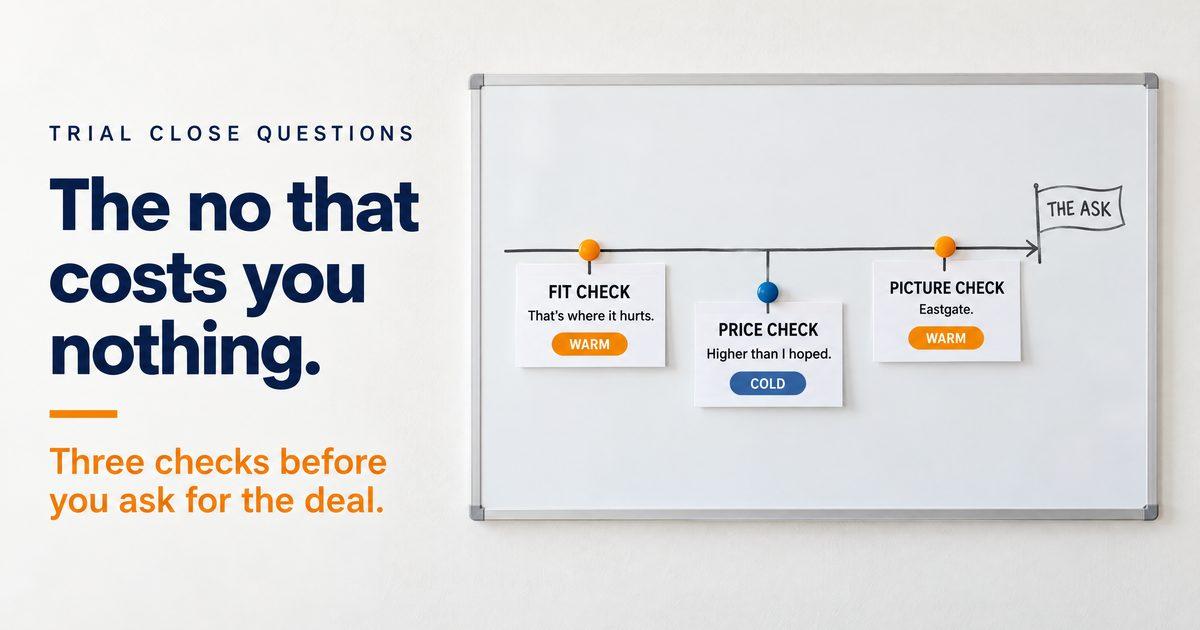
After you show the part that fixes it: the fit check. "How does that compare with how your team handles it today?" You are asking the buyer to hold your product up against their own Tuesday. Specific answers ("that would kill the spreadsheet") are warm. Vague praise ("looks slick") is not.
-
After you say the price: the price check. "How does that number sit against what you were expecting?" Say the price, ask this, then stop talking. Most reps fill the silence with a discount nobody asked for.
-
When the buyer mentions someone else: the people check. "Who else would need to see this before it went any further, and what would they look at first?" This finds the hidden approver while you can still do something about them.
-
Late in the call: the picture check. "If you went ahead, where would you want to start?" The "if" keeps this a trial close. If the buyer answers with a location, a team or a date, they have pictured the rollout, and that is the strongest warm signal there is. If they cannot picture a start, they are not ready, and you have learned that without asking for anything.
-
When something feels stuck: the gap check. "What would have to be true for this to be an easy yes?" This one invites the objection out loud. It is the most useful question on the list when the replies so far have been lukewarm.
Reading about it only gets you halfway.
Run this exact conversation out loud against a realistic AI buyer on ConvoSparr and get a scored review of how you handled it.
Warm, lukewarm or cold: reading the reply
The question is half the skill. The other half is hearing what came back and changing what you do next. Here is how to sort the three kinds of answer.
| Reply | What it sounds like | What it usually means | Your next move |
|---|---|---|---|
| Warm | Specific and about their world: "That would end the Sunday refunds." | They have pictured using it for that problem. | Move to the next part of the call. Do not resell what is already sold. |
| Lukewarm | Polite and general: "Yeah, that's interesting," "Could be useful." | They do not dislike it, but it has not connected to a pain they feel. | Ask one follow-up: "Useful for which part?" Then show the piece that answers it. |
| Cold | A comparison, a hedge or a new worry: "We tried something like this." | There is a reason not to buy that you have not heard yet. | Stop presenting. Ask what happened, and listen to the whole answer. |
A cold reply is the most valuable of the three, because it shows up while you still have twenty minutes to work with it. A cold reply you never asked for shows up after the call as silence.
Evander's call with Frostline Rinks
Evander sells Glazeboard, online ice-time booking for rink operators, at $1,150 a month for four rinks. Leocadia is director of operations at Frostline Rinks, which runs four community ice rinks. Hockey clubs, figure skating coaches and public sessions all book through the front desk by phone, and the schedule lives in a shared spreadsheet. Discovery has already turned up eleven double bookings last season. Here is the middle of the call, with notes on each trial close.
Evander: So that's the club portal. Coaches see open ice, they claim a slot, it disappears for everyone else. Does that make sense?
Leocadia: Sure, makes sense.
Commentary: Not a trial close. "Does that make sense?" checks understanding, and Leocadia understood fine. Evander learned nothing about whether she wants it. He catches himself.
Evander: Let me ask that better. How does that compare with how your front desk handles a club booking today?
Leocadia: Honestly, the double bookings aren't from the clubs. It's the Sunday six a.m. slot. Two coaches swear they called first, and we refund one of them. That's where it hurts.
Commentary: The fit check turned a polite "sure" into the real pain, and it is narrower than Evander assumed. The clubs are fine. One contested slot is costing refunds and goodwill. That is a lukewarm reply with a gift inside it.
Evander: Then let me show you the timestamp. Every claim is logged to the second, and the second coach sees the slot as taken before they can book it. If the Sunday slot stopped being a fight, how much would that matter next to everything else this season?
Leocadia: That's a top-three thing. My desk staff dread Sunday mornings.
Commentary: Evander showed the one feature that answers her actual pain, then ran the priority check. "Top-three" and a named, felt cost (staff who dread Sundays) is warm.
Evander: For all four rinks it's $1,150 a month, including the club portal and online payments. How does that sit against what you were expecting?
Leocadia: Higher than I hoped. Our board looks hard at anything over a thousand.
Commentary: Cold, and specific. Evander does not discount. The real information is the board and the thousand-dollar line, which he would never have heard if he had asked for the deal instead.
Evander: That's useful. Who on the board would look at this first, and what would they want to see?
Leocadia: Our treasurer. She'd want to know what we lose now. The refunds, and the hours my desk spends on the phone.
Evander: Then let's build that with the numbers you have. If you went ahead, which rink would you want to start with?
Leocadia: Eastgate. That's the one with the Sunday problem.
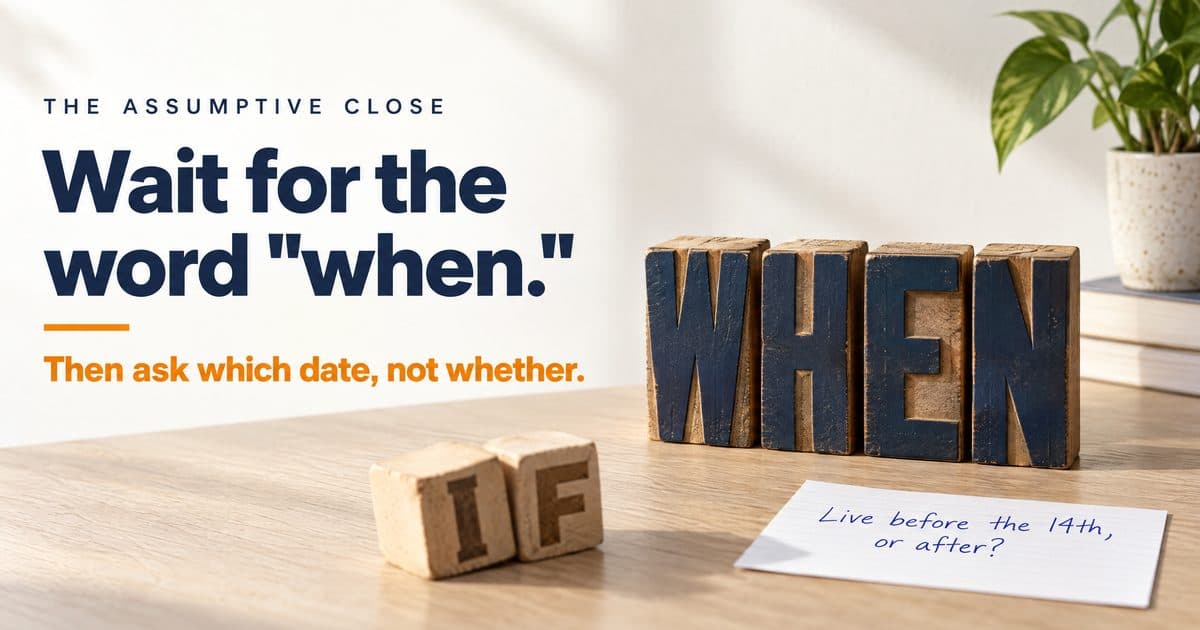
Commentary: The people check found the treasurer and her test. The picture check came back warm with a place, Eastgate, and a reason. Evander now knows exactly what is left: a cost-of-today page for the treasurer. He closes on that next step, not on a signature, and the assumptive close is the right line for later, once the treasurer's answer comes back and Leocadia starts saying "when."
Notice what the first, weak question would have produced if Evander had kept asking it: four "sure, makes sense" replies, a confident ask at minute twenty-eight, and a board objection he heard about by email a week later.
When does a trial close start to feel like pressure?
Buyers can feel a check-in turn into a squeeze. These are the habits that cause it.
- Leading questions. "Wouldn't you agree that would save your team hours?" is a request for agreement, not an opinion. Buyers hear it as a setup and give you a guarded yes. Ask open questions that let the answer go either way.
- Asking before showing. A trial close needs something to react to. Asking "how does this sound so far?" two minutes into a call checks the temperature of nothing.
- Arguing with a cold answer. When Leocadia said the price was higher than she hoped, a rebuttal would have taught her to stop telling Evander the truth. Thank the buyer for the cold answer and ask what sits behind it.
- Treating warm as signed. Four warm replies are permission to ask for the decision. They are not the decision. Reps who skip the real close because "they obviously loved it" leave the call with no next step.
How many trial closes belong on one call?
For a thirty-minute call, three or four is about right: one after the main pain, one after the feature that answers it, one after the price, and one when another person enters the story. A useful rule is never two trial closes in a row without something new in between. If you have not shown, said or learned anything since the last check, the next one is just pressure with a question mark.
A shorter call might get two. A long demo with several stakeholders might earn five or six, spread out. The number matters less than the habit of asking each one right after the moment it measures.
On your next call, pick two of the six questions before you dial and write them at the top of your notes, with the moment each one belongs to. After the call, write down what each reply was (warm, lukewarm or cold) and what you did next. If you would rather try them on a buyer who pushes back first, you can run a practice call and see how the replies change when the question does.
Practice this out loud
Run this conversation against a live AI buyer and get a scored review.
Start free, no cardPractice this callPractice this before it counts
ConvoSparr puts you in a live voice call with an AI buyer who pushes back like a real one. Every session ends with a transcript, scores, and coaching notes.
Free to start. No credit card required.