Cold Email vs Cold Call: Choose by Where Your Buyer Spends the Day
Cold email vs cold call: a quarry manager in a pickup never sees your email, and a CFO at a desk rarely answers. Which one is your next prospect?
An ignored cold email costs the prospect nothing: never opening it takes no decision. An ignored cold call costs them something small but real, a ring and a glance at the screen. That difference cuts both ways. The email is easy to ignore, so it rarely gets a reply. The call is hard to ignore, so it gets answered more often, and resented more often too.
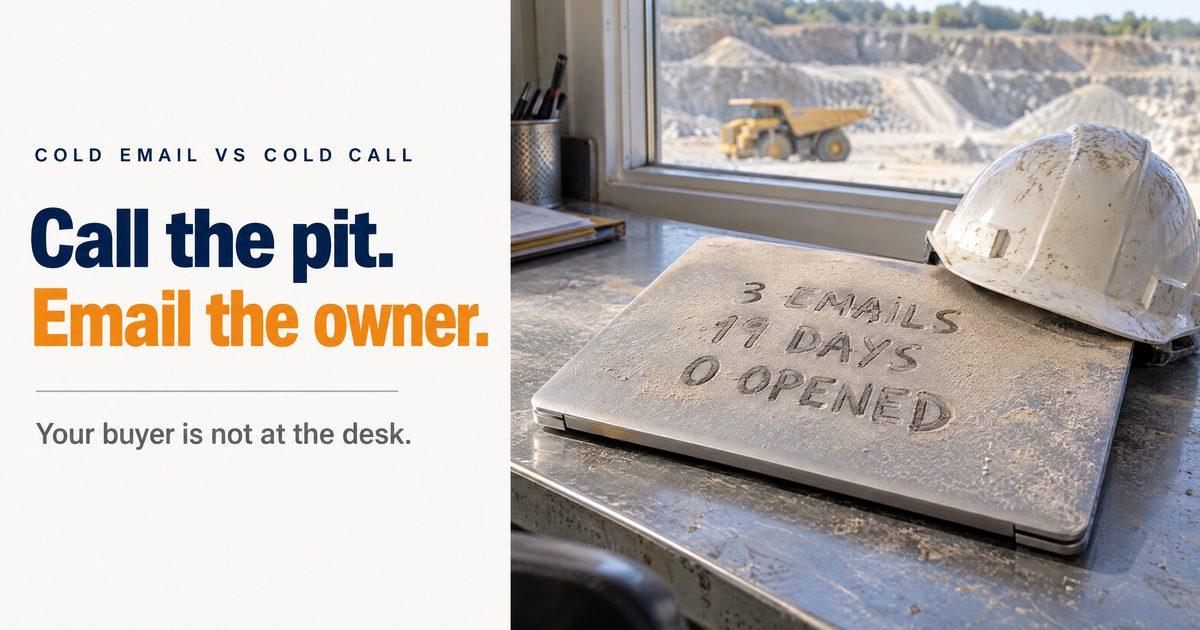
So the honest answer to cold email vs cold call is that neither wins in general. Choose the channel by where the buyer spends the workday. A buyer who lives at a desk and in an inbox, and who has to forward anything interesting to two other people, should get the email first and a short call that points to it. A buyer who spends the day on a site floor, a shop floor or in a vehicle should get the call first, because your email will not be read until 9 PM, if ever, and then the email that follows the call should be written so they can forward it. Most prospects need both. The question is the order.
Is a cold email or a cold call better for booking a first meeting?
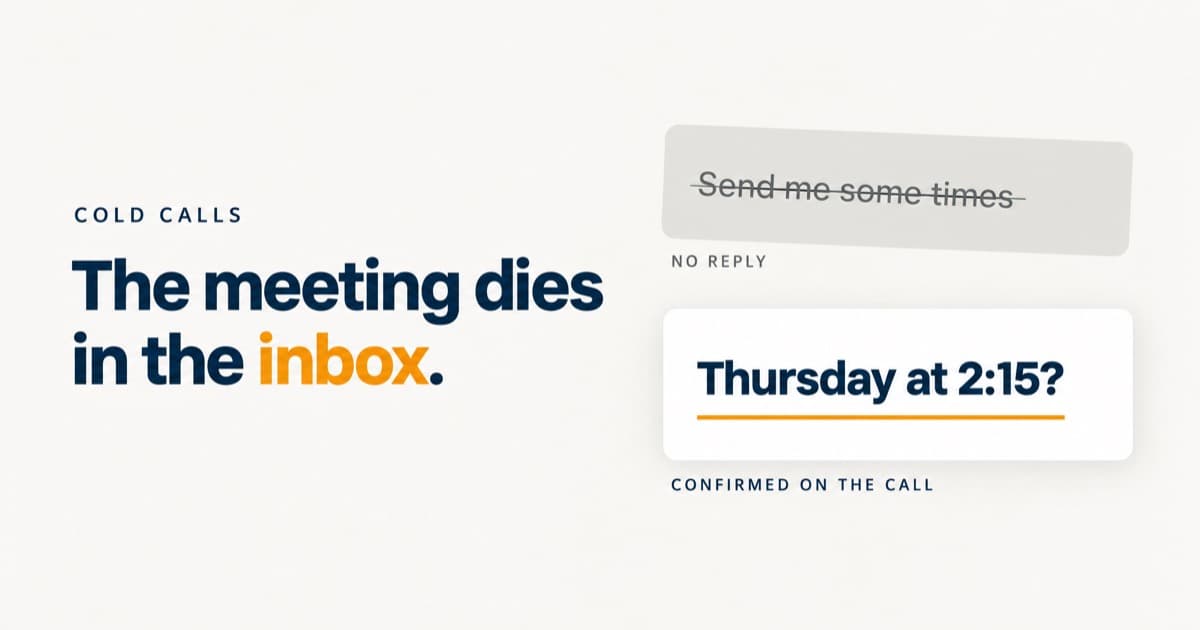
A call books the meeting faster when the buyer answers, because you can ask for a time and hear the answer in the same minute (the guide on booking a meeting from a cold call shows the exact ask). An email books it when the buyer needs to read a number, check it against their own, or send it to someone else before they can say yes.
| Cold email | Cold call | |
|---|---|---|
| What it costs the buyer to ignore it | Nothing. No decision is needed | A ring and a glance. Small, but they notice |
| When the buyer meets it | Whenever they next clear their inbox, which for some buyers is late at night | Right now, wherever they are standing |
| What it is good at | Carrying a number, a link or a comparison the buyer wants to check or forward | Getting a yes, a no or a "not me, call Thorvald" in under a minute |
| What kills it | A subject line that sounds like every other vendor | An opening that makes the buyer guess why you called |
| What you learn when it fails | Almost nothing. Silence looks the same for every reason | Usually the reason, said out loud |
| Who it reaches | The buyer, plus anyone they forward it to | Only the person who picked up |
The last two rows are the ones reps forget. A failed call teaches you something and a failed email teaches you nothing, but a call reaches one person while an email can reach a whole buying group. That is why the sequence matters more than the choice.
Three questions that pick the channel for each prospect
Ask these about the person, not the company, before you write a word or dial a number.
- Where does this person spend the working day? Desk and laptop: email has a chance. A pit, a warehouse floor, a ward, a truck, a job site: call first, and call at the edges of their shift, when they are near the office phone or in the cab. If you cannot tell, the title helps: an operations manager at a quarry is outside, the controller is at a desk.
- Can you say your reason in one sentence, or does it need a number they will want to check? "A quarry like yours lost two haul truck tires in March to low pressure nobody saw" works out loud. A four-line savings breakdown does not; it belongs in writing, after the buyer has agreed it is worth reading.
- Who else has to see this before anything happens? If the answer is "the owner" or "finance," the buyer will need something to forward. A call cannot be forwarded, so even when the call goes first, the email is the second half of the same touch.
If the first answer is "outside" and the third is "someone else," you have the most common case in field-heavy industries: call first, then send three lines the buyer can forward without rewriting.
Reading about it only gets you halfway.
Run this exact conversation out loud against a realistic AI buyer on ConvoSparr and get a scored review of how you handled it.
Severin calls the Mossgrove pit office
Severin sells tire pressure and idle-time sensors for haul trucks at Gritline, a small fictional telematics company. His prospect is Cordelia, operations manager at Mossgrove Aggregates, a fictional gravel quarry running nine haul trucks. Severin has sent her three emails over nineteen days. None was opened. Cordelia, it turns out, reads email at night, on her phone, and only from people she knows.
He calls the pit office at 6:40 AM, twenty minutes before the first shift loads.
Pass one: "Did you get my emails?"
Severin: Hi Cordelia, it's Severin from Gritline. I sent you a few emails about our tire monitoring platform. Did you get a chance to look at them?
Cordelia: I don't know. I get a lot of email.
Severin: No problem. Basically we help quarries cut tire costs and idle time with real-time sensor data, and I'd love fifteen minutes to walk you through a demo.
Cordelia: Just send me something and I'll look at it.
Severin: Sure, I'll resend the last one.
Commentary. The opening asks Cordelia to remember three emails she never opened, so the call starts on a small failure. "Tire costs and idle time" is a category every telematics vendor says, not a reason. "Just send me something" is the predictable result, and resending the unread email takes Severin back to the channel that already failed: a cold email read aloud. The send me an email scenario is built around exactly that brush-off.
Pass two: the reason, said out loud, then three lines for the owner
Severin: Cordelia, it's Severin at Gritline. I'm calling because Harrowfield Sand and Gravel, two counties over, lost two haul truck tires in March to slow leaks nobody saw until the sidewalls went. At about twenty-two thousand dollars a tire. You run nine trucks, so I wanted to ask: how do you find a slow leak today?
Cordelia: The drivers walk round them at start of shift. Gauge check on Mondays.
Severin: So a leak that starts on a Tuesday afternoon gets found the next Monday?
Cordelia: If it gets found. We lost one in August.
Severin: Then here's what I'd suggest. I'll send you three lines today, written so you can forward them to whoever signs off on tires. If it's worth a look, I'll come out to the pit on a Thursday morning and put a sensor on one truck. Who would you forward it to?
Cordelia: Thorvald. He owns the place. He reads email at night.
Severin: Then I'll write it for Thorvald.
Commentary. The first sentence asks Cordelia to remember nothing: a quarry she can picture, a month, a number, a failure she recognizes. The question is about her process, not his product, so she answers with a fact ("gauge check on Mondays"). Severin turns it into a gap she can see, Tuesday to Monday, and she volunteers the August tire. Only then does he mention email, and now the email has a job: carry the story to Thorvald, who was never going to take the call.
The forwardable email: three lines Thorvald can read at night
Here is what Severin sends forty minutes later, while the call is still fresh for Cordelia.
Subject: Slow leaks on the Mossgrove haul trucks (from Cordelia's call)
Thorvald, Cordelia and I spoke this morning. Your trucks get a gauge check on Mondays, and a slow leak that starts midweek can run for days; Mossgrove lost a tire that way in August, and Harrowfield lost two in March at about $22,000 each.
Gritline puts a pressure sensor on each tire and texts the shift lead when one drops. I can fit one truck on a Thursday morning, at no charge, so you can see it for a month.
Would a Thursday in the next two weeks work, or should I check back with Cordelia?
Three things make it forwardable. The subject names the quarry and the call, so it does not read as a stranger's pitch. The first line is Cordelia's own fact, so she is the source, not Severin. And the ask has an easy second option Thorvald can answer in five words from his phone. No attachment, no feature list, no brochure link.
When the email should go first
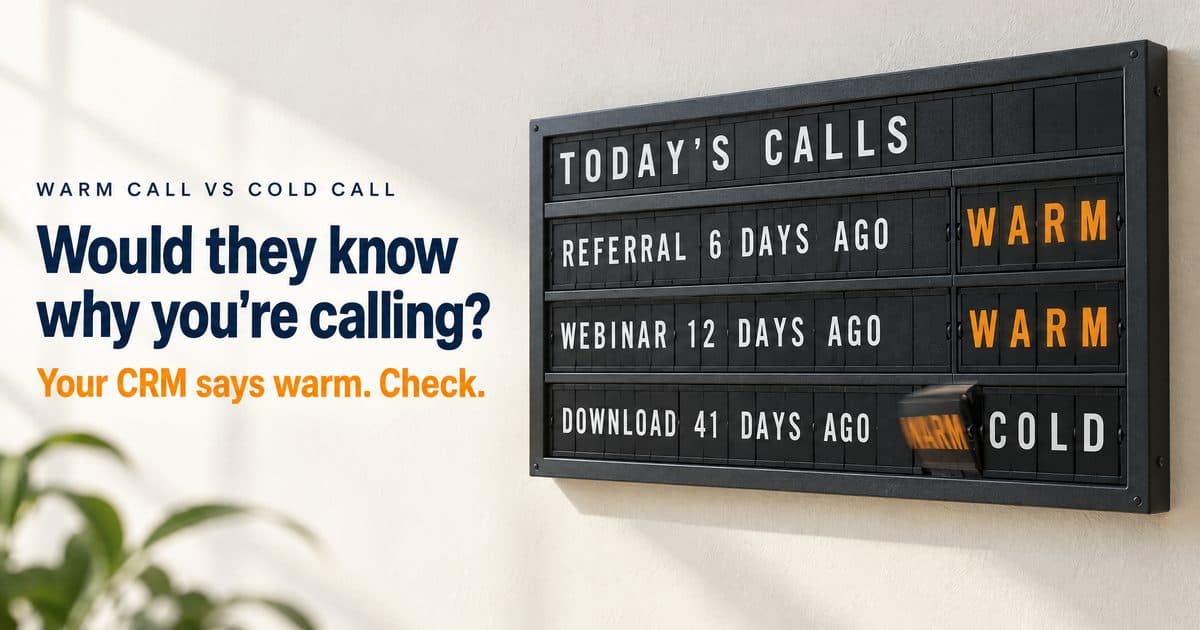
Flip the order when the buyer lives in the inbox and the call would arrive cold. A controller or a procurement lead at a desk all day is more likely to read a sharp two-line email than to pick up an unknown number. (An opened email still does not make the call warm; the warm call vs cold call test is whether they could name why you are calling.) The trick is that the call must point at one specific line from the email, not at the email in general. "I wrote to you Tuesday about the gap between your Monday gauge checks and midweek leaks" works. "Did you get my email?" does not, for the same reason it failed for Severin. If the call goes to voicemail, use the voicemail to point the buyer back to the email's subject line; the guide to what to say when a cold call goes to voicemail covers how to keep it under twenty seconds.
Three ways reps get the sequence wrong
- Choosing by their own comfort. Reps who dislike the phone default to email for everyone, and the field buyers never see it. Phone lovers do the reverse.
- Opening the call with the email. "Did you get my email?" asks the buyer to recall something, admits it did not work, and gives them an easy "no."
- Writing the follow-up for the person on the call. If someone else signs, write it for them, and say so on the call. "Who would you forward it to?" is one of the most useful questions in cold outreach.
Before you sequence your next ten prospects
Run this checklist against each name on tomorrow's list, and write the answer next to it.
- Desk or floor? Mark each prospect E (email first) or C (call first) by where they spend the day, not by what is easier for you.
- One sentence. Write the reason you would say out loud in one sentence, with a place, a month and a number. If you cannot, you are not ready to call.
- The forward. Note who else has to see it, and draft the three-line email for that person before you dial.
- The pointer. For every E prospect, pick the one line from your email your follow-up call will quote.
- The same morning. Block twenty minutes after each calling block to send the follow-ups while the calls are fresh.
The one-sentence reason is worth rehearsing most, because you only get one try at it. You can rehearse it against an AI buyer on ConvoSparr, who will answer the way Cordelia did, or brush you off the way she did in the first pass, and get a scored breakdown of the call afterward. The cold calling guide covers the rest of the call once the buyer stays on the line.
Practice this out loud
Run this conversation against a live AI buyer and get a scored review.
Start free, no cardPractice this callPractice this before it counts
ConvoSparr puts you in a live voice call with an AI buyer who pushes back like a real one. Every session ends with a transcript, scores, and coaching notes.
Free to start. No credit card required.
Keep reading
All articles