How Should You Follow Up After a Demo? Start Before the Call Ends
How to follow up after a demo: book the next step on the call, send a recap in the buyer's words, and drop the five habits that let a good demo go cold.
Try this before you read on. Pick the last demo you ran that felt good, the one where the buyer nodded, asked smart questions and said something like "this looks great." Now open the first message you sent after it and look for one sentence: a date and a time the buyer agreed to, out loud, before you hung up.
If that sentence is missing, the email probably reads "Great to connect today, attaching the deck and pricing, let me know your thoughts." And the thread under it probably holds two cheerful check-ins and no reply. The demo was not the problem. The follow-up started too late and asked for nothing specific.
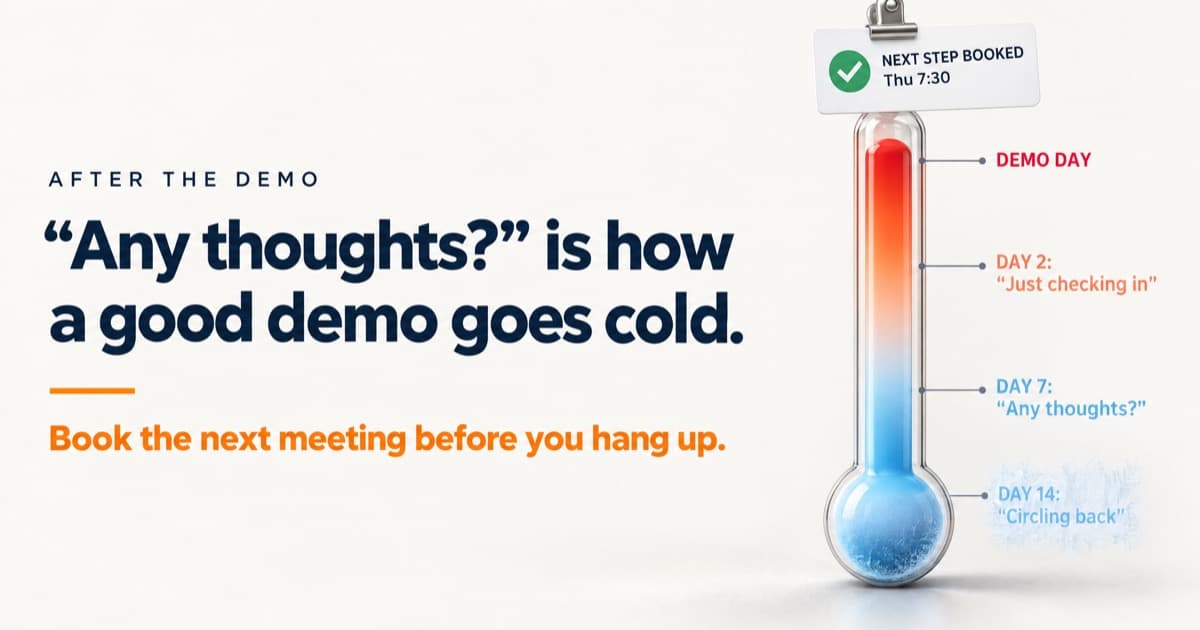
So here is the answer to how to follow up after a demo. The follow-up begins in the last ten minutes of the demo itself, when you book the next conversation with a named person and a named purpose. Within the same business day, send a short recap written in the buyer's own words: the problem they described, what they saw that addressed it, the one question still open, and the date already on the calendar. Then make the first follow-up call about that open question, never about "any thoughts." A follow-up that carries something new gets answered. A follow-up that only asks for a reaction gets filed.
Why do deals stall in the week after a demo?
A demo creates a burst of attention that decays fast. The buyer leaves with a favorable impression and no task, and the impression rarely survives a full calendar on its own.
Three things usually happen in that week. First, the person who saw the demo has to retell it to someone who did not, and they retell it worse than you would, because they remember features, not the reason the features mattered. Second, the open questions from the call stay open, so the deal has nothing to move on. Third, the rep's follow-ups ask the buyer to do the work of restarting the conversation: "any thoughts?" is a request for an essay, and busy people do not write essays for vendors.
A better subject line fixes none of these. Deciding, before the demo ends, what the next conversation is for fixes all three. The sales follow-up guide makes the same point about every stage of the cycle: nothing you send later repairs a call that ended without a reason to talk again.
Book the follow-up while the buyer is still on the call
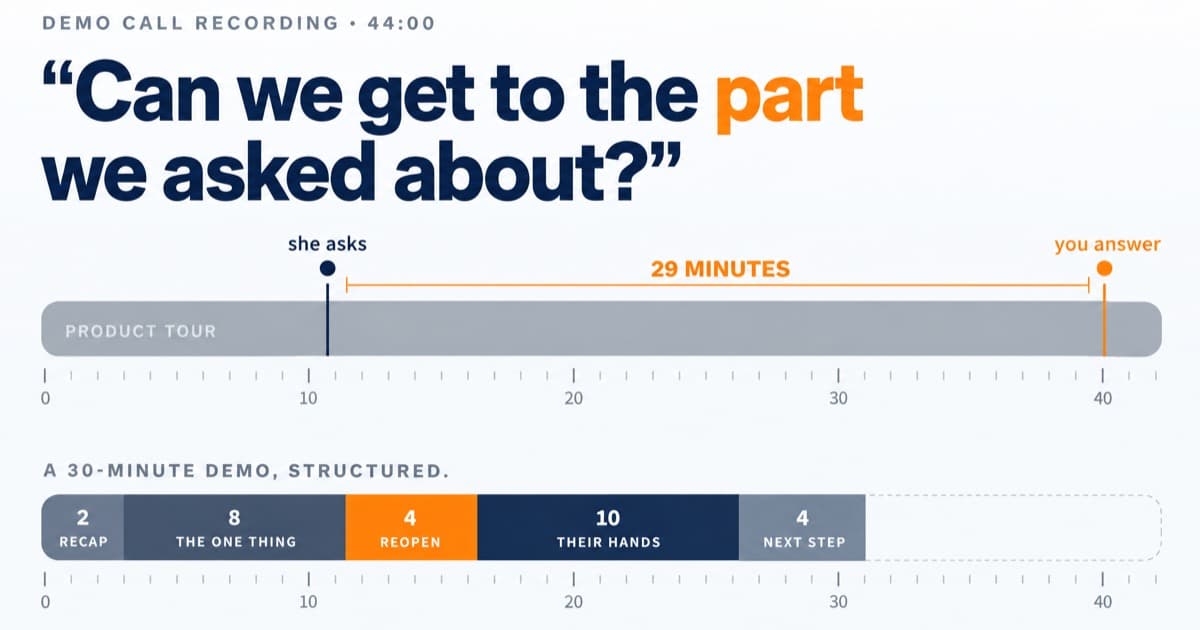
The cheapest follow-up is the one you never have to chase, because it is already on the calendar. Hold the last eight to ten minutes of every demo for this, and if the demo is running long, cut a feature, not the close. The demo call structure guide covers how to protect that block.
Use three questions, in this order:
- "Who else needs to see what you saw today before you can decide?"
- "What would they need to see that we didn't cover?"
- "Can we put twenty minutes on the calendar with them now, before we hang up?"
The first surfaces the real decision maker. The second gives the next meeting a job. The third turns intent into a date while everyone can still see a calendar. If the buyer will not book, ask for the smallest real commitment instead: "Then can we hold fifteen minutes on Thursday just for the two of us, so I can answer what comes up when you brief them?"
Reading about it only gets you halfway.
Run this exact conversation out loud against a realistic AI buyer on ConvoSparr and get a scored review of how you handled it.
The recap email, written in the buyer's words
Send the recap the same business day. Its job is not to summarize your product; it is to give your champion a version of the demo they can forward to their boss without editing it.
Keep it to four short parts:
- What you told us. One or two sentences of the problem, in the buyer's phrasing. If they said "we're drowning in haul-out requests," write that, not "you are seeking operational efficiency."
- What you saw. The one or two moments in the demo that answered it. Skip the tour.
- What's still open. The question you could not fully answer, named honestly. This is the hook for your next call.
- What's next. The date and time already booked, and who will be there.
Attach the deck if they asked for it, but never make the deck the email. Naming the open question shows you listened and gives them a reason to show up next time.
Call, email or a shared plan: which follow-up fits which buyer
Match the format to where the deal stands, not to your habit.
| Format | Best when | What it carries | Where it fails |
|---|---|---|---|
| Same-day recap email | Every demo, without exception | The buyer's problem, the proof they saw, the open question, the booked date | When it becomes a feature list or the only follow-up you send |
| Short call within two business days | An open question needs a conversation, or the champion has to brief a boss | An answer to the open question, plus help shaping the internal pitch | When it opens with "just checking in" and carries nothing new |
| Shared mutual plan | Three or more people are involved and the steps to a decision are unclear | Named owners and dates for each step from now to signature | When the buyer never agreed to it and it reads as your plan, not theirs |
| Short recorded walkthrough | The champion must retell the demo to someone who missed it | The two or three moments that mattered, in under three minutes | When it is the full demo again, which nobody watches |
Most deals need the recap plus one of the other three. The call is the default, because a voice conversation is where the real objection shows up.
The Thursday call to Halyard Point Marina
Fenella sells Quayline, scheduling software for boatyards. On Tuesday she demoed it to Gwyneth, service manager at Halyard Point Marina, a full-service yard with about 140 boats to haul out before winter storage. The demo went well. Gwyneth's last words were "This looks great. I'll need to run it by Wynn," the owner. Fenella's recap named the open question: whether the yard crew, who work from a whiteboard in the shed, would use a tablet at all.
The call she almost made:
Fenella: Hi Gwyneth, it's Fenella from Quayline. Just checking in after Tuesday's demo. Any thoughts so far?
Gwyneth: Oh, hi. Honestly, it's been chaos here, we're in the middle of haul-outs. I haven't had a chance to talk to Wynn yet.
Fenella: No problem at all. Did you get a chance to look at the pricing I sent?
Gwyneth: I glanced at it. Look, can you try me in a couple of weeks, once things calm down?
Fenella: Of course. I'll circle back then.
Every line asks Gwyneth to restart the deal for Fenella. "Any thoughts" asks for an opinion she has not formed, and the pricing question puts the most sensitive item first. And "a couple of weeks, once things calm down" is a polite exit: haul-out season is the exact problem Quayline solves, so things will not calm down until the problem has already cost the yard another season.
The call she made instead:
Fenella: Hi Gwyneth, it's Fenella from Quayline. I'll keep this to five minutes. On Tuesday you said the real question for Wynn would be whether the guys in the shed would put down the whiteboard. I found something on that.
Gwyneth: Okay, go ahead.
Fenella: Another yard we work with had the same worry, so they kept the whiteboard for the first month and had one person copy it into the tablet at the end of each day. After three weeks the crew started checking the tablet first, because it showed which boats were cleared to haul. I can send a two-minute clip of what their screen looks like.
Gwyneth: That's exactly the thing Wynn will ask. He hates anything that slows the crew down.
Fenella: Then would it help if I showed him that part directly? Twenty minutes, just the yard screen and the copy-over process. What does his week look like?
Gwyneth: He's in the office Thursday mornings before the lift starts.
Fenella: Does Thursday at 7:30 work, with you on too? I'll send the invite with the clip attached so he can watch it before.
Gwyneth: Let's do it.
Fenella opened with the open question from her recap, so the call had content before Gwyneth said a word. She brought a specific answer to the owner's likely objection rather than a general reassurance, and she offered a small, low-risk version of the change (keep the whiteboard for a month) instead of asking the crew to switch overnight. Notice she never asked "any thoughts." She asked for one meeting, with one person, for one purpose, and she let the buyer choose the time. Pricing did not come up, and that is correct: it belongs in the meeting with Wynn, once the crew question is settled.
Five habits that quietly let a demo go cold
Each of these feels polite at the time.
- Sending the deck instead of a recap. A forty-slide deck forwards badly. Your champion will not cut it down for their boss, so the boss sees nothing.
- Waiting a "respectful" few days. Interest decays fastest in the first two days. Same-day recap, follow-up call inside two business days.
- Following up with the person who has no authority. If the decision sits with someone you have not met, every follow-up aimed only at your champion adds work to their week. Ask to include the decision maker directly.
- Leading with pricing. Raising price first invites a "too expensive" before the value has been agreed. Let the buyer bring it up, or hold it for the decision meeting.
- Letting "let me think about it" end the call. That line is often a brush-off, not a thought. Ask what specifically they want to think through, then book the time to answer it. The guide to a follow-up call after no response covers the case where the buyer has already gone quiet.
Before your next demo ends
Here is the challenge for your next demo. Do not let the call end until three things are true: you know who else has to see it, you know what that person will need to see, and a date with that person is on the calendar. Then, before you leave your desk that day, send a recap of four short parts with the open question named in it.
Do that live, with a buyer who is rushed or half out the door, and the follow-up stops being a chase. It becomes the next scheduled meeting. The hard part is saying the booking questions under pressure, which is exactly the part worth rehearsing before a real buyer hears it.
Practice this out loud
Run this conversation against a live AI buyer and get a scored review.
Start free, no cardPractice this callPractice this before it counts
ConvoSparr puts you in a live voice call with an AI buyer who pushes back like a real one. Every session ends with a transcript, scores, and coaching notes.
Free to start. No credit card required.
Keep reading
All articles