A Product Tour vs a Decision Meeting: How to Structure a Demo Call
How to structure a demo call in five blocks, with a transcript of the middle eight minutes and the exact lines that reopen discovery mid-demo.
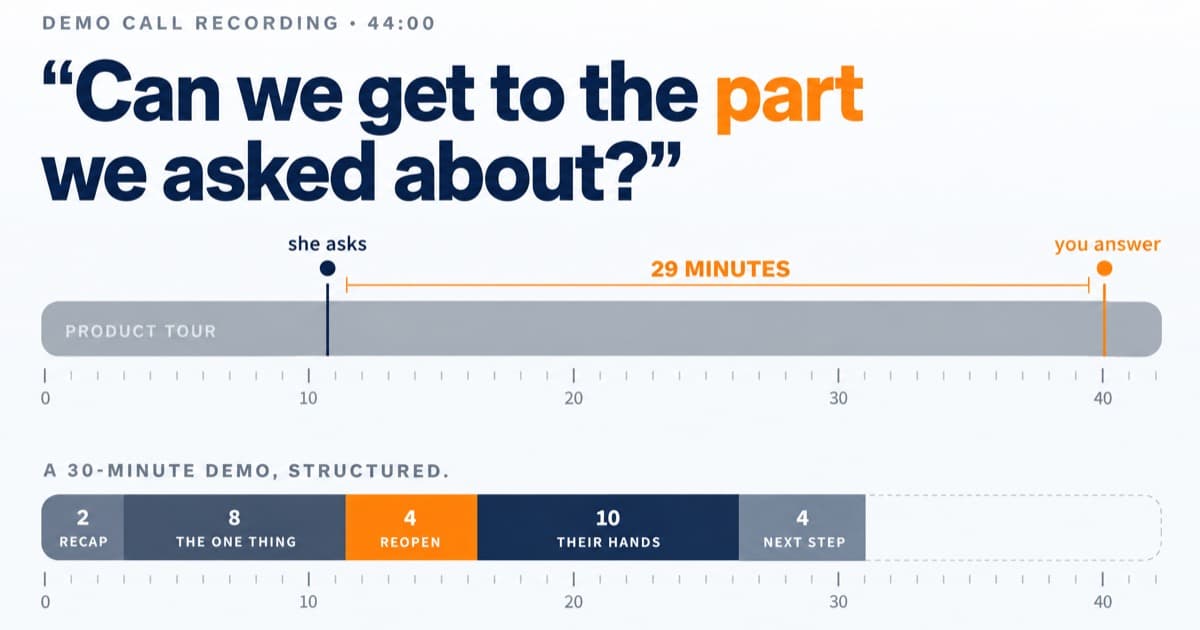
The recording runs forty-four minutes. For thirty-one of them one voice talks over a screen share, moving left to right along a navigation bar. At minute nine a second voice asks whether they can see the thing they emailed about, and is told "absolutely, I'm getting there." They get there at minute thirty-eight. The call ends on "it looks comprehensive, let me talk to my colleague," said with the colleague still on the line.
Nothing in it was wrong. Every screen was real and the rep knew the product cold. The agenda was the problem: it followed the order the software was built in rather than the order this buyer was deciding in, and those two never match.
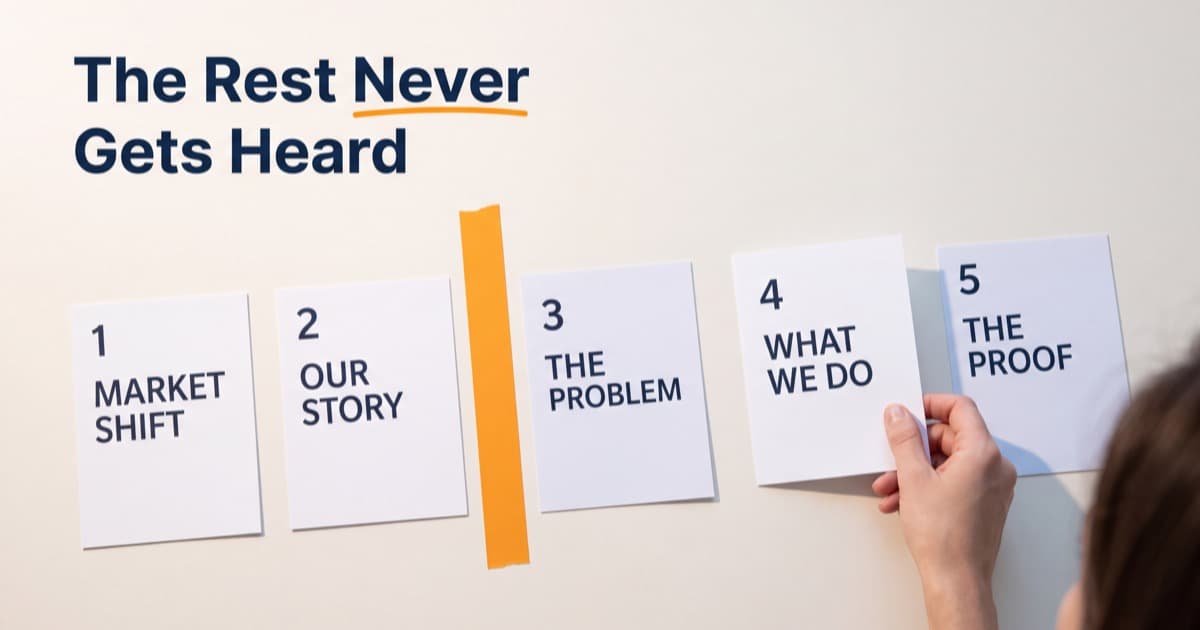
So here is the answer before the detail. To structure a demo call, replace the feature order with five blocks: two minutes recapping what you heard and naming what you will show, eight minutes on the single problem they told you about, four minutes reopening discovery in the middle of the call, ten minutes with the buyer driving the one workflow they would own, and four minutes agreeing a dated next step out loud. When time is short, cut scope inside a block, never a block. Reps delete the reopen first, and it is the only block that tells you whether the remaining twenty minutes are worth spending.
What is a demo call structure supposed to do?
A demo call structure exists to move one specific person from "that looks capable" to "I can picture my team running this, and I know what happens next." It is not a training session or a feature audit. Judge it on three outputs: evidence aimed at the problem the buyer named, a felt sense of the workflow the person in the room would inherit, and a dated next step naming whoever else has to see it. A demo that produces all three in twenty minutes beats one that shows everything in fifty.
Most demo agendas fail that test because nobody wrote them. They are inherited. The dashboard comes first because it is the home screen, the integrations last because they were built last, and the rep narrates a tour of a building instead of showing someone the room they would work in. No buyer decides in that order, which is the same problem our sales pitch guide takes apart across the whole conversation.
The five blocks, and how long each one gets
The timings assume a thirty-minute call; the ones booked for sixty fill the hour with whatever is available.
Block one: the recap. Two minutes. Say the problem back in the buyer's own words and numbers, then name what you will show and what you will skip. The omission is what makes the promise credible.
Block two: the one thing. Eight minutes. One problem, end to end, including the ugly middle. A buyer who watches one thing resolved completely can extrapolate; one who watches three things started cannot.
Block three: the reopen. Four minutes. Stop demoing and ask. The account you are working from is a week old, came from one person, and is about to justify the next ten minutes.
Block four: their hands, their workflow. Ten minutes. The buyer drives, or at least directs: where would you click, what would you do with that, who gets this. It is what turns a demo into a memory, and it is what gets eaten when block two overruns.
Block five: the next step. Four minutes. A named date, named people, and a sentence saying what the next meeting decides, agreed out loud on the call.
That is twenty-eight minutes, and the missing two are deliberate slack. On a forty-five minute call, add the extra time to blocks two and four only.
Reading about it only gets you halfway.
Run this exact conversation out loud against a realistic AI buyer on ConvoSparr and get a scored review of how you handled it.
Three demo formats, and what each one earns
| Format | What the buyer does | What you learn | When it is the right call |
|---|---|---|---|
| The full tour: every module, left to right | Watches, says "that makes sense" at intervals | Nothing you did not already know | A technical review where someone is checking a requirements list, and even then send a recording |
| The use-case demo: one named problem, shown end to end | Watches closely, interrupts once or twice | Whether your version of their problem is the real one | A first demo with one or two people who both live in the problem |
| The earned walkthrough: you show the first step, they direct the rest | Chooses what happens next, out loud | Their vocabulary, their workaround, and who they will have to convince | Any demo where the person in the room would use the product themselves |
The second and third rows are not alternatives: the use-case demo is blocks one and two, the earned walkthrough is block four, and a good thirty minutes runs one, then a reopen, then the other. The full tour survives because it is safe, prepared once and delivered forever, never producing a moment the rep was not ready for.
Reopening discovery in the middle of a demo without starting over
The reopen feels like a detour and takes about ninety seconds of nerve. Three lines do the work.
"Before I show the next part, can I check one thing?" Permission framing, so the pause does not read as lost momentum. Then ask something real; "does that make sense" collects politeness.
"Who on your side would be doing this, and what are they doing instead today?" The answer is where the current cost lives, and it often names someone who was not in your notes.
"Is this the version of the problem you have, or a tidier one?" Buyers describe a cleaner problem in discovery than the one they live with, because the clean version is easier to say. The messy one is what your product has to survive.
You are running a compressed discovery call inside a demo, so the rules from how to open a discovery call apply at speed: one question, then silence, then follow the answer rather than returning to your plan. If it changes what matters, say so out loud. "That changes what I was going to demo" is the most credible sentence available on that call.
The eight minutes where the agenda earns its keep
Marit sells for Solbrink, a cold chain monitoring platform. Terrence is operations director at Hedstrom Creamery Cooperative, a member-owned dairy co-op running two plants for forty farms, and Bianca is its quality manager. In discovery, Terrence said the co-op wrote off roughly thirty thousand dollars of rejected loads last year, most of it milk that left plant two between June and August.
The recording, as it happened.
Marit: I'll share my screen and take you through the platform. This is the main dashboard. Every sensor on every trailer reports in here, and you can filter by route, by depot, by asset class.
Terrence: Mm.
Marit: Over here is the alerting engine. Thresholds are per product type, and there are forty pre-built templates.
Bianca: Can we get to the part we asked about?
Marit: Absolutely, I'm getting there. Reporting first, it ties into the answer.
Marit: So that is the overview. Does that make sense?
Terrence: Yeah, it looks comprehensive. Let me talk to Bianca and we'll come back to you.
Bianca asked at minute nine, was told to wait, and never asked again. That is where the call ended, twenty-five minutes before anyone hung up. "It looks comprehensive" is what a buyer says about a product they cannot picture using, and "let me talk to Bianca" with Bianca on the call says the decision has left the room. Marit will log this as a good demo, because nothing went visibly wrong.
The rebuild, with the blocks holding.
Marit: Before I share anything. You wrote off about thirty thousand dollars of rejected loads last year, nearly all of it leaving plant two in June and August. Most of today goes on that, and I am skipping the dashboard. If we finish and you have not seen how a June load would have been caught, I've run this badly.
Terrence: Fair enough.
Marit: Bianca, you get the call when a load is rejected. What happens in the first hour?
Bianca: I call the driver, then the plant, then I go looking for the temperature printout, which is in the cab. It's usually next day before we know whether it was the trailer or the dock.
Marit: So the delay is finding out which one it was.
Bianca: The delay is proving which one it was. We usually know. We can't show it.
Marit: That changes what I show you. Here is the load record for a trailer that sat warm on a dock for nineteen minutes before it pulled out. Treat this as your screen, Bianca. Where do you look first?
Bianca: The dock. That line there.
Marit: Open it. Dock door sensor, trailer, same chart, same timestamps. What would you do with that on the call with the customer?
Bianca: Send it. That is the argument. Right now the argument is me saying so.
Marit: Then the question is whether a record like that is worth what it costs. Terrence, who else has to see this before you can answer?
Terrence: Our general manager, and the board treasurer signs capital spend.
Marit: Can we book thirty minutes with those two before the end of next week? I'll rebuild this record from three of your own rejected loads for it.
Same product, same twenty minutes, one different decision at minute four. The reopen earned the rest: "proving" is a different problem from "finding out," and it turns a monitoring tool into a piece of evidence. Bianca drove the screen, which is why she can describe it to the general manager without Marit in the room, and that is the only durable thing a demo produces. The close named two people, a week and what the next meeting decides, rather than asking whether they were interested, the same discipline as asking for the close.
Mistakes a tight agenda does not fix
Demoing to whoever showed up. Two people accepted and one owns the problem. Find out which in block one, then demo to that person.
Answering a question with a feature. A buyer asks "can it handle split shipments" and gets a click path. They were checking whether you have met their mess before. Answer that first, then click.
Saving the hard part for the end. Whatever the buyer is most skeptical about belongs in the first ten minutes, while there is still time to recover if it lands badly.
Treating enthusiasm as a result. "This looks great" costs the buyer nothing. A demo has worked when they say something specific and slightly awkward, like the name of whoever will object to it.
Leaving the next step to the follow-up email. The last four minutes are the only ones with everyone who must agree on the call.
One question to answer before your next demo
Take the last demo you ran and find the minute where a buyer asked something you deferred. There is almost always one, and it felt reasonable at the time: you were three screens from the answer.
Now look at what they said afterward. If the tone went from specific to polite, the call ended there and the rest was a presentation for an audience that had stopped deciding. So the question to answer before your next demo is not about your product: what will you do differently in the ninety seconds after a buyer asks for the part they came for?
Practice this out loud
Run this conversation against a live AI buyer and get a scored review.
Start free, no cardPractice this callPractice this before it counts
ConvoSparr puts you in a live voice call with an AI buyer who pushes back like a real one. Every session ends with a transcript, scores, and coaching notes.
Free to start. No credit card required.