What Do You Write Down When Taking Notes During a Sales Call?
Taking notes during a sales call costs you the room. The four things worth writing down, the capture methods compared, and a full worked call.
"The dyehouse is fine. It's the reorders that kill us. Somebody has to phone the mill and ask what's on the frame, and by the time they call back the customer has gone somewhere else."
That is the whole account, said in nineteen seconds, forty minutes into a call. The rep wrote down "reorders, phone the mill, slow." Three weeks later, in front of a finance director, that note could not be turned back into a sentence anyone could act on. The buyer had named the cost, the workaround and the person who carries it. The page kept none of it.
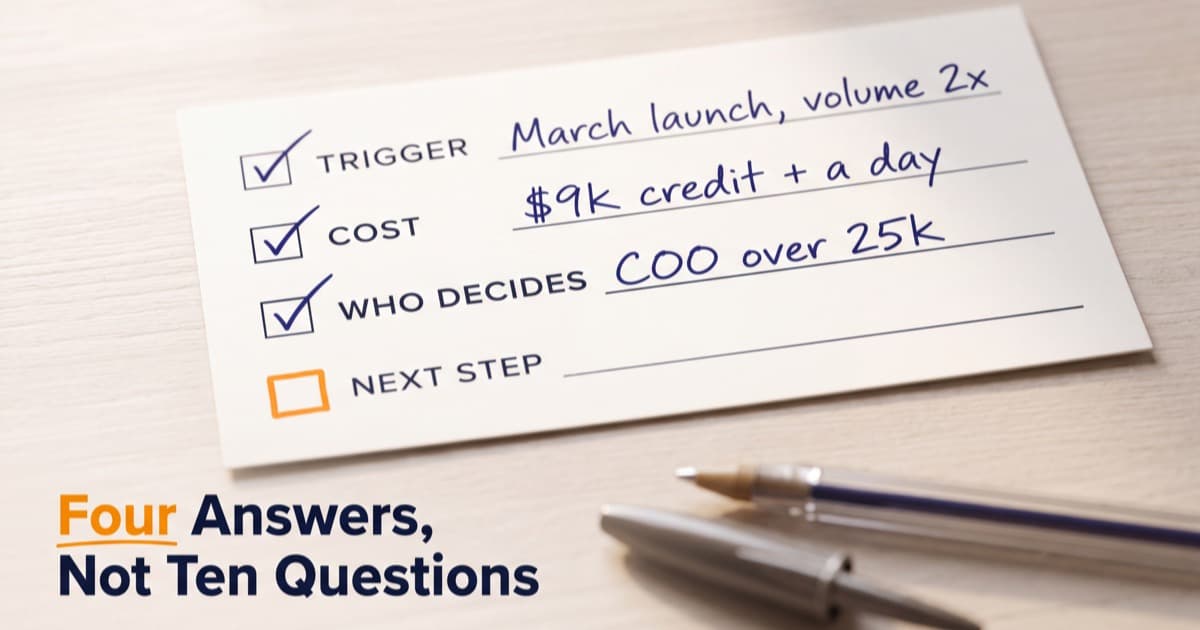
So here is the answer before the detail. Taking notes during a sales call means capturing four things and deliberately skipping everything else: the buyer's exact words when they describe the problem, any number they say out loud, who decides and who objects, and the next step with a date on it. Everything else is recall, and recall is what the ninety seconds after the call are for. If you are writing full sentences while they talk, you are transcribing, and transcribing is a different job from selling.
The buyer can hear you stop listening
Nobody has to see your screen to know you have left. The tell is timing: a buyer says something, hears two seconds of nothing, then gets a question belonging to the thing they said before that one. Do it three times and their answers get shorter, because long answers are clearly not being used.
Typing is worse than writing here, and not because of the sound. A keyboard lets you keep up, and keeping up is the trap: you can transcribe at conversational speed, so you do, while the part of your attention that should be noticing what they did not say is busy being a stenographer. A pen is slow enough to force a decision about every line. That constraint is the feature.
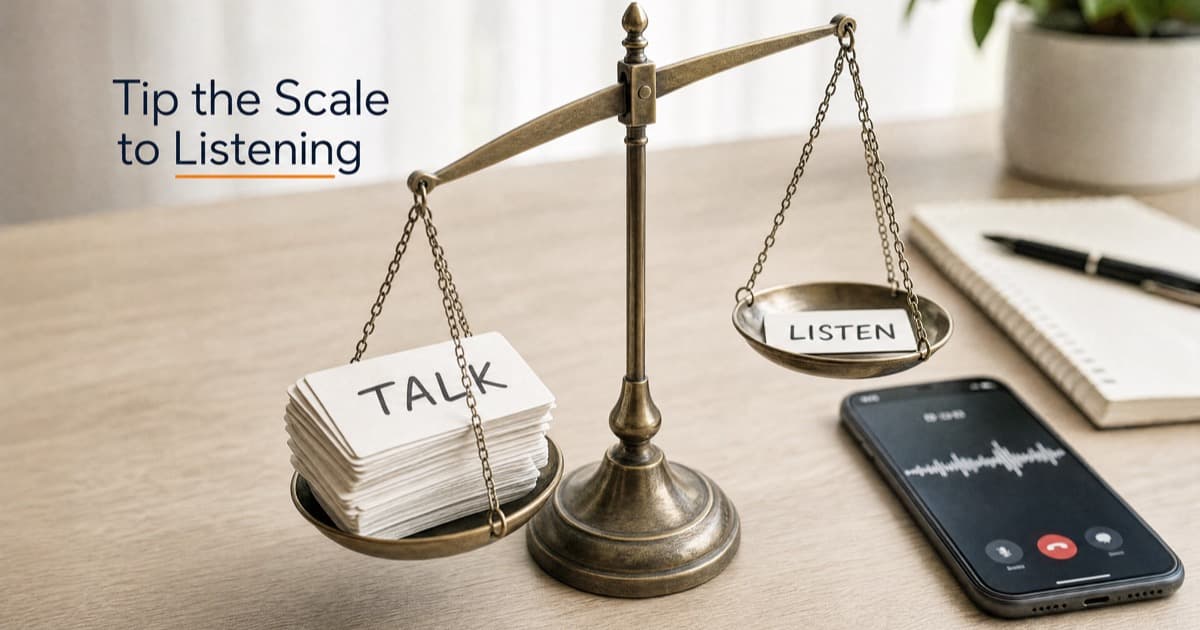
The cost lands where the talk-listen ratio problem lands, from the opposite direction. There you lose the call by filling the silence. Here you lose it by filling the page.
What should you write down during a sales call?
Write down four things, and let the rest go.
Their words, not your summary. Capture the problem verbatim, in quotation marks. "Somebody has to phone the mill and ask what's on the frame" is usable in a proposal, in an email, and in front of their boss. "Manual process, poor visibility" is your vocabulary, it will be in nine other decks, and it cannot be quoted back to them as evidence you were listening.
Every number they say out loud. Volumes, headcounts, dollars, days, dates. Numbers are the only part of a discovery call that survives a finance review, and buyers say them casually once and never repeat them. Write the digits and one word for what they measure.
Names, with what each name does. Not an attendee list. "Yolanda, controller, signs anything over ten" is a note. "Yolanda" is a reminder to ask later, which you will forget.
The next step, with a date, written while it is being agreed. If you write it after the call you will write what you hoped they said.
Skip the rest. Your product thoughts, your rebuttals, your reminder to send the case study: those are yours, and a minute of recall rebuilds them. What recall cannot rebuild is the sentence they said once.
Reading about it only gets you halfway.
Run this exact conversation out loud against a realistic AI buyer on ConvoSparr and get a scored review of how you handled it.
Pen, laptop, recorder, or memory: what each one costs you
| Method | What you capture | What it costs on the call | Where it is the right choice |
|---|---|---|---|
| Paper, four-line limit | Quotes, numbers, names, next step | Roughly nothing, once you have practiced the limit | Any call where you are the only seller on the line |
| Laptop, typed freely | Most of what was said, in your own paraphrase | The second half of every answer, and the follow-up you never thought to ask | A call a colleague is running, where you are the scribe |
| Recording plus transcript | Everything, searchable, after the fact | Consent friction at the start, and a tendency to half-listen because you can re-listen | Multi-stakeholder deals where wording gets disputed later |
| Memory alone, written up after | The gist, plus whatever confirmed what you believed | Nothing during the call, everything afterward | A short qualification call with one decision in it |
The rows are not alternatives. The working combination is row one during the call and row three as insurance: a recording is evidence, notes are attention. Row two is what does not work, and it is the most common setup in the industry.
Fourteen minutes with Braewick Textile Finishing
Rasmus sells a production scheduling platform. Imelda is operations director at Braewick Textile Finishing, a commission dyeing and finishing mill that runs fabric for about sixty clothing brands, most of them repeat customers placing small reorders at short notice.
Take one: everything on the page.
Imelda: So we've got four jet dye machines and two stenters, and the scheduling is done on a whiteboard in the planning office, which sounds primitive but it has worked for a long time.
Rasmus: Got it, four jets, two stenters, whiteboard. And how many people are in the planning office?
Imelda: Two, plus me some of the time. The dyehouse is fine. It's the reorders that kill us. Somebody has to phone the mill and ask what's on the frame, and by the time they call back the customer has gone somewhere else.
Rasmus: Right. And is that a daily thing or a weekly thing?
Imelda: Daily. Well, it depends.
Rasmus: Okay. Are you tracking it anywhere, or is it all on the board?
Imelda: The board.
Rasmus's page reads: four jet dye machines, two stenters, whiteboard scheduling, 2 planners plus ops director, reorder visibility daily/weekly TBC, no system of record. Tidy, complete, useless. The nineteen seconds where Imelda described losing customers passed while he wrote "whiteboard scheduling," and his next question was about headcount. Her answers got shorter after that, which is what a buyer does when the long one went nowhere.
Take two: four things on the page.
Imelda: So we've got four jet dye machines and two stenters, and the scheduling is done on a whiteboard in the planning office, which sounds primitive but it has worked for a long time.
Rasmus: Understood. Go on.
Imelda: The dyehouse is fine. It's the reorders that kill us. Somebody has to phone the mill and ask what's on the frame, and by the time they call back the customer has gone somewhere else.
Rasmus: Say that last part again. The customer has gone where?
Imelda: To whoever answers first. A reorder is four hundred meters and they want it in ten days. If we can't say yes on the phone, someone else will.
Rasmus: How often does somebody else say yes first?
Imelda: Honestly? Two or three a week. Call it forty thousand a year we just hand over, and that's the low version of the number.
Rasmus: And when you say somebody has to phone the mill, who is that?
Imelda: One of the two planners. It's ten minutes each time, and it's the same ten minutes over and over.
Rasmus: Last one on this. If you wanted to fix it, who else has to be in the room?
Imelda: Yolanda, our controller. Anything over ten thousand goes past her, and she'll ask what it replaces.
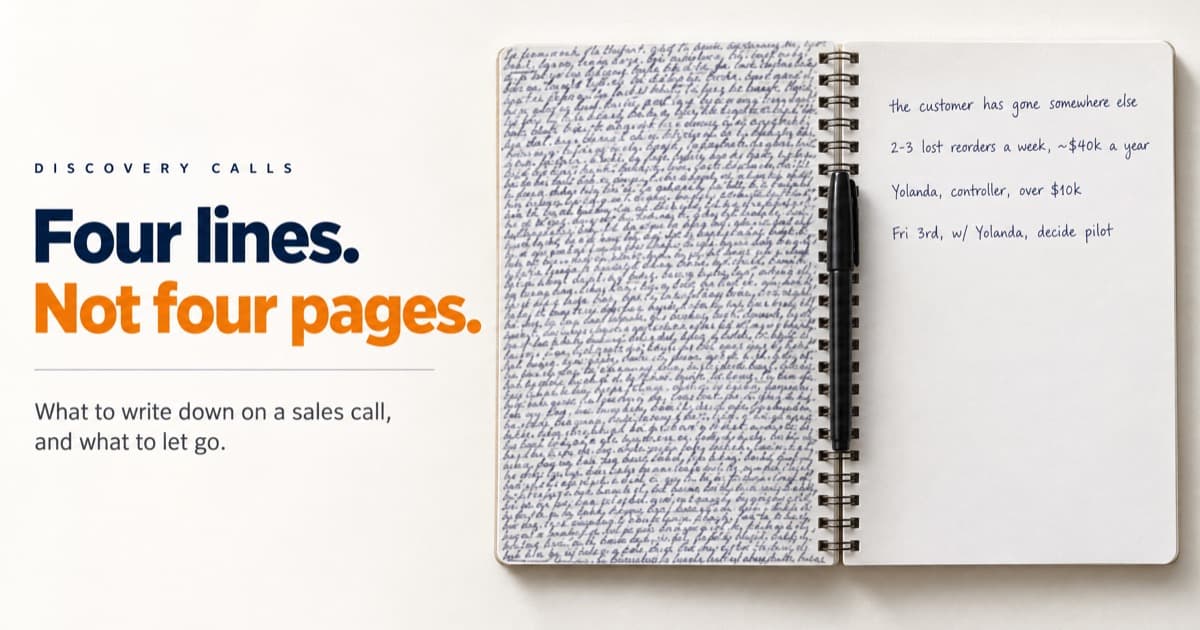
The page after this exchange holds four lines. "It's the reorders that kill us. By the time they call back the customer has gone somewhere else." 2 to 3 lost reorders a week, ~$40k a year, low estimate. 400m, 10 days, 2 planners, 10 min per check. Yolanda, controller, over $10k, will ask what it replaces.
Nothing about jet dye machines, because Rasmus will remember there is equipment and can ask later. Three of the four lines only exist because he did not interrupt the first answer, and the fourth arrived because he asked who else was in the room while he still had her attention. The follow-up to Yolanda writes itself, in Imelda's words and Imelda's numbers. That is the whole return on not writing much down, and it is the test the discovery call guide sets for the call as a whole.
The five lines that fit on one index card
A working format, small enough to keep to under pressure:
- The quote. One sentence in their words, in quotation marks.
- The numbers. Digits and a single word each.
- The people. Name, role, what they control.
- The next step. Date, who is on it, what it decides.
- The gap. One thing you should know and do not, written as the question you will ask next time.
Line five is the one people leave off, and it is why the second call starts well instead of starting over. What belongs there comes from noticing which of your discovery call questions got a short answer.
The gap between your notes and your CRM
These are two artifacts and merging them ruins both. Notes are for thinking; the CRM record is for whoever touches the account next. Typing into CRM fields live lets a reporting schema decide what you listen for, which is why so many opportunity records hold a clean pain statement and no quote.
Write the record within the hour, not during the call and not on Friday. Paste the quote verbatim, keep numbers as digits, and leave the gap line where a colleague will see it. "Loses them 2 to 3 orders a week, approx $40k a year, her estimate, unverified" beats a paragraph of confident summary, because the next person can tell how solid it is.
Notes that cause trouble later
Writing a conclusion instead of a quote. "They're frustrated with the incumbent" is your read. Six weeks later nobody can tell whether the buyer said it or you decided it.
Recording without asking properly. A rushed "you're okay with me recording this, right?" gets a yes and costs you the candor for the next ten minutes. Ask at the start, say what it is for, and offer to turn it off.
Letting the page decide the agenda. A rep who has written six lines goes looking for a seventh. Run the call from what they just said, not from what is missing on your sheet.
Over-capturing on a deal going nowhere. Long, detailed notes feel like diligence. They are usually a way to stay busy instead of asking the question that would end it.
Back to the sentence you nearly missed
Go back to the top of this page. "Somebody has to phone the mill and ask what's on the frame, and by the time they call back the customer has gone somewhere else." That sentence contains a workaround, a cost, a cause and an implied number, and it went by in nineteen seconds while a competent rep was writing down how many dye machines there were.
You have one of those on a recent call. Open your last set of notes, find the line that summarizes something the buyer said better, and try to write their actual words. If you cannot get close, that is the measurement: the page was busy, and the sentence is gone.
Practice this out loud
Run this conversation against a live AI buyer and get a scored review.
Start free, no cardPractice this callPractice this before it counts
ConvoSparr puts you in a live voice call with an AI buyer who pushes back like a real one. Every session ends with a transcript, scores, and coaching notes.
Free to start. No credit card required.