Four Things to Say When You Don't Know the Answer on a Sales Call
What to say when you don't know the answer on a sales call: name the gap, ask what's behind the question, set a date, and come back before it.
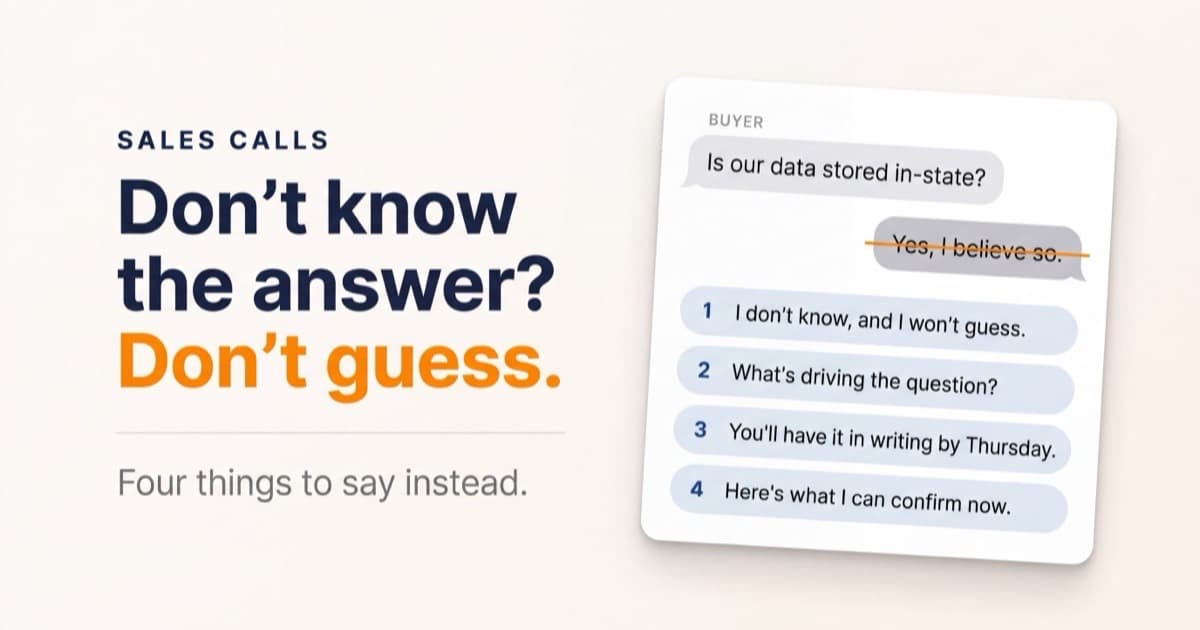
Gideon lost the Esterbrook deal in May, but the losing happened in March, in about four seconds. Ottoline, the district's director of technology, was forty minutes into evaluating Rollcover, the substitute teacher scheduling platform Gideon sells, when she asked whether the data was stored in-state. He had no idea. He said, "Yes, I believe so," because the call was going well and the question sounded like a formality.
It was not. Esterbrook's board had passed a residency policy for any system touching student records, and Rollcover's sub plans carry class rosters. In May the district's counsel found the hosting region in the security packet, and the deal went to a competitor whose answer had been, "I don't know. Let me find out by Friday."
So here is the answer to the title. When you don't know the answer on a sales call, say so in one plain sentence, ask what is driving the question, commit to a named person and a specific time for the real answer, and offer the part you do know, labeled as partial. Then deliver early. Buyers forgive a gap almost every time. They do not forgive a confident answer that turns out wrong, because it makes every other answer suspect.
Why a guess costs more than a gap
A guess feels cheaper because the cost is deferred. The call keeps its rhythm and you move on. The bill arrives later, at the worst stage, when the buyer has told their boss and is checking your claims against documents.
That asymmetry is the whole argument. An honest "I don't know" costs a small dip in perceived expertise, recovered the moment the follow-up lands. A wrong answer, once discovered, costs the claim itself plus a discount on every claim before it. Ottoline did not just reject Rollcover on residency. She told the committee she could no longer trust what the rep had said about uptime.
What should you say when you don't know the answer on a sales call?
Four lines, in this order. Each does a separate job.
1. Name the gap in one sentence. "I don't know that one, and I'd rather not guess on it." Keep it short; a long apology turns a routine gap into an event. The phrase "I'd rather not guess" matters: it tells them you understand the question has stakes.
2. Ask what is behind the question. "Can I ask what's driving it? Is that a policy you have to meet, or something you'd prefer?" Most reps skip this line, and it is the one that makes the follow-up useful. "Is the data in-state?" can mean a legal requirement, a board member's worry, or a template box nobody reads. Each needs a different answer, and sometimes the context shows the honest answer is fine even when the literal one is no.
3. Commit to a person and a time. "I'll get the answer from Saoirse, our solutions engineer, and have it to you in writing by Thursday at noon." A name makes it concrete; a day and hour make it checkable. "I'll circle back" is not a commitment; it is a way of ending the topic.
4. Offer what you do know, labeled as partial. "What I can tell you now is that we host in the US and we've passed two district security reviews this year. Whether that meets your policy is what I'm confirming." This keeps the call moving without sliding back into guessing. Partial information presented as partial builds trust; partial information presented as the answer is just a slower bluff.
Reading about it only gets you halfway.
Run this exact conversation out loud against a realistic AI buyer on ConvoSparr and get a scored review of how you handled it.
Sort the question before you promise anything
Not every unknown is the same kind, and the follow-up you promise should match what the buyer is really asking. Use this as a quick sort while they are still talking.
| Type of question | What the buyer is usually checking | Lead with | What to bring back |
|---|---|---|---|
| Compliance, security, data residency | Whether you clear a written requirement they cannot waive | Line 2 first: is it policy or preference? | A written answer citing the document they will check |
| Technical integration | Whether rollout lands on their team | Line 4: what you know works, then the gap | A short engineer-to-engineer call |
| Commercial exception (terms, payment schedule) | Whether you have any authority on this deal | Line 3, with the name of who approves it | A yes, a no, or a counter, with the reason |
| Roadmap or future feature | Whether they would be buying a promise | Line 1, and no dates you do not own | What ships now, and what is public about the rest |
| A claim a competitor made | Whether you will trash-talk or stay factual | Line 2: what exactly did they say? | A factual side-by-side on that one point |
Guesses do the most damage in the first row, because compliance answers get checked against documents. The last row is where reps most want to improvise, because the question feels like an attack. Both reward slowing down. If the question arrives wrapped in pushback, separate the two first; the brush-off vs objection test applies here too.
Nine minutes with Esterbrook Unified
Esterbrook Unified School District has about eleven thousand students across fourteen schools. Here is the March exchange, then the moment run on the four lines.
What Gideon said in March:
Ottoline: One thing before we go further. Is the data stored in-state?
Gideon: Yes, I believe so. We take data security really seriously.
Ottoline: Okay. Good. And that covers the sub plans too? They have rosters attached.
Gideon: Everything's in the same environment, so yes.
Ottoline: Great. Let's talk pricing, then.
Two problems, and neither is the word "believe." First, "we take data security really seriously" is a sentence buyers hear as a dodge, bolted onto a factual claim that needed no adjective. Second, Ottoline asked a follow-up, a clear signal the question mattered, and Gideon answered it with more confidence than the first. The call moved on cleanly and left a false statement in the evaluation notes, waiting for counsel.
What the four lines sound like:
Ottoline: One thing before we go further. Is the data stored in-state?
Gideon: I don't know that one, and I'd rather not guess on it. Can I ask what's driving it? Is that a requirement you have to meet, or a preference?
Ottoline: Requirement. The board passed a residency policy last fall for anything touching student records.
Gideon: That's helpful, because it changes what I need to check. Our sub plans can carry class rosters, so I'm assuming that brings us inside the policy. Is that right?
Ottoline: If there are student names in it, yes.
Gideon: Then here's what I'll do. I'll get the exact hosting region and whether rosters can be kept out of the sub plans entirely, from Saoirse, our solutions engineer, in writing by Thursday at noon. What I can tell you now is that we host in the US and we've been through two district security reviews this year. Whether that meets your policy is the part I'm confirming.
Ottoline: Thursday works. Copy our counsel, Philippa, on it. She'll be the one checking.
Gideon: Will do. Can you send me the policy text, so Saoirse answers the actual wording?
Line by line: the first sentence names the gap without ceremony. Asking what drives the question turns a yes-or-no into a requirement with a source, and the source tells Gideon the real issue may be the rosters rather than the servers, a second route to yes. The named engineer and the time give Ottoline something to write down. The labeled partial answer keeps the meeting from stalling. And asking for the policy text makes Thursday's answer land: Saoirse answers the wording counsel will use, not Gideon's paraphrase.
Notice what Ottoline volunteered once the honest version started: counsel's name, and the fact that counsel would check. In March she never mentioned Philippa, because nothing suggested the answer needed checking.
The follow-up is the second half of the answer
The four lines buy a few days of credit. The follow-up repays it or loses it with interest.
Send it before the deadline. Thursday at noon means Wednesday afternoon if you can; early delivery on a small promise is the cheapest proof you will keep the larger ones.
Write it to stand alone, because Philippa was not on the call. Restate the question in the buyer's words, answer it in the first line, cite the document behind it, then add context. If the answer is no, say no first and put the workaround second. A buried no reads as a hidden one.
Then close the loop out loud. Open the next meeting with one sentence: "You asked about residency. Saoirse sent the answer Wednesday; did Philippa have what she needed?" That turns a gap into a demonstrated habit, which is worth more than having known the answer. The objection handling guide treats hard questions as objections for this reason: the second touch decides whether the first counted.
Ways an honest "I don't know" still loses the room
Saying it too often on basics. One gap on a niche compliance point is credible. Three gaps on how your own product works is a preparation problem. If a question stumps you twice, it belongs in your prep.
Apologizing at length. "I'm so sorry, I really should know this" turns a routine gap into a confession. One sentence, then line two.
Promising a date you don't control. If the answer depends on legal or engineering, check their turnaround first. Missing your own deadline costs more than naming a later one.
Letting the partial answer drift into a full one. If you hear yourself sliding from "what I can tell you now" into "so you should be fine," stop. That slide is how Gideon's March answer happened.
Back to the board meeting in May
Esterbrook's board did not reject Rollcover because the data sat outside the state. Rosters could be stripped from sub plans with a setting, and the winning competitor had the same hosting situation and said so. The board rejected Rollcover because counsel found a confident answer in the notes that contradicted the vendor's own security packet, and after one wrong answer none were safe to rely on.
The four seconds in March were the whole deal. Gideon had everything he needed to win it: the question, a follow-up that signaled it mattered, and an engineer who could have answered by Thursday. What he was missing was a sentence ready to say when he didn't know, so that the easier one did not come out first. Esterbrook's competitor had that sentence, and it took them about four seconds too.
Practice this out loud
Run this conversation against a live AI buyer and get a scored review.
Start free, no cardPractice this callPractice this before it counts
ConvoSparr puts you in a live voice call with an AI buyer who pushes back like a real one. Every session ends with a transcript, scores, and coaching notes.
Free to start. No credit card required.