How to Tell a Customer About a Price Increase Before the Invoice Does
How to tell a customer about a price increase: say it on a call, weeks before the invoice. Customers leave over the surprise more often than the number.
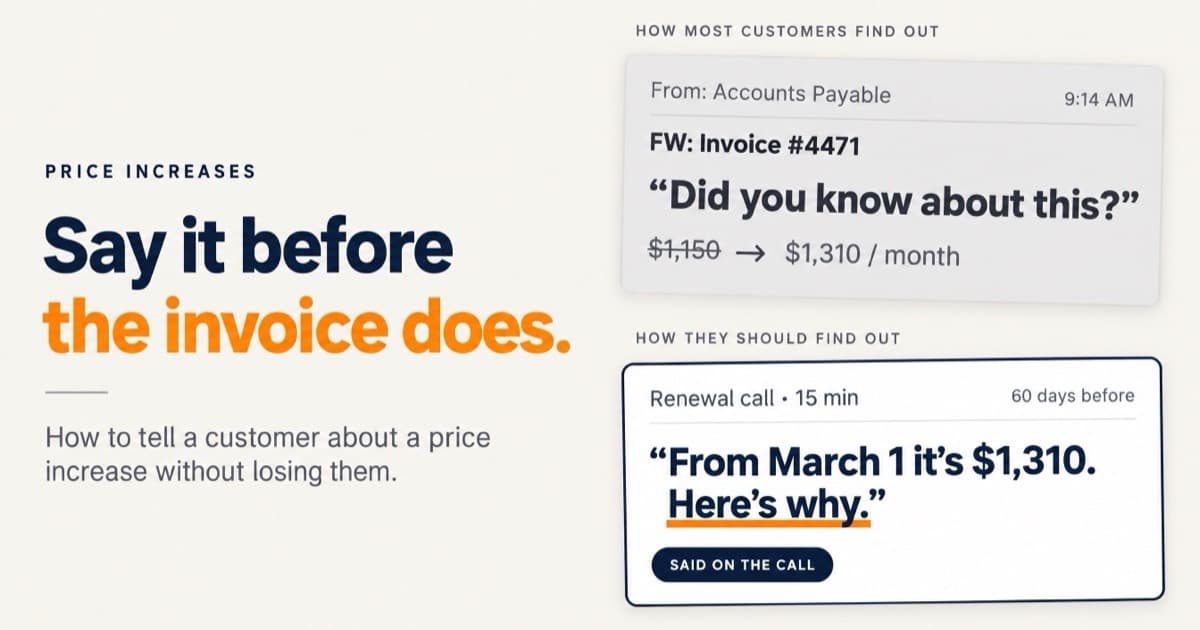
The first person to see a price increase on an invoice is almost never the person who chose you. It is someone in accounts payable, matching a number against last year's purchase order. When the two numbers disagree, that person does not call you. They forward the invoice to the buyer with one line on top, "Did you know about this?", and the buyer reads your price increase for the first time as a question from their own finance team.
From there, the buyer is defending a decision they were never told about, and your reason, however good, arrives second, in a reply to a complaint.
So here is the answer to the title. To tell a customer about a price increase, say the new number yourself, on a live call with the person who owns the relationship, at least sixty days before it takes effect. Give one honest reason in one sentence, state the date, and stop talking long enough for them to react. Put it in writing the same day, after the call, never instead of it. Do not open with a discount and do not apologize for the number; both tell the customer the price is still open, and most of the time it should not be.
Why the invoice is the worst messenger for a price increase
An invoice cannot explain anything. It carries a number and a date, and it lands in a queue where nobody has context. A renewal notice email is only slightly better: it reaches the right inbox, but it reads as a policy, and a policy invites a policy response. Procurement replies, someone asks for a call "to discuss," and you are now negotiating a number you meant to announce.
There is a second cost. A customer who hears about an increase from paperwork assumes you hoped they would not notice. A customer who hears it from you, early and plainly, assumes you respect them enough to say it out loud. The number is identical. The relationship it lands in is not.
The call is not there to soften the increase. It makes sure the first version the customer hears is yours, with the reason attached, while they can still plan.
How do you tell a customer about a price increase on a call?
Five moves, in order, in under two minutes of your talking.
1. Book the call for this purpose, and say so. "I'd like fifteen minutes this week to walk you through your renewal pricing before anything goes out in writing." Hiding the topic behind a "quick check-in" makes the reveal feel like an ambush.
2. Say the number in the first minute. Old price, new price, effective date. "Your plan is $1,150 per location a month today. From March 1 it will be $1,310." Reps who build up to the number with three minutes of context make the customer sit through a speech they know is a setup.
3. Give one reason, and make it true. "We've added a second support shift so your front desk gets an answer on weekends, and that is what the increase pays for." One reason the customer can repeat to their own finance team beats four reasons that sound like a list prepared to win an argument.
4. Stop. This is the move most reps skip. Silence after a price is uncomfortable, and the instinct is to fill it with reassurance or, worse, an early concession. Let the customer speak first. Their first sentence tells you whether you have a question, a budget problem or a real objection.
5. Name what happens next. "You'll get the written notice from me tomorrow, and I'm happy to go through it with your finance lead if that helps." The customer leaves the call knowing exactly what will arrive and when.
Reading about it only gets you halfway.
Run this exact conversation out loud against a realistic AI buyer on ConvoSparr and get a scored review of how you handled it.
Email, call or meeting: which channel fits which customer?
The size of the increase and the depth of the relationship decide how much effort the announcement deserves. Use this as a starting point, not a rule.
| Customer situation | Channel | Lead time | What the message must contain |
|---|---|---|---|
| Small account, increase under 5 percent, no recent issues | Personal email from the account owner, not a system notice | 45 to 60 days | Old price, new price, date, one reason, a reply-to that reaches a person |
| Mid-size account, or any increase over 5 percent | Phone or video call, then a written summary the same day | 60 to 90 days | The number in the first minute, one reason, the date, what arrives in writing |
| Strategic account, multi-year history, or an increase over 15 percent | Scheduled meeting with the buyer and, ideally, their budget owner | 90 days or more, ahead of their budget cycle | The above, plus what changed in the product or service and any term options you can stand behind |
| Account with an open complaint or a recent outage | Call, after the open issue is resolved or has a dated fix | As early as the fix allows | Acknowledge the issue first, separately, then the pricing; never bundle them in one breath |
The last row matters most: an increase announced to a customer still waiting on a fix reads as charging more for less.
Soledad, Cragline and a 14 percent renewal
Ruairi is the account manager at Belayboard, a booking and membership platform for climbing gyms. His customer, Cragline Climbing, runs four gyms, and Soledad, their operations director, chose Belayboard three years ago. Cragline's plan goes from $1,150 to $1,310 per location per month on March 1, an increase of about 14 percent, or $7,680 a year across the four sites. Ruairi called her on January 2.
Ruairi's first attempt, the one he rehearsed and threw out:
Ruairi: Hey Soledad, happy new year! Just wanted to touch base quickly. So, as you probably know, costs have gone up across the board for everyone, and we've been investing a ton in the platform, new features, more support, infrastructure, all of that. And we really value Cragline as a partner, you've been with us a long time.
Soledad: Okay...
Ruairi: So we are making some adjustments to pricing starting in March. It's going to be a bit higher, around fourteen percent, but honestly, if that's a problem, I can talk to my manager and see if there's some flexibility for long-standing customers like you.
What went wrong: The call opens disguised as a catch-up, so Soledad is braced by the time the topic surfaces. Ruairi spends forty seconds on generic reasons ("costs have gone up for everyone") before the number, and she cannot repeat any of them to her finance lead. Then he offers flexibility before she has said a word. He has turned an announcement into a negotiation and told her the opening price is not the real one.
Ruairi's second attempt, the call he made:
Ruairi: Soledad, thanks for the fifteen minutes. As I said in my note, this is about your renewal pricing, and I wanted you to hear it from me before anything arrives in writing. Today you pay $1,150 per location a month. From March 1, it will be $1,310.
Soledad: That's a jump.
Ruairi: It is, about 14 percent. The reason is the weekend support shift we added in September. Your Saturday desk staff were waiting until Monday for answers on failed card payments, and now they get one within the hour.
Soledad: We did notice that. I still have to take this to Haruto, and he'll ask why we didn't get more warning.
Ruairi: That's fair, and it's why I'm calling now rather than in February. You have eight weeks. I'll send the written notice tomorrow with the old and new figures and the date, and I'm glad to join a call with Haruto if it's easier to hear it directly.
Why it works: The purpose was stated when the call was booked, so nothing is sprung. The number arrives in the second sentence, with the date. The reason is one concrete thing Soledad has already seen in her own gyms, so she can defend it in a sentence. When she pushes ("That's a jump"), Ruairi agrees with the fact instead of retreating from the price. When she raises her real concern, which is how this looks to Haruto, her finance lead, he answers that concern directly with the lead time and an offer to join the conversation. Nothing in the call invites a discount.
When the customer asks you to hold the old price
Sometimes the customer asks anyway: "Can you keep us at the current rate for another year?" That request is not a rejection of the increase. It is a test of whether the number is firm.
Decide before the call what, if anything, you can trade. A longer term, an earlier signature or a prepayment can each justify a smaller increase, because each gives you something real. A smaller increase for nothing teaches the customer that asking works. If you have nothing to trade, say so plainly: "I can't hold the old rate. What I can do is lock $1,310 for two years if you renew by February 1." For how to handle the request when it turns into a full negotiation, the price negotiation guide covers the trade structure, and responding to discount requests covers the first reply.
If the customer says they will leave over the increase, ask what they would move to and when. Whether a specific account is worth keeping at the old number is the question covered in when to walk away from a deal.
A pre-call checklist for the next increase you announce
Before you dial, you should be able to tick every line:
- The call is booked and the invite says it is about renewal pricing.
- You can say the old price, the new price and the effective date in one breath.
- You have one reason the customer could repeat to their finance team, and it is true.
- You know whether you will trade anything, and exactly what you would get for it.
- Any open complaint on the account is fixed or has a dated fix, and you will mention it first.
- The written notice is drafted and goes out within a day of the call, not before it.
- You have said the first two minutes out loud at least once, including the silence after the number.
The last line is the one people skip, and it is the one that fails on the day. Knowing you should stop talking after the price is easy. Stopping, while the customer says nothing, is a skill, and it improves with rehearsal against someone who pushes back.
Practice this out loud
Run this conversation against a live AI buyer and get a scored review.
Start free, no cardPractice this callPractice this before it counts
ConvoSparr puts you in a live voice call with an AI buyer who pushes back like a real one. Every session ends with a transcript, scores, and coaching notes.
Free to start. No credit card required.
Keep reading
All articles