Signing Bonus vs Base Salary: Negotiation Lines for When the Base Won't Move
Signing bonus negotiation when base is capped: price what you forfeit, then ask, 'Can a signing bonus cover the March bonus I walk away from?'
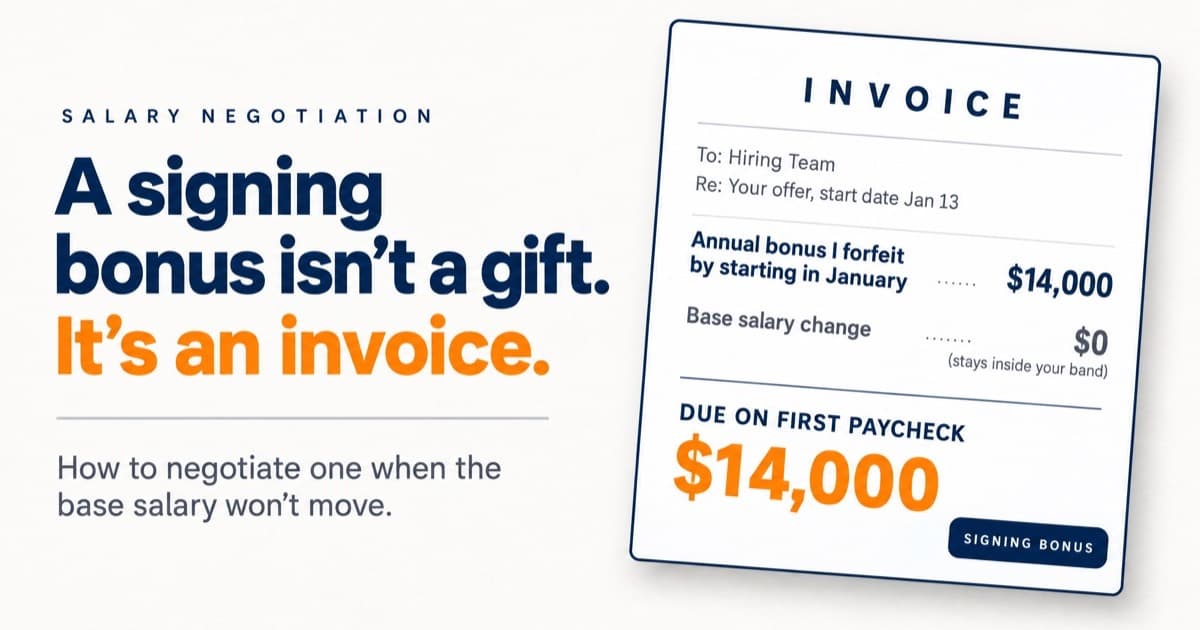
A signing bonus is usually described as a welcome gift. That description gets the money wrong. In most offers a signing bonus is a refund: the hiring company paying you back for something you lose by leaving your current job on their schedule. Read it that way and the whole negotiation changes shape, because you stop asking for a favor and start presenting an invoice.
It matters most at one moment: the recruiter has told you the base is at the top of the band. Most candidates either accept or push on base anyway, spending goodwill on a number the recruiter cannot change.
So here is the answer, before the detail. When the base is capped, ask for a signing bonus sized to a specific, nameable loss: a bonus you forfeit, unvested equity, a retention payment you would have to repay, or the gap between the base you wanted and the base they can do. Name the loss, name the figure, and ask whether a one-time payment can cover it. A signing bonus comes out of a different budget than base salary, it is approved by different people, and it is the easiest yes left in the offer once the base has stopped moving.
Why a signing bonus is the easiest yes in the offer
Base salary is a forever cost. Every dollar of base gets paid again every year you stay, it raises the floor for every future merit increase, and in many companies it sets your bonus target as a percentage. A compensation team approving base is approving a commitment that compounds, which is why bands exist and why the top of a band is guarded.
A signing bonus is a one-time cost. It is usually paid from a hiring or recruiting budget rather than the salary budget, it does not touch the band, and it creates no precedent for the next person hired into the same role. A recruiter who cannot get 4,000 more in base approved can often get 10,000 in one-time money approved the same afternoon, because the people signing off are weighing a single payment against the cost of losing a candidate and reopening the search.
That asymmetry is the whole strategy: move your ask from the budget that says no to the budget that can say yes. The salary negotiation guide covers the full sequence of an offer conversation; this page is the narrow version where base has stopped moving and you still have a real cost to recover.
Signing bonus vs base salary: what each one is worth over four years
The trade is not even, and pretending it is costs people money. If base can genuinely move, it is almost always worth more than an equal signing bonus. The signing bonus wins only when base cannot move, or when it covers a cost that lands in your first year.
| Question | 10,000 more in base | 10,000 signing bonus |
|---|---|---|
| Paid over four years | 40,000, before any raises | 10,000, once |
| Effect on future raises | Every percentage raise is calculated on the higher number | None |
| Effect on a bonus target set as a percentage of base | Raises it every year | None |
| Who approves it | Compensation, against the band | Often the recruiter's or hiring manager's budget |
| Usual strings | None | A clawback if you leave inside 12 to 24 months |
| When it is the right ask | Whenever base still has room | When base is capped, or a cost lands in year one |
A candidate who swaps 10,000 of achievable base for a 15,000 signing bonus has made a bad trade by the end of year two. Reach for the signing bonus after base is closed, not instead of asking.
Reading about it only gets you halfway.
Run this exact conversation out loud against a realistic AI buyer on ConvoSparr and get a scored review of how you handled it.
How much signing bonus should you ask for?
Ask for the cost you can name, rounded up slightly, and say what it covers. A figure with a reason attached survives being forwarded to a person you will never speak to. A figure without one gets cut in half on the way, because nobody can defend it.
Three costs justify a signing bonus, roughly in order of how easily they are approved.
A bonus you forfeit by leaving. If your current employer pays an annual bonus in March and you would start in January, that bonus is gone. This is the cleanest case, because it has a date and a figure and nobody can call it greedy.
Unvested equity or a retention payment you repay. If leaving means walking away from a vest next quarter, or repaying a retention bonus, the hiring company has seen this before. Bring the number and the date.
The gap to the base you wanted. If you wanted 135,000 and the band stops at 130,000, a first-year signing bonus of 5,000 closes the gap for year one. Be honest that this is a one-year fix; it does not change year two.
Then sanity-check the size. An ask of 14,000 against a 128,000 base, tied to a named forfeited bonus, is ordinary. An ask of 40,000 with no stated reason is a different conversation.
Femi's offer call with Kelderwyn Orthopedics
Femi is a senior quality engineer at a contract manufacturer, interviewing for a quality lead role at Kelderwyn Orthopedics, a mid-sized maker of knee and hip implant instruments. Annelise, the recruiter, calls with the offer: base of 128,000, which she says is two thousand under the band maximum. Femi's current employer pays an annual bonus every March, last year 14,000. The proposed start date is mid-January.
Asking for "something on top":
Annelise: So the base is 128, and I'll be honest with you, the band for this level tops out at 130. There isn't much room.
Femi: Understood. It's a bit lower than I'd hoped for. Is there anything else you could do? Maybe some kind of signing bonus?
Annelise: I can ask. What were you thinking?
Femi: I don't know, whatever's normal? Maybe ten?
Annelise: I'll see what I can do. No promises.
Femi asked for the right thing and gave Annelise nothing to carry. "Lower than I'd hoped" reopens the base argument the recruiter has just closed. "Whatever's normal" invites the smallest standard figure. "Maybe ten" is a guess with a question mark on it, and the March bonus, the one fact that would have made the request easy to approve, never came up. Annelise now has to justify an unexplained 10,000 to a hiring manager, and the likeliest outcome is 5,000.
Pricing the forfeited bonus:
Annelise: So the base is 128, and I'll be honest with you, the band for this level tops out at 130. There isn't much room.
Femi: That's helpful, thank you. I'm not going to push you on base if the band is where it is. There is one cost I want to put in front of you. My current employer pays an annual bonus in March. Last year it was 14,000. If I start in January, I walk away from it.
Annelise: Okay. That's useful to know.
Femi: Could a signing bonus of 14,000 cover it? That keeps the base inside the band, and it makes the January start work for me without waiting until April.
Annelise: I think that's a reasonable thing to take back. Can you send me something showing last year's figure?
Femi: I'll send last year's bonus statement today. And one detail for the letter: if there's a clawback, could it be prorated over twelve months rather than all-or-nothing?
Annelise: I'll ask for both. The proration is usually fine.
The second version is not tougher. It is easier to say yes to. Femi agreed with the band out loud, so Annelise knows this will not become a fight over a number she cannot move. She named a real loss with a date and a figure and attached it to something the company wants, a January start. And she raised the clawback while goodwill was high, instead of discovering it in the signed letter. Annelise can now forward one sentence to the hiring manager: "She forfeits a 14,000 March bonus to start in January; the base stays at 128."
The salary negotiation scripts page drills lines like these, the phone negotiation guide covers holding them live, and the top-of-the-band scenario runs this exact moment against a counterpart who pushes back.
Clawbacks, payout timing and the line in the offer letter
A signing bonus you have to repay in full if you leave on day 364 is worth less than it looks. Before you accept, find three things in the letter.
The clawback period and shape. Twelve months is common, twenty-four is not unusual. A prorated clawback, where you repay only the unearned share, is a fair and frequently granted ask. All-or-nothing on a 24-month term is the version to push back on.
When it is paid. First paycheck, after 30 days, or after 90 days. If the bonus is covering a cost you incur in January, a payment in April leaves you carrying it. Ask for the first paycheck.
How it is withheld. In the US, a signing bonus is often withheld at a flat supplemental rate, so the deposit looks smaller than the letter. That is withholding, not your final tax bill; it is taxed as ordinary income in the end.
Four habits that shrink the bonus before it is offered
Asking with a question mark. "Maybe ten?" sounds like a guess, and guesses get discounted. State the figure and what it covers.
Re-arguing the base first. Contesting a band the recruiter has already named spends the goodwill you need for the one-time ask.
Hiding the reason. A forfeited bonus is the strongest case you have. Keeping it private turns an easy approval into a hard one.
Trading achievable base for one-time cash. If base can still move, ask about base first. The four-year table above is the reason.
The sentence to rehearse before the call
The whole negotiation hangs on one sentence said early and calmly: the loss, the figure, and the ask, in that order. For Femi it was "I walk away from a 14,000 March bonus if I start in January; could a signing bonus cover it?" Yours will have a different loss and a different number, but the shape holds.
Say your version out loud before the call, three times, until it comes out without an apology attached. Then say it to someone, or to a practice counterpart, who answers the way recruiters do: "What were you thinking?" The first time you hear that question should not be the time it costs you money.
Practice this out loud
Run this conversation against a live AI buyer and get a scored review.
Start free, no cardPractice this callPractice this before it counts
ConvoSparr puts you in a live voice call with an AI buyer who pushes back like a real one. Every session ends with a transcript, scores, and coaching notes.
Free to start. No credit card required.
Keep reading
All articles