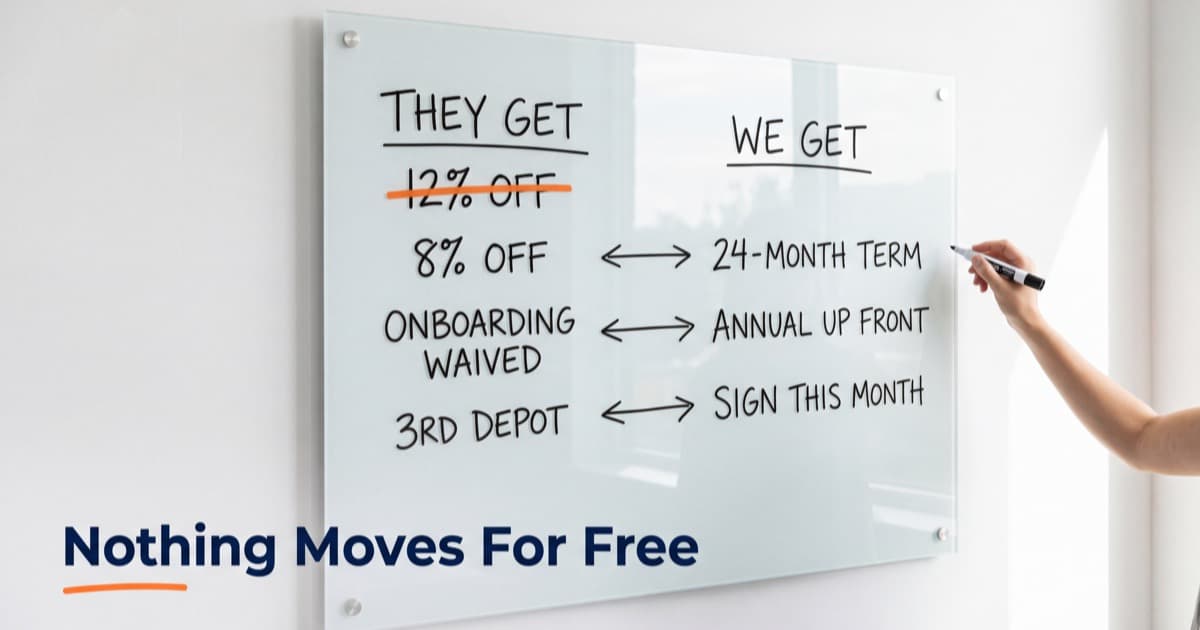
Two Days From Signature, the Buyer Threatens to Walk Away From the Deal
When a buyer threatens to walk away from the deal, matching a 15% cheaper quote on a $186,000 renewal costs you $84,000 over three years.
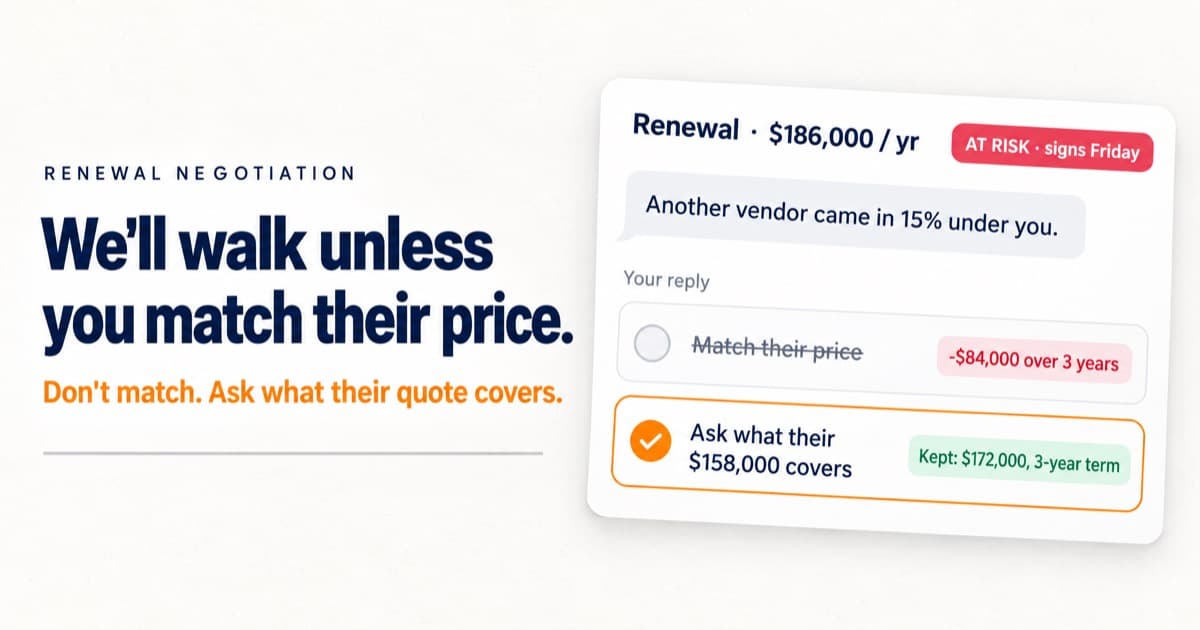
You are two days from signature. The renewal is in your forecast, legal has the redlines back, and your manager has stopped asking about it. Then the buyer calls, sounds tired rather than angry, and says it plainly: "Another vendor came in fifteen percent under you. If you can't get there by Friday, we're going with them." Your stomach drops, and the first sentence that forms in your head is "Let me see what I can do."
That sentence is the most expensive thing you can say on the call. It tells the buyer the threat worked before you know what the threat is.
So here is the answer to the title. When a buyer threatens to walk away from the deal, do not concede and do not argue. Acknowledge the threat calmly, then ask one question that tells you which kind of threat it is: a leverage play, a real cheaper alternative, an unsolved problem, or a budget mandate from above. Each kind needs a different reply. If you move on price at all, move only in exchange for something real, such as a longer term, a smaller scope or an earlier signature, and say out loud what the buyer gives up for the lower number.
Is the buyer bluffing, or are they really about to walk away?
Most of the time you cannot tell from the words, because a bluff and a real exit sound identical in the first sentence. What separates them is detail. A buyer who is truly leaving has done work: they have a named vendor, a quote with a scope on it, a date, and usually an internal person who has already said yes to the switch. A buyer using the threat as leverage has a percentage and a deadline and very little else.
So the first job is not to respond to the threat. It is to collect detail without sounding like you are calling a bluff. "Help me understand what they quoted" is a fair question to ask any buyer. "Are you serious?" is not, and it forces them to defend the threat, which makes it more real than it was a minute ago.
There is a second signal worth listening for: who else is on the call. A threat delivered alone by your day-to-day contact is often a message they were told to send. A threat delivered with their finance lead in the room is usually a decision already half made.
Four walk-away threats and what each one protects
Every walk-away threat is protecting something. Find out what, and the right reply usually becomes obvious.
| Kind of threat | What you hear | What the buyer is protecting | Your first move |
|---|---|---|---|
| Leverage play | A percentage and a deadline, no named vendor, no quote to share | Their own review: they want to show their boss they pushed | Hold the price, offer a trade they can report upward as a win |
| Real cheaper alternative | A named vendor, a written quote, a start date | Budget, and the fear of overpaying in public | Compare scope line by line before you discuss any number |
| Unsolved problem | Price talk that keeps drifting back to a missed visit or a bad month | Their credibility with the people who complained to them | Fix or put a date on the problem first, then talk renewal |
| Budget mandate | "Finance told every department to cut 15 percent" | Their job: the cut is not optional for them | Restructure scope or term to meet their number without discounting the same scope |
The mistake most reps make is treating all four as the second row. They hear "cheaper" and start defending price, when the buyer may be protecting something a discount does not touch.
Reading about it only gets you halfway.
Run this exact conversation out loud against a realistic AI buyer on ConvoSparr and get a scored review of how you handled it.
The three-part reply when a buyer threatens to walk away
Whatever kind of threat it turns out to be, your reply on the call has the same three parts, in this order.
First, acknowledge without flinching. "That's a real gap, and I'm glad you told me before Friday instead of after." It shows you are not panicking, and it agrees to nothing.
Second, ask the sorting question. For a named competitor: "Can you walk me through what their quote covers?" When no competitor is named: "What would have to be true for you to stay with us?" Then be quiet. The answer tells you which row of the table you are in.
Third, name what can move and what it costs. Never offer a lower number for the same deal. Offer a different deal: "I can get closer to that number on a three-year term," or "If we drop the overnight emergency coverage, the price comes down by about that much." Make the buyer choose what to give up. That choice is the difference between a negotiation and a retreat.
For the general mechanics of trading rather than conceding, the price negotiation guide covers the full trade structure, and responding to discount requests covers the first reply to a softer ask.
Corinna, Saltmarrow and the Friday deadline
Bertil is the account executive at Hobcrest Kitchen Service, which maintains and repairs commercial kitchen equipment (walk-in coolers, fryers, combination ovens) for restaurant groups. Saltmarrow Hospitality runs 14 restaurants and pays Hobcrest $186,000 a year. The contract expires Sunday. On Wednesday afternoon, Corinna, Saltmarrow's vice president of operations, calls him.
The reply Bertil nearly gave, in his head on the drive back:
Corinna: Quenchline came in at $158,000. That's fifteen percent under you. If you can't get close by Friday, we sign with them Monday.
Bertil: Wow, okay. I really don't want to lose you, you've been a great partner. Let me talk to my director tonight. I'm pretty sure we can match that, or at least get very close.
Corinna: Okay. Let me know by tomorrow.
Why it fails: Bertil never learned which kind of threat this was. He offered to match a quote he had not seen, for a scope he did not know, before Corinna had asked for a match. Even if it works, it costs Hobcrest $28,000 a year ($84,000 over three years) and teaches Saltmarrow that a phone call two days before signature is worth $28,000. They will make the same call at the next renewal.
The reply Bertil gave on the call:
Corinna: Quenchline came in at $158,000. That's fifteen percent under you. If you can't get close by Friday, we sign with them Monday.
Bertil: That's a real gap, and I'm glad you called today instead of Monday. Can you walk me through what their $158,000 covers? I want to compare it fairly, not guess.
Corinna: Preventive maintenance on everything, quarterly. Emergency calls during business hours.
Bertil: Business hours meaning what, roughly?
Corinna: Seven to seven, I think. Why?
Bertil: Because about a third of your emergency calls with us last year came after 9 p.m., mostly walk-in coolers failing after close. The one at your harbor location in July was a Saturday night. If that happens under a seven-to-seven contract, it's an after-hours rate or a morning wait with a full cooler.
Corinna: I hadn't looked at it that way. But I still have a number from my CFO, and it isn't $186,000.
Bertil: Understood. Two options I can put in writing today. One: keep overnight coverage at $172,000 a year on a three-year term. Two: match their scope, business-hours emergencies only, at $163,000 on your current one-year term. You'd be choosing between overnight coverage and the lowest number. Which one is easier for you to defend to your CFO?
Corinna: Send me both. The three-year one is probably the one he'll like.
Why it works: Bertil's first line acknowledges the gap without conceding, and his second asks the sorting question. Corinna's answer reveals two things: the cheaper quote has a smaller scope, and the real pressure is a number from her CFO, so this is partly a real alternative and partly a budget mandate. He does not argue that Quenchline is worse. He uses Saltmarrow's own service history to show what the lower number leaves out, which Corinna can repeat to her CFO. Then he offers two different deals instead of one smaller price, and each costs Saltmarrow something real: a longer commitment, or overnight coverage. The best-case result is $172,000 for three years, a $14,000 annual reduction that bought Hobcrest two more years of certainty. That is a trade, not a rescue.
Concessions that keep the logo and lose the account
Some ways of surviving a walk-away threat cost more than losing the deal would have. Watch for these:
- Matching blind. Agreeing to a competitor's number before seeing their scope means you may be discounting your full service to the price of a smaller one.
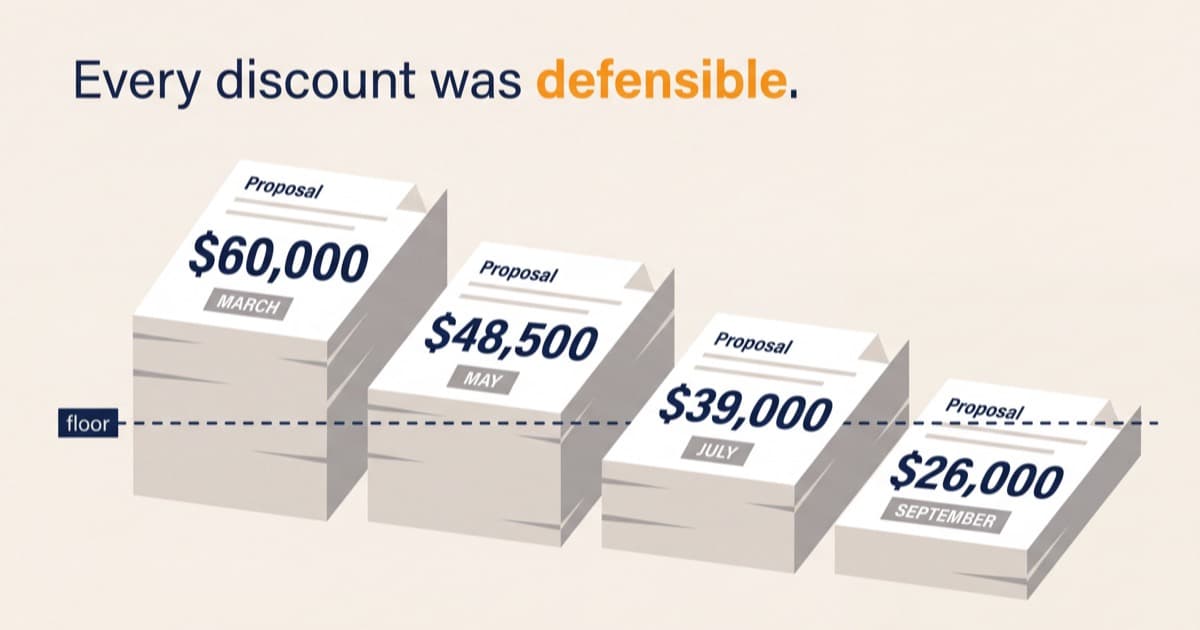
- Discounting the same scope for nothing. If the buyer gives nothing in return, the new price becomes the floor for every future negotiation with them.
- Escalating straight to your boss. "Let me talk to my director" signals the decision is above you, so the buyer stops negotiating with you and waits for the bigger concession.
- Ignoring the unsolved problem. If the threat is really about a bad month of service, a discount without a fix just means you lose the account a year later at a lower price.
Sometimes the right answer is to let the account go. If their number is below your cost to serve, or the buyer has already decided and is using you to pressure the other vendor, holding firm is better business. When to walk away from a deal covers how to make that decision while you still have a choice. And if the threat came on a first sale rather than a renewal, the your competitor is cheaper scenario walks through that version of the conversation.
One warning before you match the number
A walk-away threat that works once becomes a habit. The buyer who got $28,000 by calling two days before signature will call two days before the next signature, and their next vendor shortlist will include you only as the price to beat. The concession you make on Wednesday sets the opening position for every renewal after it.
So before you say "let me see what I can do," be sure you know what you are being asked to save. If you cannot name the kind of threat, what the cheaper quote leaves out, and what the buyer gives up for a lower number, you are not negotiating yet. You are just paying to make the call end sooner.
Practice this out loud
Run this conversation against a live AI buyer and get a scored review.
Start free, no cardPractice this callPractice this before it counts
ConvoSparr puts you in a live voice call with an AI buyer who pushes back like a real one. Every session ends with a transcript, scores, and coaching notes.
Free to start. No credit card required.
Keep reading
All articles