Decline a Job Offer Politely: Why a Five-Minute Call Beats the Email
How to decline a job offer politely: call before you email, say no in the first two sentences, give one true reason, and leave a door you can walk back through.

Two years ago, Zinnia turned down an offer from a logistics software company with a two-line email: "Thank you for the offer. After careful consideration, I have decided to pursue another opportunity." It took her four seconds to send, after six weeks of interviews. Eighteen months later the job she had really wanted at that company opened up, a team lead role, and she applied. The recruiter who had made her the first offer was still there. Zinnia never got a screen, and nobody had to explain why: the last thing that company had of her was those two lines.
The answer, before the detail. To decline a job offer politely, call the person who made the offer before you send anything in writing, ideally within a day of deciding. Thank them for something specific, state the decision in your first two sentences so it cannot be mistaken for a bargaining move, give one short and true reason if you want to, and close by naming how you would like to stay in touch. Then send a brief email that confirms what you said. The call takes about five minutes, and it decides whether you become a closed file or a warm name.
Should you decline a job offer by phone or by email?
Both, in that order. The call carries the courtesy and the email carries the record. An email alone is not rude, but it is the version that gets forgotten, and the people who interviewed you for six weeks rarely see it at all: the recruiter forwards one line to the hiring manager and closes the requisition.
| Email only | Call, then a confirming email | |
|---|---|---|
| Time it takes you | About two minutes | About five minutes, plus two for the email |
| What the hiring manager hears | A forwarded line: "Candidate declined" | Your thanks, in your words, passed on by someone who heard your voice |
| What goes in the candidate file | "Declined, other opportunity" | "Declined, called us personally, open to future roles" |
| Risk it reads as a negotiation | Low, but a vague email invites a "what would it take?" reply | Low, if the decision is in your first two sentences |
| What you can ask for | Nothing, realistically | A name to stay in touch with, and a heads-up on a future role |
There are fair exceptions. If the whole process ran over email, if the recruiter has asked you to reply in writing, or if a company has pressured you hard enough that a call feels unsafe, a warm email is the right channel. Otherwise, pick up the phone. The same instinct runs through the salary negotiation guide: the important moments of an offer happen live, and writing confirms them.
The four parts of a decline call
A good decline call has four parts, and the order matters more than the wording. The decision comes second, not last, because everything before it is a preamble the other person spends trying to guess where you are going.
- Specific thanks. Name one real thing: a conversation, a site visit, the speed of the process. "Thank you for the process" is filler. "Thank you for walking me through the grow rooms" is a memory.
- The decision, early and in the past tense. "I've accepted another role" or "I've decided not to accept." Past tense tells them it is done. "I'm leaning toward" or "I'm not sure this is the right fit" tells them it is open.
- One true reason, or none. A short reason is generous ("the other role is closer to demand planning, which is where I want to grow"). You do not owe them the other company's name or salary, and naming a number turns your reason into an invitation to beat it.
- The door. Ask for something small and specific: to stay in touch with the hiring manager, or to hear about a role they mentioned. A door you name is far more likely to stay open than "let's keep in touch."
Say all four out loud before you dial. The decision sentence is the one that wobbles under pressure, and it is easier to keep steady once your mouth has produced it a few times.
Reading about it only gets you halfway.
Run this exact conversation out loud against a realistic AI buyer on ConvoSparr and get a scored review of how you handled it.
Gaspard's call to Canopyline Farms
Gaspard is a supply planner. He has two offers: one from Canopyline Farms, an indoor vertical farming company that grows leafy greens for regional grocery chains, at $84,000, and one from a food distributor at $92,000 with a path into demand planning. He has signed the distributor's offer. Wynona is the Canopyline recruiter, and Peregrine, the operations director, would have been his manager. Gaspard calls Wynona on Tuesday morning.
The version that sounds like a bargaining move:
Wynona: Gaspard, hi! Have you had a chance to think things over?
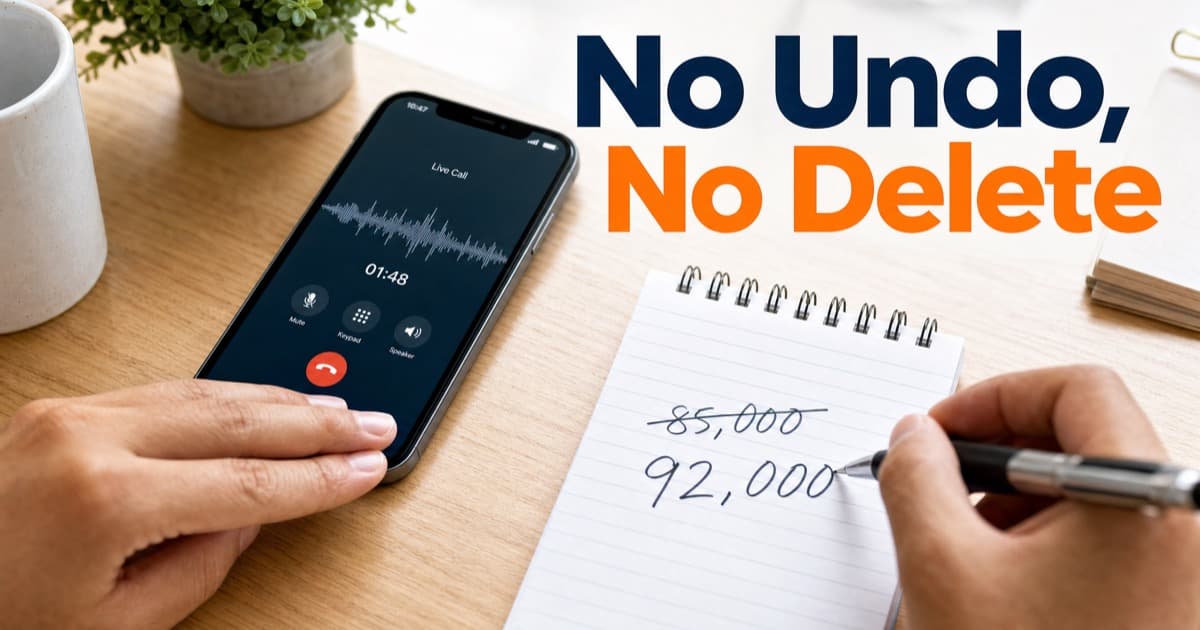
Gaspard: I have, yeah. So, honestly, I've been going back and forth. I really liked the team. It's just that the other offer I have is quite a bit higher, around 92, and I'm sort of leaning that way.
Wynona: I appreciate you telling me. Let me talk to Peregrine. If we could get closer to 90, would that change things?
Gaspard: Oh. Maybe? I'd have to think about it.
Wynona: Totally fair. I'll come back to you by Thursday.
Gaspard meant to decline, and Wynona heard a counter-request. "Going back and forth" and "leaning" say the decision is not made. The salary figure told her exactly what to beat. Now she spends two days getting an exception approved, Peregrine goes out on a limb for him, and on Thursday Gaspard has to say no anyway, after the company has made an effort. That second no costs far more goodwill than a clear first one would have. Worse, he has already signed elsewhere, so "I'd have to think about it" was not true.
The version that closes cleanly:
Wynona: Gaspard, hi! Have you had a chance to think things over?
Gaspard: I have, and I wanted to call rather than email. I've accepted another role, so I'm going to decline the Canopyline offer. I'm grateful for it, and especially for Peregrine walking me through the grow rooms. That was the best hour of the whole search.
Wynona: Oh, that's a shame. Can I ask what tipped it?
Gaspard: The other role moves me into demand planning sooner, which is the direction I want to go. It wasn't anything Canopyline did.
Wynona: Is there anything we could do that would change your mind?
Gaspard: I appreciate that, and no, I've signed. One thing I'd like, though: Peregrine mentioned a planning lead role opening next year. If it's still on the cards, I'd love to hear about it.
Wynona: I'll make a note of that and let Peregrine know you called.
The decision arrives in his second sentence, in the past tense, so Wynona never has to guess. The thanks is specific enough that she can pass it on word for word. His reason is about where he is going, not about what Canopyline lacks, and it carries no number, so there is nothing to counter. When she tries anyway, he answers in one line and moves straight to the door, naming the exact role Peregrine raised. The call takes under four minutes, and his file now says something a future recruiter will want to act on.
What if they counter after you say no?
Decide before you dial whether any number would change your answer. If none would, the line is short: "I appreciate that, and my decision is final." Say it once, warmly, and move to the door. Do not explain further, because every extra sentence reads as room.
If a number would change your answer, you are not declining, you are negotiating, and it is fairer to everyone to say so: "Before I decide, I want to be straight with you. The other offer is at 92. If Canopyline could match that, I'd take it seriously." That is a legitimate move while both offers are still open. It is not legitimate after you have signed elsewhere, and reneging on a signed acceptance to take a counter burns two companies at once.
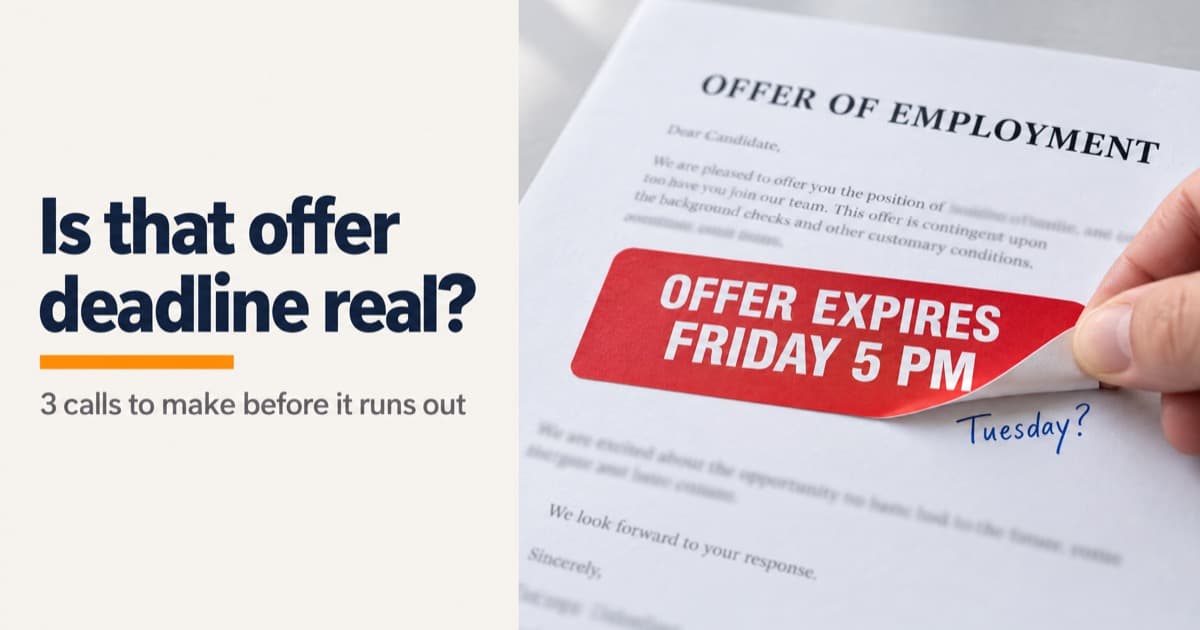
Timing matters here too. If one offer is about to expire while you wait on the other, the exploding offer deadline article covers the calls to make before you are forced into a choice, and negotiating a salary offer over the phone covers how to hold a number live once you do open a negotiation.
Five lines that burn the bridge
These are the phrases that turn a polite decline into a closed file. Each one sounds harmless when you say it.
- "I'm leaning toward the other offer." It is a decline that reads as an opening bid. Use the past tense, or say nothing yet.
- "They're paying a lot more." True, perhaps, but it invites a counter you will have to refuse, and it makes the whole process sound like an auction you ran.
- "I didn't really click with the team." Criticism lands on the people you would want to hire you later, and recruiters pass feedback on.
- "I'll keep you posted." If you have decided, this is a delay, and a delay with nothing behind it ends with you ghosting the deadline.
- Silence until the deadline lapses. Letting an offer expire without a word is the one decline that is never forgiven. A late, awkward call is still far better than none.
The confirmation email, word for word
Send it within an hour of the call, to the recruiter, and copy the hiring manager only if you dealt with them directly. Keep it short; the warmth already happened on the phone.
Subject: Canopyline offer, thank you
Hi Wynona,
Thanks for taking my call this morning. As I mentioned, I've accepted another role and won't be accepting the Supply Planner offer. Please pass my thanks to Peregrine for the grow room tour and the time the team gave me.
I'd be glad to stay in touch, especially about the planning lead role if it opens next year.
Best, Gaspard
Notice what is missing: no salary, no other company's name, no "after careful consideration," no apology. It confirms the decision, repeats the thanks and restates the door, so the written record matches the warm call that produced it.
If you have an offer to decline this week, make the call today, not the email. Before you dial, say the four parts out loud twice, and have your one-line answer to "is there anything we could do?" ready before anyone asks it. Then send the confirmation, and you will have turned a no into a name they remember.
Practice this out loud
Run this conversation against a live AI buyer and get a scored review.
Start free, no cardPractice this callPractice this before it counts
ConvoSparr puts you in a live voice call with an AI buyer who pushes back like a real one. Every session ends with a transcript, scores, and coaching notes.
Free to start. No credit card required.
Keep reading
All articles