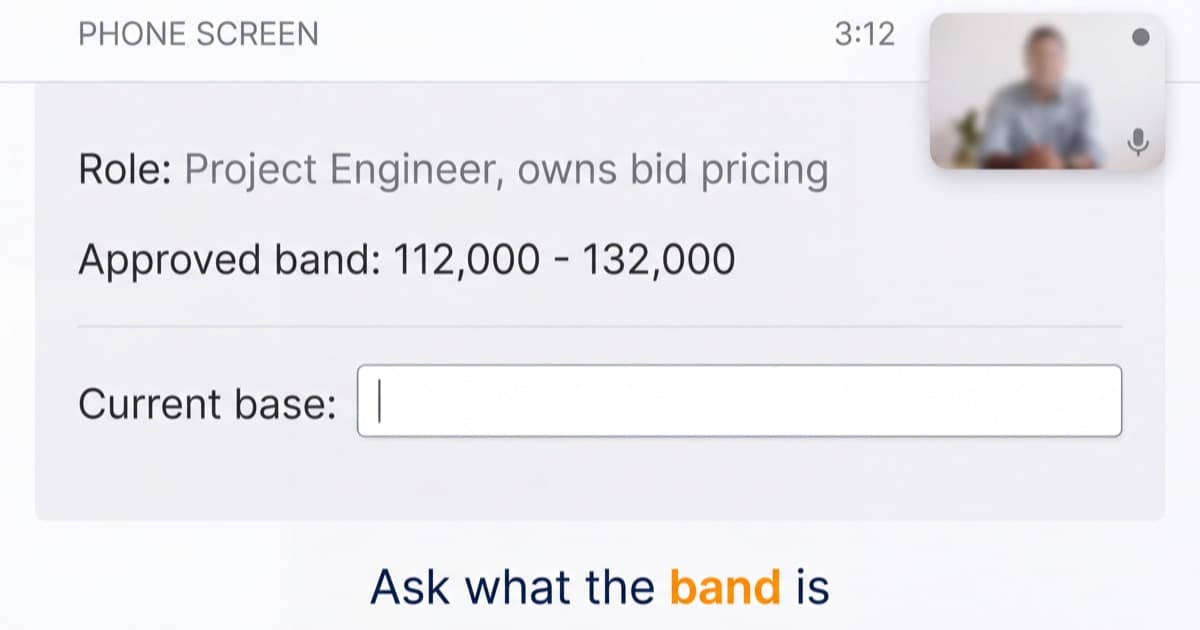
How to Get a Number When the Recruiter Will Not Give the Salary Range
When a recruiter will not give the salary range, the refusal is usually a script, not a policy. Four trades get you the band without naming your number.
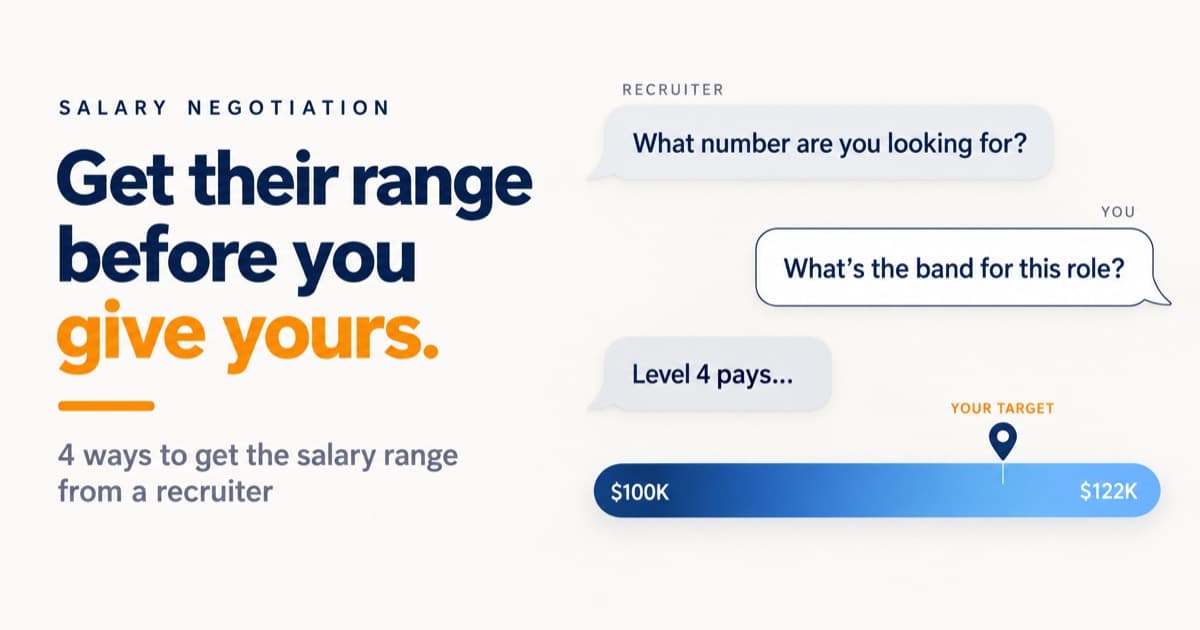
Recruiter: "We like to keep the range flexible until we know more about you. What number are you looking for?"
You: "..."
That pause is where most candidates lose money. The recruiter has just declined to share something they know and asked you for something you do not. Whatever figure you say next becomes the ceiling of every conversation that follows, and you will have set it without a single fact about what the role pays.
Here is the answer up front. When a recruiter will not give the salary range, do not fill the silence with your own number. Treat the refusal as an opening move, not a final policy, and trade instead: offer to confirm you are in the same zone if they share the band, ask what the band was for the last person hired, ask what level the role is graded at, or ask them to name a number they think would be competitive. One of those four almost always produces a figure. If none does, give a researched market range for the role, never your current pay, and say plainly that you will refine it once you see the full package.
Why won't the recruiter tell you the salary range?
Recruiters rarely withhold a range because they do not know it. Almost every role has an approved band before the posting goes live, because finance signed off on the headcount. They withhold it for one of three reasons.
The first is anchoring. Whoever names the first number shapes the negotiation, and a recruiter who gets your number first knows whether they can offer below the midpoint. This is the most common reason, and it is a script, which means it bends.
The second is a wide or messy band. Some roles are approved across two levels, so the real range is huge, and the recruiter worries that quoting it sets expectations at the top. That worry is solvable: ask which level you are being considered for.
The third is a genuine instruction from the company not to disclose. Even here, the recruiter can usually confirm or deny whether a number is in range, because that is how they screen out mismatches. A recruiter who will not say the band will very often say "yes, that works" or "that's above what we have."
Knowing which reason you are facing tells you which ask to use. The salary negotiation guide covers where this screening moment sits in the full offer process.
Four trades that surface the band
Each of these gives the recruiter something they want (a screen, a signal, a smooth process) in exchange for the figure. Use them in order, and stop as soon as one produces a number.
| The trade | What to say | Why it works |
|---|---|---|
| Range for alignment | "Happy to confirm we're aligned. If you share the band, I'll tell you straight away whether it works." | The recruiter's real goal is screening out mismatches, and this gives them that answer immediately |
| The last hire | "What did the last person brought in at this level start at, roughly?" | It feels like history, not disclosure, so recruiters who cannot quote a band will often answer it |
| The level | "Which level is this approved at internally?" | A level name lets you look up the band yourself, and it exposes whether the role spans two grades |
| Their number first | "What figure would you consider competitive for someone with my background?" | It invites them to anchor, which they will sometimes do just to move the call forward |
The tone matters as much as the wording. Every trade above is said with warmth and a slight forward lean: you want the process to move, and the number is how it moves. Candidates who ask for the range as a demand ("I'm not going to share mine until you share yours") turn a routine exchange into a standoff, and recruiters in a standoff dig in.
Reading about it only gets you halfway.
Run this exact conversation out loud against a realistic AI buyer on ConvoSparr and get a scored review of how you handled it.
Mirela's screening call with Ardloch Wind Services
Mirela is a field service supervisor applying for an operations lead role at Ardloch Wind Services, a company that maintains turbine fleets for wind farm owners. Corentin is the Ardloch recruiter running the first screen. The posting said only "competitive compensation." Mirela currently earns 88,000 and her research suggests similar roles pay 95,000 to 115,000.
Filling the silence:
Corentin: Before we go further, I want to make sure we're in the same ballpark. What salary are you targeting?
Mirela: Could you tell me the range for the role first?
Corentin: We keep it flexible until we know more about the candidate. It depends a lot on experience.
Mirela: Okay. Well, I'm at 88 right now, so I guess something around 95 would be good?
Corentin: Great, that's well within what we have. Let's get you set up with the hiring manager.
Mirela asked for the range, which was right, but took the first refusal as final. Then she volunteered her current salary, which handed Corentin an anchor below the market and made 95 sound like a generous step up. Her question mark at the end told him the number was a guess. "Well within what we have" is the most expensive sentence in this call: it means the band goes meaningfully higher, and she will never learn how much.
Trading for the band:
Corentin: Before we go further, I want to make sure we're in the same ballpark. What salary are you targeting?
Mirela: Makes sense, and I want that too. If you can share the band, I'll tell you right now whether it works, so neither of us wastes a round.
Corentin: We keep it flexible until we know more about the candidate.
Mirela: Understood. Could you tell me which level it's approved at? Or what the last operations lead started at, roughly? Either helps me answer you honestly.
Corentin: It's a level four role. The band for level four runs roughly 100 to 122.
Mirela: That works. Based on running two crews and the uptime numbers I'll walk the hiring manager through, I'd expect to land in the upper half of that.
Corentin: Good to know. I'll flag that.
Mirela agreed with Corentin's goal before asking for anything, so the request read as cooperation. When the first trade bounced, she did not argue; she offered two easier questions at once, and the level question gave Corentin a way to answer without feeling he had broken a rule. Once the band was on the table, she claimed a position inside it (the upper half) and tied it to evidence she would bring later. She never mentioned 88,000, and the offer conversation now starts from 100, not from 95.
For the moment the question arrives in its blunt form, the salary expectations scenario runs it against a counterpart who keeps pressing, and the current salary article covers what to do when the recruiter asks what you earn now.
Do pay transparency laws make the recruiter share the range?
Sometimes, depending on where the job is. Several US states and cities, including Colorado, California, Washington and New York, now require employers above a size threshold to include a pay range in job postings, and some of those laws also require sharing the range with an applicant who asks. The thresholds, the triggers and the exact wording differ by location, so check the rules for the job's location before you rely on them.
Two practical notes. First, a posted range is often wide, so the level question above still matters: a range of 80 to 140 tells you less than knowing the role is graded at the middle of it. Second, citing the law on a first screen rarely helps the relationship. A lighter version works better: "I noticed the posting didn't list a range. Is there one you can share?" Most recruiters in covered locations will answer that, and you keep the conversation friendly.
If you reach the offer stage and still have no number, the offer itself is the range disclosure. Ask the recruiter where the figure sits in the band: "Is this the midpoint, or is there room above it for this level?" That question is far easier to answer once an offer exists.
Three replies that give away the leverage
Naming your current salary. It anchors the offer to your past pay instead of the role's value. If asked directly, redirect to the market range for the role and what you are targeting now.
Guessing out loud. A number delivered with a question mark ("around 95?") tells the recruiter you have not done the research, and they will hold you to the low end of the guess. Say a researched range as a statement.
Refusing outright. "I won't share a number until you do" can stall the process or quietly mark you as difficult. The trades work because they give the recruiter something; a flat refusal gives nothing.
Before your next screening call: a checklist
Run through this before any recruiter call where pay might come up:
- Research a market range for the exact title, level and location, from at least two sources, and write the low and high figures down.
- Prepare all four trades in your own words, so the second and third come out as easily as the first.
- Decide your position inside a band before you hear one: upper half, top quarter, or midpoint plus specific terms.
- Write one sentence of evidence that justifies that position, so you can attach it the moment the band appears.
- Have your redirect ready for the current salary question, in one line, without apology.
- Say the trades out loud once. Reading them is not the same as producing them when a recruiter has just pushed back, and the second trade is the one that usually lands.
The range exists before the first call. Your job on that call is to make sharing it the easiest thing the recruiter can do.
Practice this out loud
Run this conversation against a live AI buyer and get a scored review.
Start free, no cardPractice this callPractice this before it counts
ConvoSparr puts you in a live voice call with an AI buyer who pushes back like a real one. Every session ends with a transcript, scores, and coaching notes.
Free to start. No credit card required.
Keep reading
All articles