How to Build a Mutual Action Plan Backward From the Buyer's Deadline
A mutual action plan starts from the buyer's deadline, not your forecast. Open the call with one line: "Is there a date on your side that matters?"
Tobiah had done everything right on the demo. Lucasta Pettersen, who runs member experience at Glenhaven Federal Credit Union, said the text messaging platform from Oxbury was exactly what her branches needed. So that afternoon Tobiah sent her a tidy plan: proposal December 15, contract December 31, kickoff January 6. Lucasta replied "looks great." Then nothing moved for five weeks.
What Tobiah's plan did not know was that any vendor touching member data at Glenhaven has to pass a vendor risk committee, that the committee meets once a month, and that the credit union's old texting contract renews itself for another year unless notice goes out by January 30. Lucasta knew all three facts. Nobody had asked her to write them down.
So here is the answer. A mutual action plan is a short, shared list of every step between "yes" and "live," built backward from a date the buyer cares about, with a named person on the buyer's side next to each step and a due date for each one. You build it with the buyer on a call, not for the buyer in an email. If a step has no buyer-side name, or the end date is yours rather than theirs, you have a forecast, not a plan.
What is a mutual action plan, and what makes one real?
A mutual action plan (often shortened to MAP, and also called a close plan or joint execution plan) is a document the seller and buyer both agree to, listing the steps, owners and dates needed to reach a shared goal. Most sellers have heard of it. Far fewer have one that survives contact with the buyer's calendar.
A real one passes three tests. First, the final date belongs to the buyer: a contract renewal, a launch, a board meeting, a season. "We'd love to close this quarter" is your date, and buyers do not move for it. Second, at least half the steps are owned by people on the buyer's side, because that is where deals stall: approvals, reviews, signatures. Third, the buyer helped write it. A plan the buyer only received is a plan the buyer can ignore without breaking a promise.
The move that makes all three tests pass is asking about the deadline first. The sales pitch guide argues that a pitch should end on a next step the buyer chose. A mutual action plan is the same idea stretched across the whole deal: every step is one the buyer chose, in order, with a date.
Count backward from the date that hurts if missed
Start at the end. Ask what happens if nothing changes, and when. Then walk backward, one step at a time, asking what has to be true before that step can happen. You will find steps you did not know existed, and you will find them in November instead of January.
Here is how the two kinds of plan compare.
| Seller's forecast in a table | Mutual action plan | |
|---|---|---|
| End date | Your quarter end | A deadline the buyer loses something by missing |
| Built by | The seller, after the call | Both sides, on the call |
| Owners | Mostly "us" or blank | A named person on every row, most of them the buyer's |
| Approval steps | Guessed or missing | Listed with the date each group next meets |
| When a date slips | The close date quietly moves in the CRM | Both sides see which later step is now at risk |
Four columns are enough: the step, the owner by name, the due date, and the status. Resist adding more. A plan with twelve columns gets filled in once and never opened again.
Reading about it only gets you halfway.
Run this exact conversation out loud against a realistic AI buyer on ConvoSparr and get a scored review of how you handled it.
Building the Glenhaven plan with Lucasta on the call
Here is the call where Tobiah should have built the plan, set right after the demo. First, the version he actually ran.
The plan he sent instead:
Tobiah: So I think we're in great shape. I'll put together a proposal by the 15th, and if we can get paperwork done by end of year, we'd kick off January 6.
Lucasta: That works on my end.
Tobiah: Great, I'll send a summary with those dates.
Every date in that exchange is Tobiah's. "That works on my end" is true and tells him nothing, because Lucasta's end is not where the deal gets approved. He never asked what happens after she says yes, so she never told him.
The plan built backward, together:
Tobiah: Before we talk dates on my side, is there a date on yours that matters? Something that happens whether or not we work together?
Lucasta: Our current texting contract renews on March 31. We have to give 60 days' notice, so January 30.
That is the anchor. It is the buyer's date, and missing it costs Glenhaven another twelve months with a vendor it wants to leave. Tobiah now has a reason to move fast that is not his quarter.
Tobiah: So if notice goes out January 30, you'd want a signed contract with us a few days before that. Who signs a contract this size?
Lucasta: Anything over $40,000 goes to Radomir, our CFO. Yours is $46,000, so it's him.
Tobiah: And before Radomir signs, what does it need to have been through?
Lucasta: Our outside counsel reviews the terms, usually about a week. And before that, the vendor risk committee has to approve anyone touching member data.
Tobiah: When does that committee meet?
Lucasta: Monthly. January 14, then February 11.
This is the moment the plan pays for itself. February 11 is after January 30, so if Glenhaven misses the January committee, the deal is not delayed by a month. It is delayed by a year. Tobiah asked one plain question ("when does that committee meet?") and found the single date the whole deal hangs on.
Tobiah: Then January 14 is the real deadline. What does the committee need from us, and by when?
Lucasta: Our security questionnaire and your SOC 2 report, a week ahead, so January 7.
Tobiah: I'll own that, and I'll have it to you by December 19 so you have time to read it first. Can we put your name on getting it onto the January agenda?
Lucasta: Yes. I'll ask for a slot this week.
Notice how ownership works here. Tobiah takes the steps he can control and pulls his own date earlier than needed, which builds trust. Lucasta takes the step only she can do. Neither of them is guessing.
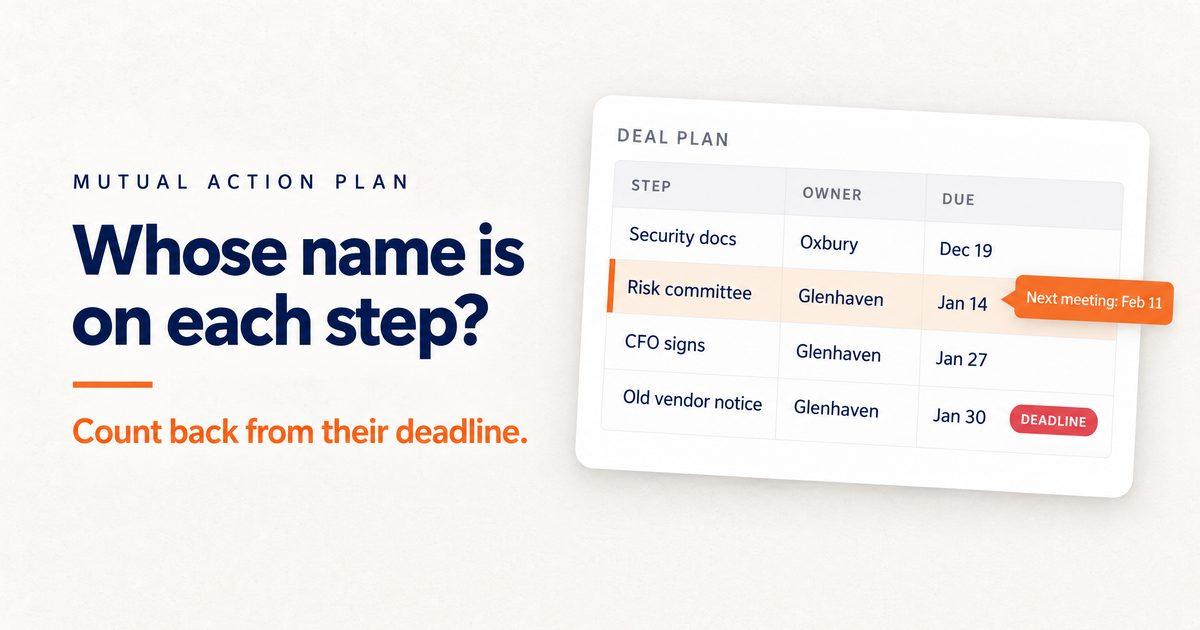
Here is the plan they agreed on the call, which Tobiah sent within the hour:
| Step | Owner | Due |
|---|---|---|
| Request a slot on the January risk committee agenda | Lucasta (Glenhaven) | Nov 20 |
| Reference call with a peer credit union | Tobiah (Oxbury) arranges, Lucasta attends | Dec 12 |
| Security questionnaire and SOC 2 report delivered | Tobiah (Oxbury) | Dec 19 |
| Vendor risk committee approval | Lucasta presents (Glenhaven) | Jan 14 |
| Counsel returns redlines | Glenhaven outside counsel, via Lucasta | Jan 22 |
| Contract signed | Radomir (CFO, Glenhaven) | Jan 27 |
| Non-renewal notice to current vendor | Lucasta (Glenhaven) | Jan 30 |
Five of the seven rows belong to Glenhaven. That is not a failure of the plan. It is the plan telling the truth about where the deal lives.
Steps buyers forget to mention until they bite
Buyers do not hide approval steps on purpose. They forget them because those steps are routine to them and invisible to you. Ask about each of these by name, because "anything else we should know?" almost always gets a no.
- Security or vendor risk review. Ask whether it exists, who sits on it, and when it next meets. A monthly committee turns a one-day slip into a four-week one.
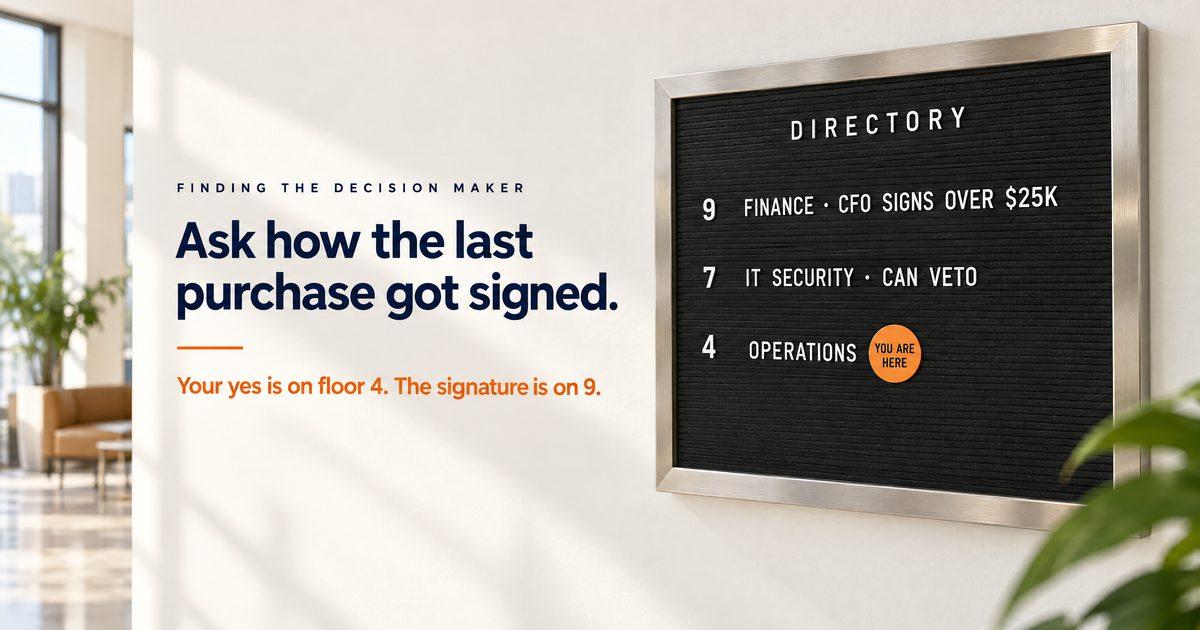
- The signing threshold. Most companies have a dollar amount above which a contract goes to a CFO or a board. The guide on finding the decision maker covers how to ask without making anyone admit a limit.
- Legal review time. Ask how long their counsel usually takes, then add a few days. Outside counsel is slower than in-house.
- Procurement onboarding. Many companies need a new vendor set up in their payment system before a contract can be signed. It is a form, but it can take two weeks.
- The notice on the old vendor. If they are replacing something, the old contract's renewal and notice dates are often the real deadline, exactly as at Glenhaven.
What to do when a date on the plan slips
A date will slip. When it does, the plan's job is to show both sides what the slip costs, without you sounding like you are pushing. Name the step, name the date it affects, and ask a question rather than make a demand.
If Lucasta writes on December 20 that the reference call moved into January, Tobiah does not need to chase. He can say: "Thanks for letting me know. That still works as long as the committee packet goes in by January 7. Is the January 14 slot still confirmed on your side?" The plan already holds the logic. He just points at it.
The deal that is really in trouble is the one where a buyer-owned step slips and nobody tells you. Check one buyer-owned step a week, and if the plan has gone quiet, the approach in asking for the close applies to the next step just as well as to the signature: ask for the specific thing, on a specific date.
The question to ask before your next plan
Look at the last plan you sent a buyer. Whose date is at the bottom of it, and how many rows have a name from their side?
If the answer is "my quarter" and "none," the fix is one question on your next call, asked before you mention a single date of your own: "Is there a date on your side that matters, something that happens whether or not we work together?" Then keep asking "and what has to happen before that?" until you reach today. It sounds simple, and it is, but the first few times you will want to jump in with your own dates. Rehearsing the backward walk out loud against a buyer who only reveals the committee when asked directly is the fastest way to make it automatic. Which step on your current deals has no buyer name next to it yet?
Practice this out loud
Run this conversation against a live AI buyer and get a scored review.
Start free, no cardPractice this callPractice this before it counts
ConvoSparr puts you in a live voice call with an AI buyer who pushes back like a real one. Every session ends with a transcript, scores, and coaching notes.
Free to start. No credit card required.