Finding the Decision Maker on a Sales Call: 3 Questions to Ask Instead
Finding the decision maker on a sales call starts with how the last purchase got signed, not a job title. Who signed yours, and above what number?
The standard advice says to get it out of the way early: ask "are you the decision maker?" in the first ten minutes and save yourself a wasted month. It sounds efficient. In practice it is the least informative question on a discovery call, because almost everyone answers it with yes.
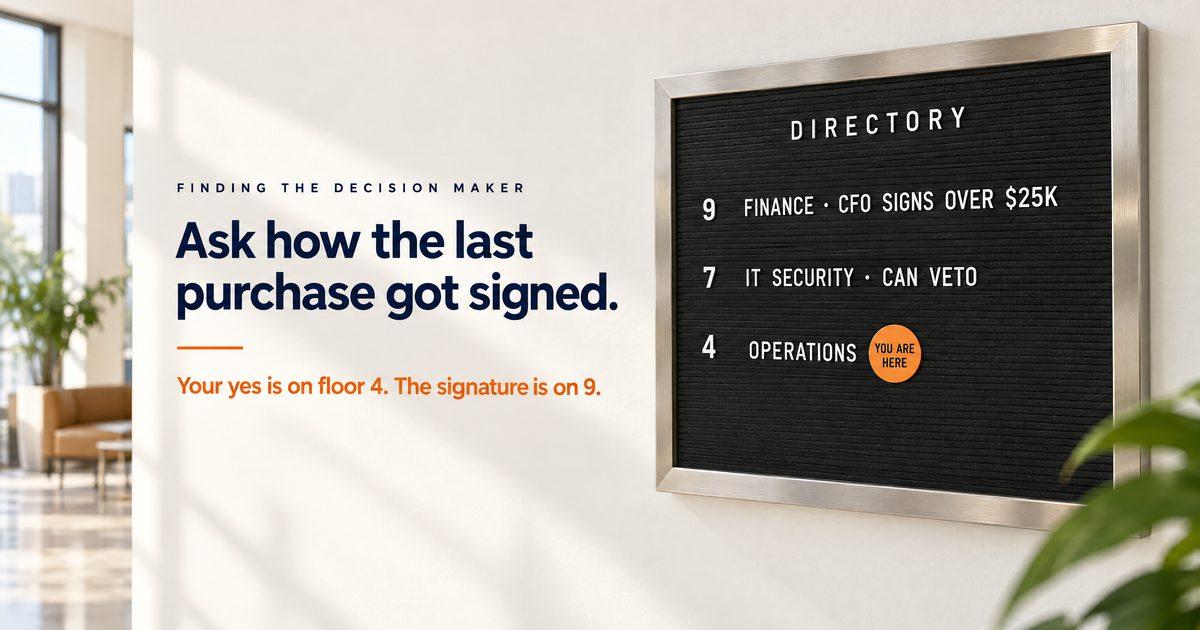
They are not lying. The director of operations really does decide which system operations will use. What they rarely volunteer, because you did not ask, is that anything over a set dollar amount goes to the CFO, that the IT security team can stop any tool that touches customer data, and that the last vendor who skipped that review lost six weeks. "Are you the decision maker?" asks a person to rank themselves. People round up.
So here is the answer. Finding the decision maker on a sales call means asking about the route a purchase travels, not the title of the person in front of you. Three questions do it without anyone losing face: how the last comparable purchase got approved, the dollar amount above which a purchase like yours leaves their desk, and who could stop it even if everyone else said yes. The answers give you the signer, the threshold and the veto, which is the real shape of the decision.
Why does "are you the decision maker?" get a yes every time?
Because it is a status question wearing a qualification costume. Answering "no" means telling a stranger you lack authority in your own job, so even people with no budget at all find a way to say yes: "I make the call on this," "it's my project," "I'll be driving it." Every one of those can be true while someone two floors up holds the pen.
It also tells you nothing even when the yes is fully accurate. A buyer who can sign alone still has a limit, a finance team that checks contracts over that limit, and colleagues whose systems your product touches. The title question collapses all of that into one word. The discovery call guide frames the fix as asking about the company's plumbing instead of the person's rank, and that is the whole move here: you stop asking who matters and start asking how a yes travels.
A purchase is a route, not a person
Most B2B purchases above a few thousand dollars pass through four or five hands, and each hand controls something different. Map the roles before the call, then use the call to put names next to them.
| Role | What they control | How they show up on your call | The question that surfaces them |
|---|---|---|---|
| Champion | Whether the problem gets a project at all | On the call, enthusiastic, says "I decide" | "What made this worth a call this month?" |
| Threshold approver | Any spend above a fixed dollar limit | Absent, mentioned as "finance will want to see it" | "Above what number does a purchase like this leave your desk?" |
| Signer | The contract itself | Absent, often a COO, CFO or owner | "When the last system got bought, whose name went on the contract?" |
| Veto holder | A review that can stop the deal outright (security, legal, IT) | Never mentioned until week five | "Who could stop this even if everyone else said yes?" |
| Daily user | Whether the product gets used after go-live | Absent, sometimes resentful | "Who would use this every day, and have they seen it?" |
The champion is the only role guaranteed to be on a first call. The others decide the deal anyway.
Reading about it only gets you halfway.
Run this exact conversation out loud against a realistic AI buyer on ConvoSparr and get a scored review of how you handled it.
Three questions that find the signer
Ask these after the buyer has described the problem in their own numbers, usually past the twenty minute mark. Asked in the first two minutes, they sound like an audit. Asked after the pain is on the table, they sound like help.
1. "Walk me through the last time you bought something like this. Who was involved by the end?" History beats hypotheticals. Asked how a future purchase would work, buyers describe the official process. Asked how the last one actually went, they describe the real one, including the person nobody mentions on the org chart. Follow up with "and how long did that take from yes to signed?" because the answer is your real timeline.
2. "Is there a dollar amount above which a purchase like this goes to someone else?" This asks about the company's policy, not the person's power, so nobody has to admit a limit. Most companies have a written approval threshold, and your buyer knows it to the dollar. Once you know it, you know whether your price lands on their desk or on the CFO's, and you can decide which conversation to prepare for.
3. "Who could stop this even if everyone else said yes?" This is the veto question, and it is the one reps skip. Security reviews, legal redlines and an IT team protecting its own roadmap kill more late-stage deals than any competitor does. Naming the veto holder in week one turns a surprise in week six into a meeting in week two.
Notice what none of the three ask: whether the person in front of you matters. They ask about the route, and people describe routes freely.
Corbin's call with Spireline Parking
Corbin is an account executive at Plazora, which sells license plate recognition entry for parking garages, so drivers stop pulling tickets. Eulalia is director of operations at Spireline Parking, which runs 22 garages. She has already told him the ticket machines jam about 40 times a week across the portfolio and that each jam backs traffic into the street. The quote she is heading toward is $58,000 a year.
Minute twenty, the title question:
Corbin: This is really helpful. Just so I know how to plan, are you the decision maker on this?
Eulalia: Yes. Operations owns the garages, so this is my call.
Corbin: Perfect. Then I'll send over a proposal this week and we can aim to get you live before the holidays.
Eulalia: Sounds good.
Every line here is pleasant and every line is a guess. Eulalia answered truthfully about operations, and Corbin heard "she signs." He has a close date with no route under it, and the proposal will land on a desk he has never seen.
Minute twenty, the route questions:
Corbin: This is really helpful. Can I ask how the last purchase like this went? Something operations brought in across all the garages.
Eulalia: The pay kiosks, last spring. I picked them, then it went to Dorian, our CFO, because it was over $25,000. And Cressida in IT security held it up for about six weeks over how long the kiosks kept card data.
That one answer named a threshold, a signer and a veto holder. Corbin did not have to ask anyone to rank themselves.
Corbin: So $25,000 is the line where Dorian gets involved, and we're well over it. What would his first question be?
Eulalia: Whether it pays for itself. He'll ask what the jams cost us.
Corbin: And Cressida, since our cameras read every plate that comes in?
Eulalia: Oh, she'll want to know where the plate images go and how long you keep them. Same fight as the kiosks.
Corbin: Then let's not have that fight in week six. Could we get twenty minutes with Cressida next week, with our security sheet, before anything goes to Dorian? And could you and I put the jam numbers into one page he can read in two minutes?
Eulalia: Yes to both. Cressida will like being asked first, honestly.
Corbin now knows the decision has three names, a dollar line and a known objection, and the six-week delay from last spring has become a meeting next week. Eulalia is still the champion. She is now a champion with a plan, which is what she needed to get past floor nine.
Signals that you have been talking to the wrong person
You will not always ask the route questions early enough. These signs say the deal has a decision maker you have not met:
- The timeline has no event under it. "We'd love to move fast" with no budget date, contract renewal or board meeting attached usually means the person setting the pace does not control it.
- Your proposal needs "a few tweaks" before they send it on. They are editing it for someone else's eyes. Ask whose, and what that person will look for.
- New questions arrive by email in a different voice. A sudden question about indemnity or data retention, worded like a policy, was written by someone you have not spoken to.
- They go quiet right after the pricing call. The number crossed a threshold and left their desk. Ask directly: "Did the price land somewhere new?"
- "I just need to run it by a couple of people." Treat it as an invitation, not a stall: "Who are they, and what would each of them ask first?"
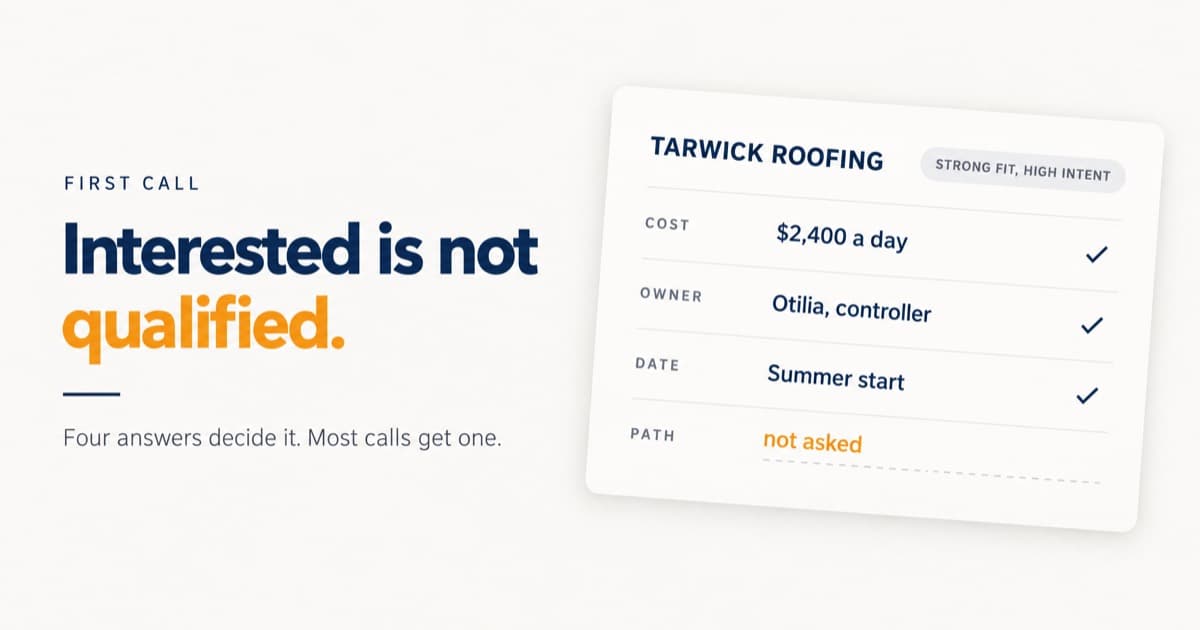
None of these mean the deal is lost. Each one means a role in the table above has a name you do not have yet. The qualifying a lead on the first call guide covers what to do when the route is longer than the deal can carry.
Before your next discovery call
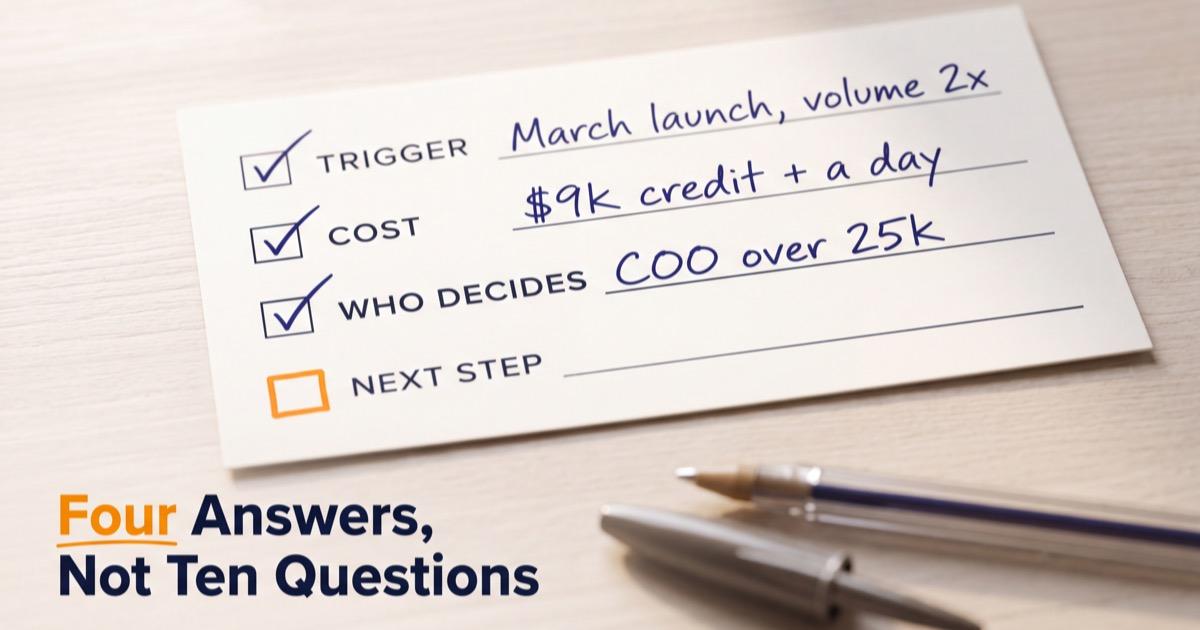
Here is the challenge for your next first call. Write the three questions on a card, word for word: the last purchase, the dollar line, the veto. Then hold yourself to one rule: you may not write a close date in your CRM until you have a name next to "signer" and a name next to "who could stop this."
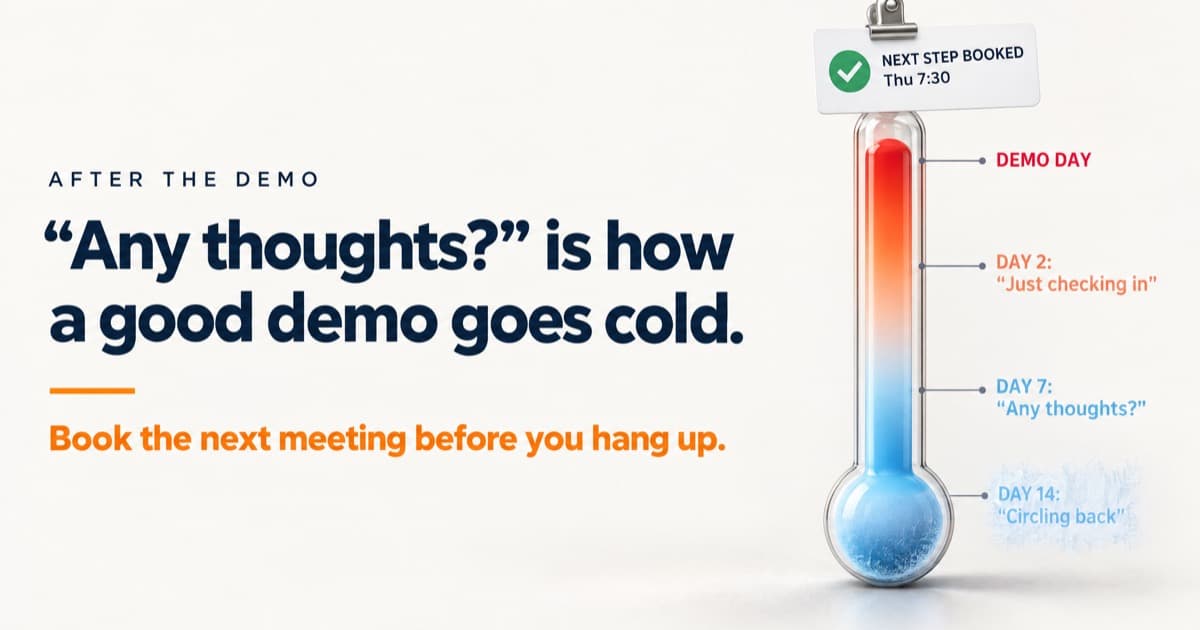
If you cannot get both names on the call, that is the next step to book. Plan the conversation for the person who signs, and make sure the first follow-up after it goes to them; the guide on following up after a demo shows how to make that meeting stick. The questions feel awkward the first few times, mostly because the old one was so easy to ask. Rehearse them out loud with a buyer who answers "yes, it's my call" until the route question comes out on its own.
Practice this out loud
Run this conversation against a live AI buyer and get a scored review.
Start free, no cardPractice this callPractice this before it counts
ConvoSparr puts you in a live voice call with an AI buyer who pushes back like a real one. Every session ends with a transcript, scores, and coaching notes.
Free to start. No credit card required.