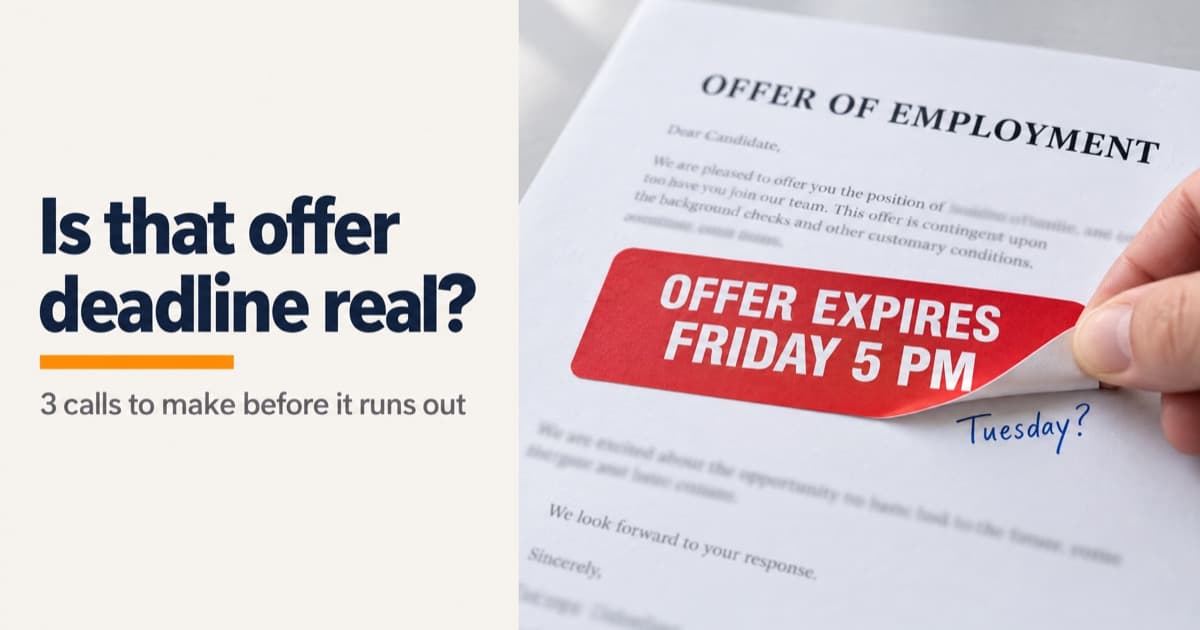
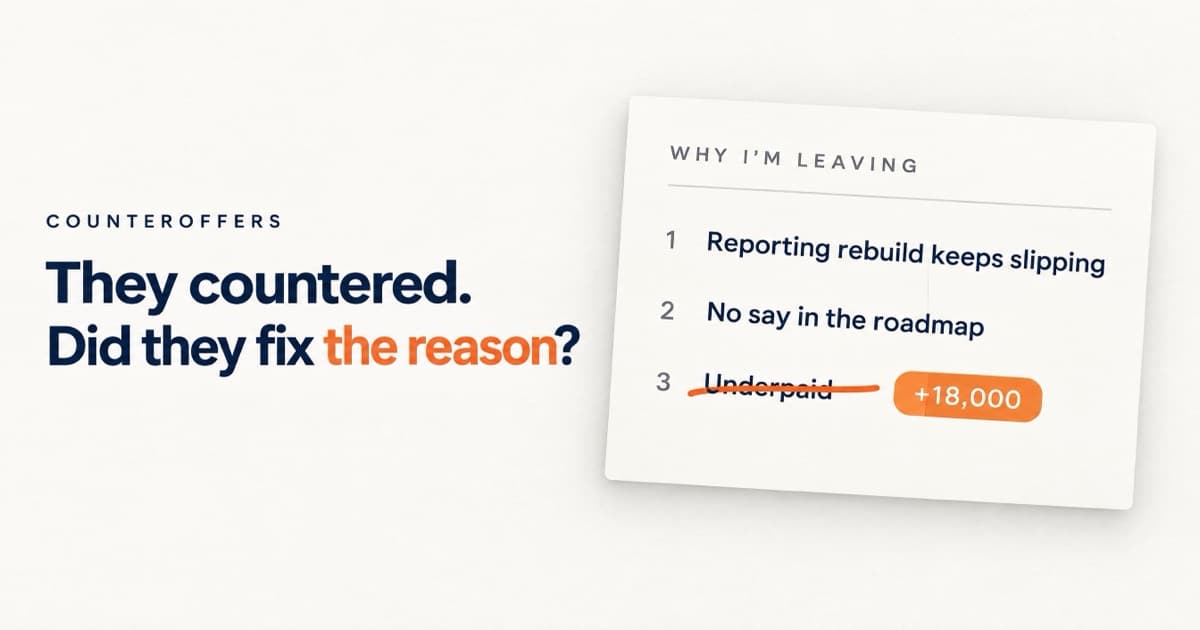
Using a Competing Offer to Negotiate Salary: Leverage, Not an Ultimatum
How to use a competing offer to negotiate salary: a $151,000 rival offer moved a $138,000 offer to $146,000 plus $5,000, with no ultimatum.
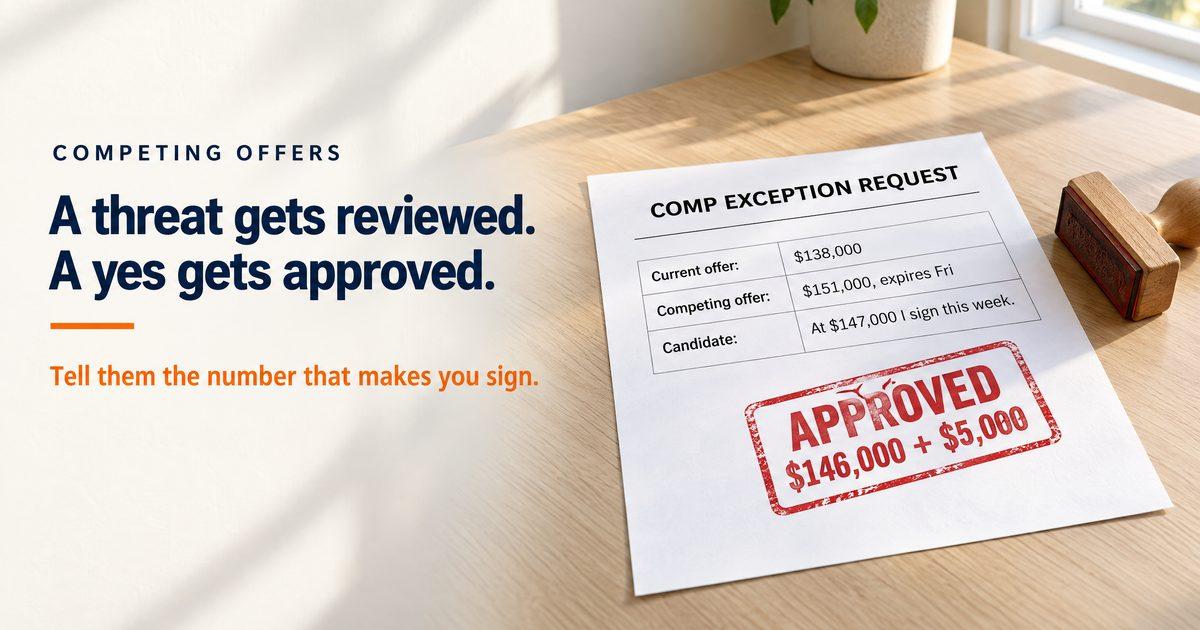
A recruiter cannot take "I'd like more money" to a compensation team and win. There is nothing in that sentence to approve. A written offer from another employer is different: it is a price the market has already set for you, with a date on it, and it is the one piece of evidence that lets a recruiter ask for an exception without looking like they lost control of the hire. That is why a competing offer moves numbers that nothing else moves.
It is also why candidates waste it. The most common way to use a competing offer is as a threat ("match it or I take it"), and a threat puts the recruiter in the worst seat in the conversation: they now have to defend you to their own team while you sound like you are already halfway out the door.
The answer, then, before the detail. To use a competing offer to negotiate salary, compare the two offers line by line so you know the real gap, then tell the recruiter three things in one breath: you would rather join them, the other offer's figure and its deadline, and the specific number that would make you sign. End with a promise, not a threat: "If you can get to that number, I'll sign this week and withdraw from the other process." You are not asking them to beat a rival. You are handing them a yes they can sell upstairs.
Should you tell the recruiter about a competing offer?
Yes, when it is real, written and has a deadline. Tell them early enough that they have time to act, and tell them yourself rather than letting it leak through a timeline question. A competing offer kept secret does nothing; a competing offer announced on the day you have to decide forces a rushed answer that is usually lower than a considered one.
Share the figure and the date. Keep the employer's name unless you are comfortable sharing it, since "another firm in the same space" is enough for most recruiters. And never invent one or round one up. Recruiters ask to see the letter more often than candidates expect, and a bluff that gets called ends the negotiation and sometimes the offer.
If the other offer is not yet in writing, say so plainly: "I'm in a final round elsewhere and expect an offer by the 21st." That is useful timing information, not leverage, and the where else are you interviewing scenario covers how to share it without giving away names.
Compare the two offers on the same line before you call
A headline base number is not the gap. Before you say a figure to anyone, put both offers in one table and price every line, because the honest gap is often smaller (or larger) than the base salaries suggest, and the number you ask for has to survive a recruiter doing this same math.
Here is the comparison Wenonah, a senior remote sensing analyst, built the night before her call. Skeldon Orbital, a satellite imaging company, was her first choice. Yarrowby Geospatial, a mapping data firm, had sent a written offer that expired Friday.
| Line | Skeldon Orbital (first choice) | Yarrowby Geospatial (written, expires Friday) |
|---|---|---|
| Base salary | $138,000 | $151,000 |
| Annual bonus | 10% target ($13,800), not guaranteed | None |
| Signing bonus | None | None |
| Guaranteed cash, year one | $138,000 | $151,000 |
| Target cash, year one | $151,800 | $151,000 |
| Work location | Hybrid, 2 office days | Hybrid, 3 office days |
The table changed her ask. The base gap is $13,000, but Skeldon's bonus target nearly closes it on paper. Asking Skeldon to "match 151" would have meant asking them to pay more than Yarrowby in target cash, which a compensation team can spot in a minute and refuse. The defensible gap is the guaranteed one: a target bonus is a promise, and base is money. So her number was $147,000, a figure she could explain in one sentence.
Reading about it only gets you halfway.
Run this exact conversation out loud against a realistic AI buyer on ConvoSparr and get a scored review of how you handled it.
How to use a competing offer to negotiate salary in four sentences
The call needs four sentences, in this order, and almost nothing else.
- The preference. "Skeldon is where I want to be." Said first, so everything after it reads as a problem to solve together, not a bidding war.
- The fact. "I have a written offer from another firm at $151,000 base, and it expires Friday." Figure and date, nothing inflated.
- The honest math. "Your bonus target closes some of that, but it's a target, so I'm looking at the guaranteed gap." This shows you did the table and you are not asking for more than is fair.
- The conditional yes. "If base can get to $147,000, I'll sign before Friday and withdraw from the other process."
The fourth sentence carries the weight. It gives the recruiter something to bring to the approver that is better than a number: certainty. A compensation team approving an exception wants to know it buys a signed candidate, and you have just promised one, with a date.
Wenonah's offer call with Skeldon Orbital
Margarethe, the Skeldon recruiter, calls on Tuesday to check in on the offer. Wenonah has the Yarrowby letter, with its Friday deadline, on the desk.
Version one, the ultimatum:
Margarethe: Hi Wenonah, just checking in. Any questions on the offer?
Wenonah: Honestly, yes. I got an offer from Yarrowby at 151, so 138 is pretty far off. Can you match it?
Margarethe: I appreciate you telling me. We don't usually match other offers, but I can ask. Can you send me their letter?
Wenonah: Sure. I need to know by Friday, though, or I'll have to take theirs.
Margarethe: Understood. I'll see what comp says.
Every fact in that version is true, and the call still went badly. "Can you match it?" asks Skeldon to pay $151,000 base on top of a $13,800 bonus target, which is more than Yarrowby offered in total, and Margarethe knows it. "Or I'll have to take theirs" tells her Wenonah is a flight risk, so the request goes to compensation as a defensive exception. Nothing in the call says what number would actually close the hire. The likeliest reply on Thursday is a best-and-final around $141,000, and an awkward first week if Wenonah takes it.
Version two, the trade:
Margarethe: Hi Wenonah, just checking in. Any questions on the offer?
Wenonah: Thanks for calling. First, Skeldon is where I want to be. The imaging work is the reason I applied. I want to be straight with you about one thing: I have a written offer from another firm at $151,000 base, and it expires Friday.
Margarethe: Okay. Thank you for telling me.
Wenonah: I looked at the two side by side. Your bonus target closes a lot of the gap on paper, so I'm not asking you to match their number. It's a target, though, and their 151 is base. If you can get the base to $147,000, I'll sign before Friday and withdraw from the other process.
Margarethe: That's helpful. I can't promise 147. If base lands a bit under, would a signing bonus help close it?
Wenonah: It would, if it covers the difference in year one. I'm happy to send the other letter if your team needs to see it.
Margarethe: Let me take it back today. I'll call you Thursday morning.
Thursday's answer was $146,000 base and a $5,000 signing bonus, which Wenonah accepted on the call. Look at what changed. The preference came first, so Margarethe heard a candidate trying to say yes. The math was done out loud, which made $147,000 look fair rather than greedy. The promise ("I'll sign before Friday and withdraw") gave Margarethe a sentence to forward: "She'll sign this week at 147, and she prefers us." And when the base came in $1,000 short, the signing bonus question was already on the table because Wenonah had answered it calmly. The signing bonus page covers that fallback in detail.
What if the recruiter asks to see the other offer letter?
Send it, with the salary and terms visible and anything personal (address, employee id, the other company's internal reference) redacted. A request to see the letter is a good sign: it usually means the recruiter is building the case for an exception and needs evidence. Hesitating reads as a bluff.
If you would rather not share the employer's name, say so and offer the page with the name blacked out. Most recruiters accept that. What they will not accept is a figure they cannot verify when the request is large, so if a letter does not exist yet, do not imply that it does.
Four lines that cost candidates the room
"Can you match it?" Matching invites a yes or no on someone else's number. Name your own number, built from your own table.
"Or I'll have to take theirs." A deadline is information; an ultimatum is pressure. State the date and leave the consequence unsaid.
Comparing base to base when the packages differ. If one side has a bonus, equity or a sign-on, the base gap is not the real gap, and the recruiter will do the math even if you do not.
Using an offer you would never accept. If you would turn the other job down at any price, you have timing, not leverage. Use it as timing, and negotiate on the merits of the role instead.
The pre-call checklist
Before the call, have each of these written down where you can see it:
- Both offers in one table, every line priced, guaranteed and target cash separated.
- One number, and the one sentence that explains it.
- The other offer's deadline, and the date you need an answer to meet it.
- Your four sentences, in order: preference, fact, math, conditional yes.
- Your answer if they offer a signing bonus instead of base.
- The redacted letter, ready to send.
If you cannot fill in the number and the sentence that explains it, you are not ready for the call yet. The salary negotiation guide covers the rest of the offer conversation, and the counter offer conversation scenario lets you run those four sentences against a recruiter who pushes back before you say them for real.
Practice this out loud
Run this conversation against a live AI buyer and get a scored review.
Start free, no cardPractice this callPractice this before it counts
ConvoSparr puts you in a live voice call with an AI buyer who pushes back like a real one. Every session ends with a transcript, scores, and coaching notes.
Free to start. No credit card required.
Keep reading
All articles